
Hire a professional commercial office cleaning service. That is the short answer. Define your scope, gather your building metrics (square footage, restroom count, access hours), and request a documented proposal with an on-site walk-through from the vendor who will actually manage your account.
Before that first call, look for three things:
- Licensed and insured with a current certificate of insurance (COI) covering general liability and workers’ compensation
- Written SLAs or digital reporting so quality is measurable, not just promised
- A site-specific walk-through by the account manager, not a salesperson who hands off after signing
Pro Tip: Have your building metrics ready before you call: total square footage, number of restrooms, floor types, and your preferred service window. A vendor who asks for all of this before quoting is a good sign.
Table of Contents
- What does commercial office cleaning actually include?
- How is commercial cleaning priced, and what should you budget?
- How do you measure service quality and hold a vendor accountable?
- What credentials and safety practices should you require?
- What does onboarding look like, and what should your contract cover?
- Does professional cleaning actually improve productivity and reduce sick days?
- How do you compare proposals and spot a bad vendor?
- Key Takeaways
- What most facility managers get wrong about cleaning contracts
- Florida Cleaning Crew handles commercial cleaning in Tampa Bay
- Useful sources
- FAQ
What does commercial office cleaning actually include?
Office janitorial services cover more ground than most buyers expect. Vendors typically structure their offerings in two tiers: recurring services bundled into the base contract and periodic or specialty services billed separately.
Standard recurring services (usually included in base pricing):
- Nightly or daily janitorial: trash removal, surface wiping, restroom sanitation, vacuuming, mopping
- High-touch point disinfection: door handles, light switches, elevator buttons, shared equipment
- Breakroom and kitchen cleaning: counters, sinks, appliance exteriors, floor
- Lobby and common area maintenance
Add-on or periodic services (typically quoted separately):
- Floor care: strip and wax, burnishing, scrubbing for VCT or hard floors
- Carpet extraction and spot treatment
- Interior and exterior window cleaning
- Post-construction cleanup
- HVAC vent and upholstery cleaning
- Day porter coverage during business hours
Frequency matters as much as scope. Daily janitorial fits high-traffic offices. Weekly service works for smaller or lower-occupancy spaces. Periodic deep cleans (quarterly floor care, semi-annual carpet extraction) layer on top. Cleaning routines for busy offices explains how to map frequency to actual traffic patterns so you are not paying for daily service in a space that only needs it three times a week.
How is commercial cleaning priced, and what should you budget?
Three pricing models dominate the market. Each has trade-offs.
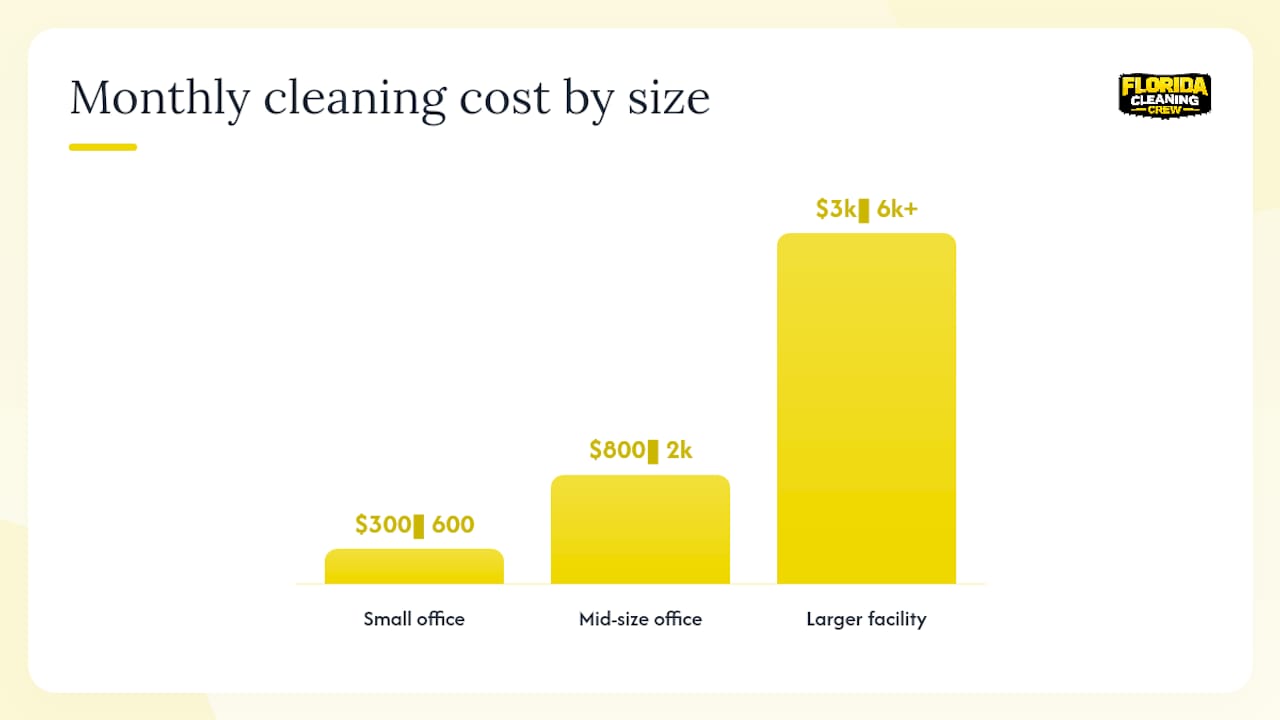
Per square foot: The most common model for recurring janitorial. Rates vary by frequency, floor type, and restroom density. A rough benchmark for standard office cleaning runs roughly $0.05–$0.20 per square foot per visit, with nightly service at the lower end of that range for large, open-plan spaces and higher rates for dense, multi-restroom layouts or medical-grade requirements.
Fixed-fee by scope: A flat monthly or weekly rate based on a defined scope of work. Predictable for budgeting; requires a well-written SOW to avoid scope creep.
Time and materials: Hourly labor plus supplies. Useful for one-off deep cleans or post-construction work, but harder to budget for recurring service.
| Facility size | Frequency | Estimated monthly range | Notes |
|---|---|---|---|
| Small office (under 2,500 sq ft) | 3x/week | $300–$600 | 1–2 restrooms, open plan |
| Mid-size office (5,000–10,000 sq ft) | 5x/week | $800–$2,000 | Multiple restrooms, breakroom |
| Larger facility (— sq ft) | Nightly + day porter | $3,000–$6,000+ | Floor care and carpet as add-ons |
These ranges are directional. Your actual quote depends on restroom count (restrooms are the most labor-intensive area per square foot), floor types, occupancy density, whether you supply consumables, and your access window.
Watch for low bids. A price significantly below market usually means fewer labor hours, which translates to skipped tasks, undertrained staff, or high turnover on your account. The cost of rework, complaints, and re-bidding a contract within six months almost always exceeds the savings from the initial low bid.
The inputs that drive your price most:
- Restroom count and fixture density
- Floor type (carpet vs. hard floor vs. specialty)
- Frequency and access window
- Whether the vendor supplies consumables (paper, soap, liners) or you do
- Security and badging requirements
How do you measure service quality and hold a vendor accountable?
Measurable service levels are what separate a professional cleaning program from a handshake agreement. A well-structured contract defines at least four KPIs: task completion rate, inspection score, response time for complaints, and rework frequency.
Service level tiers typically look like this:
- Standard janitorial: Nightly task completion, weekly supervisor spot-check
- Enhanced front-of-house: Daily inspection of lobby and client-facing areas, same-day response to appearance issues
- Day porter: Real-time coverage during business hours, logged service calls
Digital reporting tools, photo documentation, and scheduled audits are what make these tiers enforceable. Vendors using platforms that log completed tasks with timestamps and photos give you a paper trail. Without it, you are relying on self-reporting.
The ISSA Clean Standard provides audit templates, ATP testing protocols, and measurable cleaning-effectiveness ranges for commercial facilities. ATP testing (adenosine triphosphate surface testing) gives you an objective, numeric cleanliness score on any surface, which is far more useful than a supervisor’s visual check.
Pro Tip: Add a “response time to written complaint” KPI to your SLA. Most contracts specify task frequencies but skip escalation timelines. Require a written acknowledgment within 4 hours and corrective action within 24 hours for any documented deficiency.
What credentials and safety practices should you require?
Credentials are not optional. Before signing anything, verify:
- General liability insurance: Minimum $1 million per occurrence is standard; $2 million aggregate is common for larger facilities
- Workers’ compensation: Required in Florida for companies with four or more employees; confirms the vendor’s workers are covered, not yours
- Bonding: Protects against theft by employees on your property
- Background checks: Ask specifically whether checks are run at hire and periodically, and what the screening criteria are
- OSHA training: Hazard communication (HazCom), bloodborne pathogens for healthcare settings, and proper chemical handling
- CIMS certification: The Cleaning Industry Management Standard provides a management framework for consistent, quality service delivery and includes green-building criteria (CIMS-GB)
Product choices affect your indoor environmental quality (IEQ). Vendors using EPA Safer Choice-labeled products, low-VOC cleaners, and HEPA-filter vacuums reduce chemical off-gassing and particulate redistribution. For LEED or WELL-certified buildings, this is not optional. For everyone else, it is still worth asking about, because the air your employees breathe all day is directly affected by what gets sprayed on surfaces the night before.
Verification checklist: Request the COI directly from the vendor’s insurer (not a copy from the vendor). Ask for two references from facilities similar to yours in size and type. Confirm CIMS or ISSA certification status at issa.com. Check Florida’s Division of Corporations for business registration.
Cleaning supplies for offices covers specific product categories (HEPA vacuums, microfiber systems, EPA-registered disinfectants) worth asking vendors about during evaluation.
What does onboarding look like, and what should your contract cover?
Does professional cleaning actually improve productivity and reduce sick days?
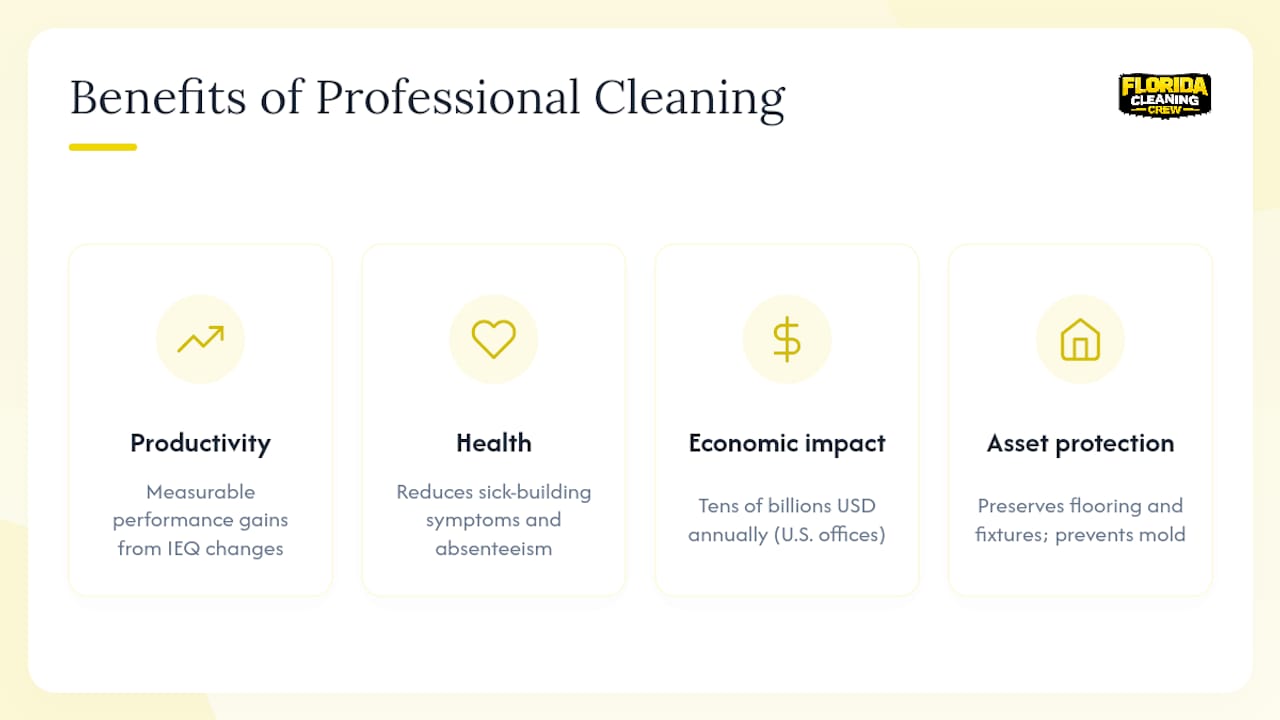
Yes, and the research is specific. The U.S. EPA’s analysis of indoor environmental quality improvements in U.S. offices links better ventilation, temperature control, and dampness management to measurable gains in work performance and reductions in sick-building symptoms. The economic benefits across U.S. offices run into the tens of billions of dollars annually when IEQ improvements are applied at scale.
Wargocki et al.’s scholarly review quantifies the relationship between ventilation rates, thermal conditions, and work performance, showing that targeted environmental interventions produce measurable productivity improvements. A systematic review published in ScienceDirect confirms that changes to ventilation, filtration, and maintenance reduce health complaints and improve comfort in office settings.
“Cleaning investments can produce measurable financial returns by reducing absenteeism, improving productivity, preserving assets, and lowering maintenance costs.” — ISSA Value of Cleaning white paper
The ROI framing is straightforward. Fewer sick days mean fewer missed hours. Better air quality and cleaner surfaces reduce the spread of illness. Preserved flooring and fixtures lower capital replacement costs. For Tampa Bay businesses where humidity accelerates mold growth and dust accumulation, consistent cleaning is also a building-protection measure, not just a comfort one.
Why invest in commercial cleaning? builds out this business case with additional context for local facility managers.
How do you compare proposals and spot a bad vendor?
Questions to ask in vendor meetings
- Who manages my account day-to-day, and will that person be at the walk-through?
- Are your cleaning staff W2 employees or 1099 contractors?
- What training do new hires complete before working on a client site?
- How do you handle staff turnover on an account?
- What digital reporting or inspection platform do you use?
- Can you provide two references from facilities similar to mine?
- What is your production rate per restroom and per 1,000 square feet of open office?
That last question is one most buyers never ask. Production-rate evidence (time per trash point, restroom, desk cluster) tells you whether the labor hours in the proposal are realistic. A vendor quoting 3 hours for a 10,000-square-foot office with 6 restrooms is either cutting tasks or planning to rush. Ask them to show their math.
As facility management procurement guidance notes, buyers should prioritize lifecycle scope definition and task-level production rates over price-first selection.
Red flags
- No site walk-through before quoting
- Vague SOW with no task frequencies
- Primary reliance on 1099 labor (training and accountability tend to be weaker)
- Missing or unverifiable COI
- No inspection or reporting system
- Pressure to sign before you have reviewed references
Pro Tip: Ask for a sample inspection report from a current client (redacted). A vendor with a real quality-control program will have one ready. A vendor who hesitates probably does not have a formal inspection process.
The office cleanliness guide for managers has a practical checklist you can bring into vendor meetings.
Key Takeaways
Hiring the right commercial office cleaning provider comes down to scope clarity, verified credentials, and measurable SLAs before you sign anything.
| Point | Details |
|---|---|
| Hire a pro with verified credentials | Require a current COI, workers’ comp, bonding, and background-checked staff before signing. |
| Insist on a site walk-through | A thorough on-site visit by the account manager is the single best predictor of a realistic proposal. |
| Require SLAs and digital reporting | Written KPIs (completion rate, inspection score, response time) make quality measurable and enforceable. |
| Budget for the right frequency | Restroom count, floor type, and occupancy density drive cost more than square footage alone. |
| Floridacc serves Tampa Bay businesses | Florida Cleaning Crew offers licensed, insured commercial cleaning in Tampa, Clearwater, and St. Petersburg with documented onboarding and flexible scheduling. |
What most facility managers get wrong about cleaning contracts
Most buyers treat cleaning as a commodity purchase. They collect three bids, pick the middle one, and assume the problem is solved. Six months later, they are re-bidding because the vendor cut corners, turnover on the account was constant, and nobody could point to a single inspection report.
The research tells a different story. The ISSA Value of Cleaning white paper frames cleaning as an investment with returns across absenteeism, productivity, and asset preservation. That framing changes how you should buy it. You would not hire an IT vendor without asking about uptime SLAs and escalation protocols. Cleaning deserves the same rigor.
The other thing buyers underestimate is the cost of a bad vendor relationship. Re-bidding a contract, managing complaints, and dealing with access and security issues after a vendor departure costs real time and money. A slightly higher monthly rate from a vendor with documented processes, W2 employees, and a real inspection program almost always costs less over a two-year period than the cheapest bid that falls apart at month four.
For Tampa Bay facilities, in particular, the humidity and seasonal occupancy patterns add a layer most national vendors do not account for. A local provider who understands how a Clearwater office building behaves in August versus January is worth more than a franchise operation running a generic national protocol.
Florida Cleaning Crew handles commercial cleaning in Tampa Bay
Florida Cleaning Crew is a licensed, insured commercial cleaning provider serving Tampa, Clearwater, and St. Petersburg. The difference from a generic bid is concrete: documented onboarding with a 30/60/90-day inspection schedule, W2 employees with background checks, eco-friendly products aligned with EPA Safer Choice standards, and written SLAs you can actually enforce.
When you request a quote, you get a free on-site walk-through, a customized scope of work, a sample SLA, and a clear onboarding plan before you commit to anything. No vague proposals, no pressure to sign before you have reviewed the details.
If you manage a small business or a multi-tenant property, the commercial cleaning for small business page covers service options and pricing guidance specific to smaller footprints. Ready to get a proposal? Request a quote for your Tampa Bay facility and have your square footage, restroom count, and preferred service window ready.
Useful sources
These are the primary standards and research documents referenced throughout this guide. Each one supports a specific part of the buying or budget decision.
| Source | What it covers | How it helps buyers |
|---|---|---|
| ISSA Value of Cleaning white paper | ROI categories: absenteeism, productivity, asset preservation | Justifies cleaning budgets to finance and leadership |
| U.S. EPA — IEQ Benefits and Costs (Fisk et al.) | Economic value of IEQ improvements in U.S. offices | Supports ventilation and HEPA requirements in SOW |
| Wargocki et al. — Ventilation and performance | Quantitative links between ventilation, temperature, and work output | Backs productivity claims in budget presentations |
| ScienceDirect — Environmental interventions review | Systematic review of office environmental interventions | Reinforces value of filtration and maintenance upgrades |
| ISSA Clean Standard | Audit templates, ATP testing protocols, cleaning-effectiveness ranges | Sets measurable benchmarks for SLAs and inspections |
| CIMS Standard (2023) | Management framework for cleaning organizations, including CIMS-GB | Vets vendor management quality and green-cleaning alignment |
| Facility Management Insights — Contract Cleaning Guide | Lifecycle procurement, production rates, performance management | Guides scope definition and vendor scoring process |
FAQ
What is a commercial office cleaner?
A commercial office cleaner is a professional service provider that maintains workplaces through recurring janitorial tasks, disinfection, floor care, and specialty services. Unlike residential cleaning, commercial cleaning operates under formal contracts with defined scopes, SLAs, and compliance requirements.
How much does commercial cleaning cost per square foot?
Standard office cleaning typically runs $0.05–$0.20 per square foot per visit, depending on frequency, restroom count, floor type, and whether the vendor supplies consumables. A small office under 2,500 square feet serviced three times a week generally falls in the $300–$600 per month range.
How much should I charge to clean a 2,000-square-foot office?
If you are pricing a job, a 2,000-square-foot office with one or two restrooms and standard finishes typically runs a low to mid-range price per visit for nightly or three-times-weekly service, factoring in labor time, supplies, and overhead. Restroom count and floor type are the biggest variables.
What is the going rate for a professional office cleaner?
Hourly rates for commercial cleaning staff vary depending on market, service type, and whether the vendor is quoting labor only or a fully managed program. Most buyers see monthly contract pricing rather than hourly rates on proposals.
What should I ask before hiring a commercial cleaning company?
Ask for a current COI, references from similar facilities, a sample inspection report, and a written scope of work with task frequencies. Confirm whether staff are W2 employees, ask about their digital reporting system, and request production-rate evidence before accepting any proposal.