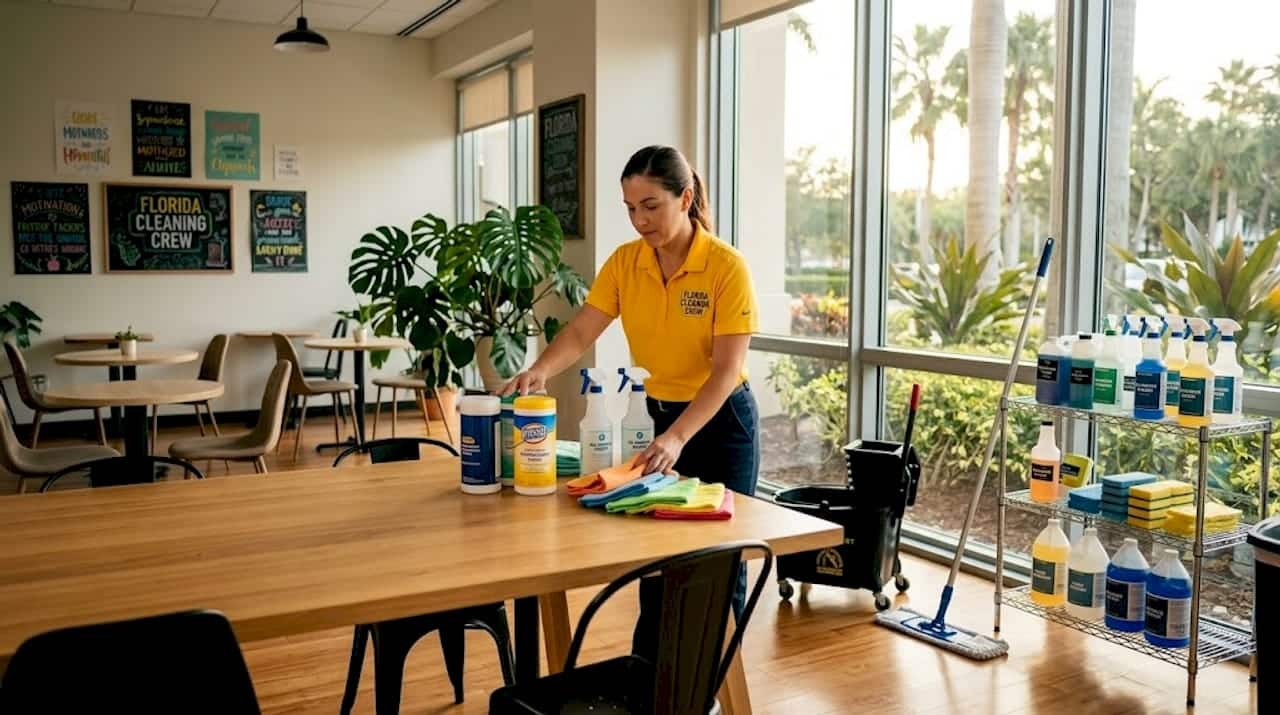
Walk into any well-run office in Tampa and you’ll notice it before anyone says a word. The surfaces are clean, the air smells neutral, and nothing feels sticky or grimy. That impression doesn’t happen by accident. It comes from having the right cleaning supplies for offices and knowing exactly how to use them. The problem most office managers and business owners face isn’t a lack of options. It’s having too many options, not enough guidance, and products that underdeliver because nobody followed the label instructions.
Table of Contents
- Key takeaways
- What to look for in cleaning supplies for offices
- 10 essential office cleaning products every workspace needs
- Comparing disinfectant types for office use
- Avoiding the mistakes that undermine office sanitation
- Practical tips for maintaining a clean office consistently
- My honest take on office cleaning supplies
- Professional cleaning services for Tampa Bay offices
- FAQ
Key takeaways
| Point | Details |
|---|---|
| Dwell time is non-negotiable | Disinfectants only work when surfaces stay visibly wet for the full contact period specified on the label. |
| Match chemicals to surfaces | Using the wrong cleaner on electronics or coated furniture causes permanent damage and costly replacements. |
| Concentrates save real money | A single gallon of floor cleaner concentrate can yield up to 128 gallons of solution, stretching your budget significantly. |
| Compliance requires documentation | OSHA mandates accessible Safety Data Sheets and proper container labeling for every chemical in your workplace. |
| Color-coded tools reduce risk | Microfiber cloths assigned by area prevent cross-contamination between restrooms, kitchens, and workstations. |
What to look for in cleaning supplies for offices
Before you spend a dollar on office cleaning products, you need a framework. Not every product that claims to disinfect actually does what it says in real-world conditions. Here is what separates a smart purchase from a wasted one.
Disinfecting power and EPA registration. The product must be EPA-registered and carry a registration number on the label. Kill claims on the label give you specifics: which pathogens are eliminated and how fast. Some commercial cleaners kill 99.9% of bacteria and viruses within 60 seconds when used correctly. That phrase “when used correctly” carries most of the weight.
Surface compatibility. An all-purpose label does not mean all-surface. Bleach-based sprays damage powder-coated metals and certain plastics over time. Alcohol-based products can strip finishes from wood desks and office furniture. Before buying in bulk, test on a small, hidden area. Mapping chemicals to specific surfaces prevents corrosion, coating loss, and costly equipment replacement.
OSHA compliance. This is the one most office managers overlook until there is an inspection. OSHA’s Hazard Communication Standard requires that every chemical in your workplace have an accessible Safety Data Sheet (SDS) and that all secondary containers be properly labeled. Missing documentation is a common citation. Pull your SDS files and check them against every product currently on your shelf.
Cost per use, not cost per bottle. A $30 concentrate that yields dozens of gallons beats a $8 ready-to-use bottle every time. Comparing per-gallon cost is the most reliable way to budget cleaning supplies, and it is a step most buyers skip entirely.
Environmental considerations. Environmentally friendly cleaners have moved well past the “gentle but ineffective” reputation they had a decade ago. Many now carry EPA Safer Choice certification and perform at the same level as conventional formulas. If your office has a sustainability policy, this matters for both compliance and culture.
Pro Tip: Before purchasing any disinfectant in bulk, download the product’s SDS and confirm the contact time. If your cleaning staff cannot realistically maintain a wet surface for that duration during their workflow, choose a different product with a shorter dwell time.
10 essential office cleaning products every workspace needs
This is not a list of every product you could possibly buy. It is the list of what you actually need to maintain a clean, professional, and health-protective office environment.
1. EPA-registered disinfectant wipes
Wipes are the workhorse of high-touch surface cleaning. Door handles, light switches, shared keyboards, elevator buttons, and conference room phones all need daily attention. The key detail most staff get wrong: surfaces must stay visibly wet for the product’s full dwell time, which ranges from one to ten minutes depending on the formula. Wiping immediately after application cancels the disinfection entirely.
2. All-purpose disinfectant spray
A quality spray gives you flexibility for desks, countertops, breakroom surfaces, and restroom fixtures. Look for products with clear spray-to-wet instructions and specified standing times. Spray-to-wet, stand, then wipe is the sequence. Products that require ventilation will say so on the label. In Florida offices with limited airflow, this matters.
3. Concentrated floor cleaner
Floors in high-traffic offices take a beating. A good concentrate dilutes efficiently. Some formulas produce up to 128 gallons of solution per gallon of concentrate, making them one of the most cost-efficient items in your supply closet. Use dilution charts and a measuring tool. Eyeballing the ratio leads to residue buildup or under-performing solution.
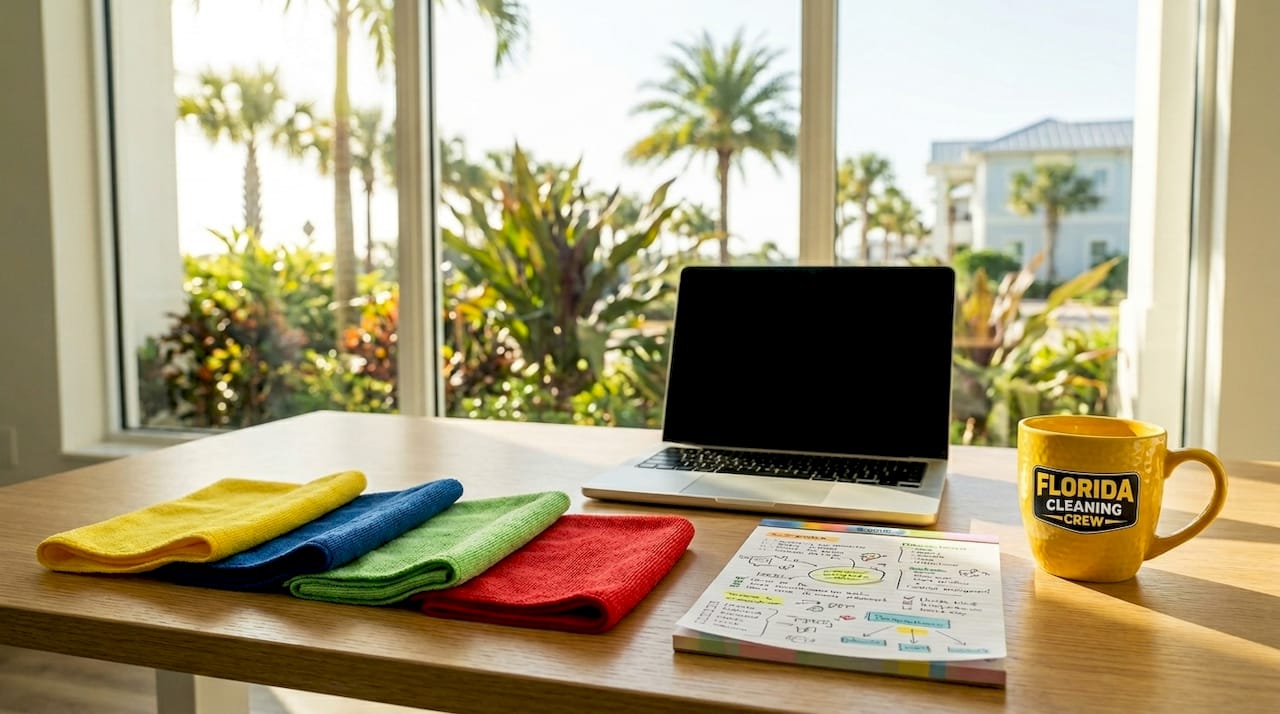
4. Microfiber cloths, color-coded by zone
Microfiber cloths outperform paper towels and cotton rags on almost every surface. They capture dust and fine particles rather than pushing them around. More importantly, color-coded cloths by area prevent cross-contamination. Red for restrooms, blue for general surfaces, green for kitchens. This is not overcomplicated. It is basic infection control that most offices skip.
5. Glass and surface cleaner for screens and windows
Electronics and glass partitions need products formulated specifically for them. Ammonia-based glass cleaners leave residue on anti-glare screens and strip oleophobic coatings from touchscreens over time. Use alcohol-free, screen-safe solutions for monitors and tablets, and save the standard glass cleaner for windows and glass partitions. For professional-grade results on office windows, window cleaning procedures matter as much as the product itself.
6. Heavy-duty degreaser for break rooms
Break rooms produce grease, food residue, and odor that a standard all-purpose spray cannot tackle effectively. A commercial-grade degreaser handles stovetop buildup, microwave interiors, and cabinet fronts without requiring excessive scrubbing. These are typically concentrate-based. Dilute correctly, apply, let it dwell, and wipe. The dwell step is where most people get impatient.
7. Restroom disinfectant and toilet bowl cleaner
These two are distinct products doing different jobs. The restroom disinfectant handles surfaces: sinks, counters, door handles, and partitions. The toilet bowl cleaner handles porcelain interiors where different chemistry is required. Using a general disinfectant inside a toilet bowl is both wasteful and ineffective. Keep both stocked and clearly labeled in your supply kit.
8. Commercial-grade mop system
Flat microfiber mops with disposable or washable pads outperform traditional string mops for office environments. String mops spread bacteria rather than removing it, and they stay damp long enough to become a contamination source themselves. A flat mop system with a dual-bucket setup (one for clean solution, one for dirty water) keeps the process controlled.
Pro Tip: Replace mop pads after each section of flooring, not after each cleaning session. A saturated, soiled pad being dragged across clean floor is doing more harm than good.
9. Trash liners and waste management supplies
This one sounds obvious, but the fit and gauge matter. Undersized liners tear and create spills. Liners that are too thin for heavy waste create the same problem. Office waste is generally moderate volume and weight, so a standard 1.2 to 1.5 mil thickness liner in the correct can size keeps the workflow clean and avoids double-bagging.
10. Nitrile gloves and personal protective equipment
Cleaning staff need proper PPE. Nitrile gloves protect against chemical exposure and cross-contamination. Thicker gloves hold up to repeated use with disinfectants and degreasers. Disposable masks are worth having on hand for tasks involving concentrated chemicals or spray applications in confined spaces. PPE is not optional. It protects your staff and your business from liability.
Comparing disinfectant types for office use
Not every disinfectant format works equally well in every office setting. Here is a direct comparison to help you choose based on your workflow.
| Format | Kill efficacy | Contact time | Surface compatibility | Cost per use | Best for |
|---|---|---|---|---|---|
| Disinfectant wipes | High (EPA-registered) | 1 to 4 minutes | Most hard surfaces | Moderate | High-touch surfaces, quick daily use |
| Ready-to-use spray | High | 30 seconds to 2 minutes | Varies by formula | Moderate to high | Desks, counters, restrooms |
| Concentrate (diluted) | High when diluted correctly | Varies | Broad, formula-dependent | Low | Floors, large surfaces, bulk cleaning |
| Disinfectant foam | High | 30 seconds to 1 minute | Vertical surfaces | Moderate | Restroom walls, appliances |
The biggest variable across all four formats is execution. Operational failure occurs most often when staff wipe surfaces before the dwell time is complete. The product’s strength is irrelevant if the application is wrong. Concentrates add a second risk: incorrect dilution causes either wasted product from over-concentration or ineffective cleaning from under-concentration. Both lead to avoidable costs.
Avoiding the mistakes that undermine office sanitation
Most office cleaning programs fail at the execution level, not the product selection level. Here are the specific mistakes that reduce effectiveness or create compliance problems.
-
Wiping too soon. This is the single most common error. The surface must remain visibly wet for the full dwell time stated on the label. If it dries in 30 seconds and the label requires two minutes, the product has not disinfected anything. Re-wet the surface or switch to a product with a shorter required dwell time.
-
Using bleach on incompatible surfaces. Bleach-based cleaners are effective but not universal. They corrode certain metals, discolor fabrics, and degrade some plastics with repeated exposure. Avoid bleach on sensitive metals and always check the surface manufacturer’s guidance.
-
Skipping SDS documentation. OSHA requires accessible SDS for every chemical during every work shift. If you change products, the SDS file must be updated. Keeping a binder in the supply closet is not enough if it is three product versions out of date.
-
Eyeballing concentrate dilutions. This is both a budget problem and a performance problem. Too little concentrate and the solution does not clean. Too much and you create a residue that attracts dirt and wastes product. Use labeled measuring tools and post dilution charts next to where mixing happens.
-
Neglecting high-touch surfaces. Modern office environments have numerous surfaces that require scheduled daily disinfection: keyboards, door handles, elevator buttons, light switches, faucet handles, and shared equipment controls. These are the vectors for illness spread and they are often skipped in favor of visible surfaces like floors and desks.
Pro Tip: Create a one-page laminated checklist of every high-touch surface in your office and post it inside the supply closet. Train every person who cleans to work through it in sequence before moving to general surface cleaning.
Practical tips for maintaining a clean office consistently
Having the best cleaning supplies for offices only matters if you use them on a reliable schedule. These are the habits that turn a good supply kit into a genuinely clean workspace.
-
Build a zone-based cleaning schedule. Divide your office into zones: reception, workstations, conference rooms, restrooms, and break rooms. Assign cleaning frequency by traffic level. High-touch surfaces in restrooms and reception need daily attention. Lower-traffic zones can rotate to a two or three times per week schedule. For more detail on scheduling strategies in Tampa Bay offices, the workplace cleanliness tips from Floridacc cover this well.
-
Train everyone who touches the supplies. Product training is not a one-time event. When you switch products, retrain. Cover contact time, dilution ratios, surface compatibility, and PPE requirements. Untrained staff with good products still produce poor results.
-
Label everything. Secondary containers must be labeled per OSHA requirements. Beyond compliance, labels prevent someone from grabbing the wrong product and applying it to an incompatible surface. Labels also reinforce dilution ratios when printed directly on the dispenser.
-
Track inventory against surface coverage. A product running out mid-shift is a compliance and hygiene gap. Track how much product each cleaning session consumes and order based on that data, not gut feeling. For offices in Tampa and Clearwater managing multiple locations, centralized purchasing for bulk office cleaning items reduces both cost and the risk of running short.
-
Consider the sustainability angle. Environmentally friendly cleaners reduce chemical exposure for staff and lower your environmental footprint. Many Tampa Bay businesses now include green cleaning criteria in their vendor standards. Products with third-party certification, such as EPA Safer Choice, signal credibility without sacrificing cleaning performance.
My honest take on office cleaning supplies
I’ve spent years working with offices across Tampa Bay, and the pattern I see most often is not that businesses are buying bad products. It is that they are buying decent products and using them wrong.
The dwell time issue is the most glaring example. I’ll walk into a supply closet, see a respectable EPA-registered disinfectant, and then watch a staff member spray and wipe in three seconds. That product is now just a smear on the desk. No disinfection happened. The label says two minutes. Nobody read the label.
My second observation: supply closets in most offices are a compliance liability waiting to happen. I’ve seen missing SDS documentation for half the products on the shelf, secondary containers with no labels, and concentrate products being mixed by staff who were never shown the dilution chart. Each of those is an OSHA citation risk.
What I tell every office manager I work with is this: the chemistry is the easy part. You can buy the right products in an afternoon. The hard part is building the habits and documentation that make those products work the way they are supposed to.
Invest one hour in product training when you bring in new supplies. Print and laminate the dilution charts. Update your SDS binder every time you change a product. These are small steps that most offices skip. They are also the steps that separate offices that stay genuinely clean from offices that only look clean until someone gets sick.
Local conditions in Tampa and St. Petersburg add one more layer. High humidity means surfaces dry slower in cooler months but bacteria thrive in warm, humid conditions year-round. That context should inform both your product choices and your cleaning frequency.
— Matt
Professional cleaning services for Tampa Bay offices
Running an office means your time is already stretched. Sourcing the right office sanitation supplies, training staff, managing compliance documentation, and staying on top of a consistent cleaning schedule is a significant operational burden on top of everything else.

Floridacc provides professional commercial cleaning for small and mid-sized businesses across Tampa, Clearwater, and St. Petersburg. The team uses EPA-registered products, follows proper contact time protocols, and brings complete compliance documentation including SDS files to every job. If you have been managing cleaning in-house and wondering why results feel inconsistent, a professional service removes that uncertainty entirely.
For offices that want the benefit of trained cleaning staff without the overhead of managing it internally, office cleaning services from Floridacc are designed to keep your workspace clean and your workday uninterrupted. Request a free estimate and see what a properly stocked, properly trained cleaning program looks like in practice.
FAQ
What cleaning supplies do offices need most?
The core list includes EPA-registered disinfectant wipes, all-purpose disinfectant spray, a concentrated floor cleaner, color-coded microfiber cloths, glass cleaner safe for screens, nitrile gloves, and heavy-duty trash liners. High-touch surfaces require daily attention with disinfectant products that carry documented kill claims.
How long should disinfectant sit on a surface before wiping?
Most EPA-registered disinfectants require surfaces to stay visibly wet for one to ten minutes, depending on the formula. Wiping too soon reduces or eliminates the product’s disinfecting effect. Always check the label for the specific contact time before purchasing.
Are concentrate cleaners worth it for offices?
Yes. Some floor cleaner concentrates yield up to 128 gallons of solution per gallon of product, making the cost per use significantly lower than ready-to-use alternatives. The key is consistent dilution using measuring tools and posted dilution charts.
What OSHA requirements apply to office cleaning chemicals?
OSHA’s Hazard Communication Standard requires that Safety Data Sheets be accessible for every chemical during every work shift, that all secondary containers be properly labeled, and that staff receive training on the hazards of each product they handle.
Can environmentally friendly cleaners work in a commercial office setting?
Yes. Many EPA Safer Choice certified cleaners perform at the same level as conventional formulas for routine office cleaning tasks. They reduce chemical exposure for staff and support sustainability commitments without sacrificing cleaning effectiveness on typical office surfaces.