
Most homeowners have experienced the same frustration. You build a detailed cleaning schedule, follow it for two weeks, then a busy work stretch or a family visit throws everything off. By the time things settle down, the schedule feels impossible to catch up with, so you abandon it entirely. This cycle repeats until the home feels perpetually behind. Understanding how to explain flexible cleaning schedules breaks that cycle by replacing rigid routines with plans that bend around real life instead of competing with it. This article walks you through what flexible cleaning schedules actually are, why they work, and how to build one that fits your home.
Table of Contents
- Key takeaways
- What flexible cleaning schedules actually are
- Why flexible cleaning schedules matter
- How to create flexible cleaning schedules
- Tools and services that support flexible schedules
- Common challenges and how to overcome them
- My honest take on flexible cleaning
- Let Floridacc handle what your schedule cannot
- FAQ
Key takeaways
| Point | Details |
|---|---|
| Flexibility beats rigidity | Adaptable schedules outperform fixed ones because they account for unpredictable household routines and property demands. |
| Micro-tasks reduce overwhelm | Breaking cleaning into small, frequency-based tasks makes it easier to stay consistent without burning out. |
| Task priority tiers matter | Separating must-do tasks from flexible ones lets you maintain a clean home even during busy weeks. |
| Technology extends your capacity | Scheduling apps and professional cleaning services make adjustable cleaning timetables far easier to manage. |
| Professional support fills gaps | A reliable cleaning service can handle what your schedule cannot, especially during high-demand property periods. |
What flexible cleaning schedules actually are
A flexible cleaning schedule is a system that assigns cleaning tasks based on actual usage, available time, and priority level rather than a fixed daily or weekly checklist that never changes. The goal is not to clean less. The goal is to clean smarter by matching effort to need.
Three core principles define these schedules.
- Adaptability: The schedule changes when your life changes. A week with guests or a property turnover between Airbnb bookings triggers a different level of cleaning than a quiet week at home alone.
- Frequency adjustment: Not every task needs to happen on the same day every week. Vacuuming a high-traffic hallway may need to happen three times a week, while cleaning a guest bathroom that nobody used can wait.
- Task prioritization: Some tasks protect health and hygiene, like cleaning kitchen surfaces or bathroom toilets. Others are maintenance-level, like wiping baseboards. A flexible plan separates these tiers so the critical tasks always happen, even when time is short.
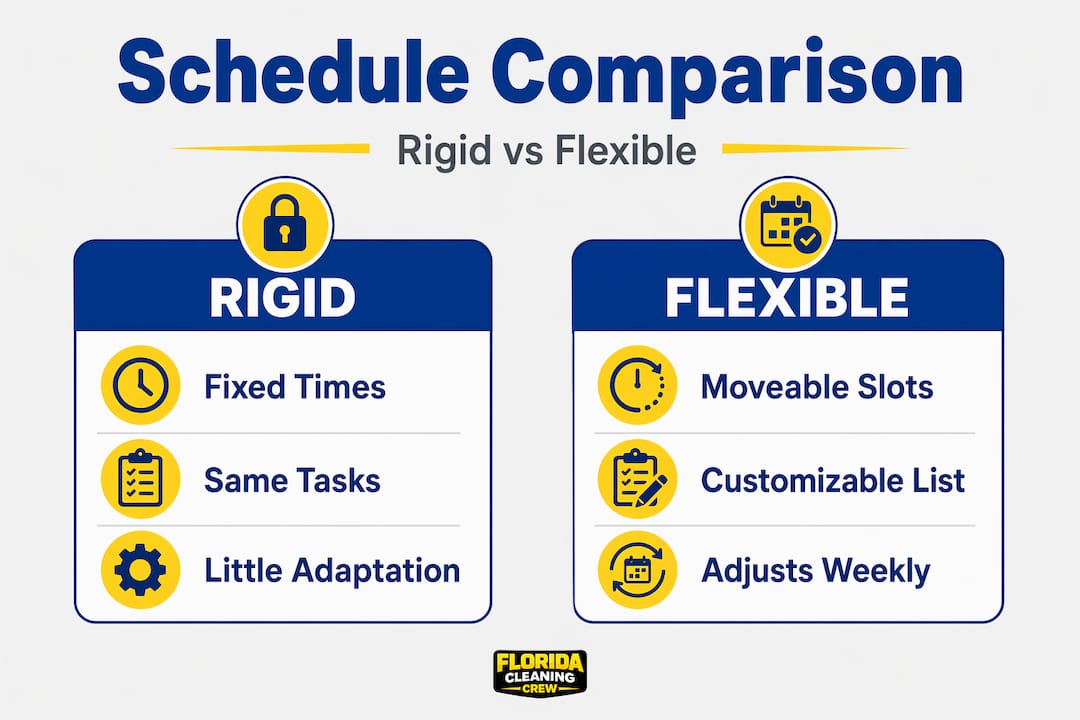
Here is how flexible and rigid cleaning schedules compare side by side.
| Feature | Rigid schedule | Flexible schedule |
|---|---|---|
| Task frequency | Fixed, same every week | Adjusts based on use and availability |
| Missed task handling | Falls behind and accumulates | Deprioritized, rescheduled without guilt |
| Response to life changes | Disrupted easily | Absorbs changes by design |
| Energy required | High, all-or-nothing mindset | Sustainable, “bare minimum” baseline |
| Best suited for | Predictable, consistent households | Most real households and managed properties |
Pro Tip: Define your “bare minimum” cleaning list before building any schedule. These are the three to five tasks that must happen no matter what. When a busy week hits, you do those and nothing else. Everything else is a bonus.
Why flexible cleaning schedules matter
Rigid schedules look great on paper and fall apart in practice. Tampa Bay homeowners dealing with humidity, sandy floors from beach trips, and unpredictable household routines know this better than most. Life does not cooperate with a fixed checklist.
Here is why the flexibility factor matters most.
- Household activity varies constantly. A home with three kids on spring break generates a completely different mess than the same home during a school week. A schedule that cannot account for that gap either over-cleans or under-cleans.
- Property managers face sudden demand shifts. An Airbnb in St. Petersburg might sit quiet for five days and then receive three back-to-back bookings. A rigid schedule cannot absorb that transition. A flexible one already accounts for it.
- Over-cleaning wastes resources. Cleaning a room that has barely been used burns time and supplies that could go toward areas that genuinely need attention. Usage-based cleaning frequency reduces that labor waste while actually improving cleaning quality where it counts.
- Under-cleaning creates health risks. Skipping bathroom sanitization or kitchen wipe-downs because the schedule got disrupted is not harmless. A flexible plan keeps those non-negotiables in place even when everything else shifts.
- Morale improves when the bar feels reachable. One of the strongest insights from ADHD cleaning research applies to every household: flexible schedules prevent stress caused by missed daily goals by giving people a realistic baseline rather than an all-or-nothing standard.
“A flexible schedule is not permission to do less. It is permission to do the right things at the right time, which is actually harder to get wrong than following a list that ignores your reality.”
That shift in mindset is where most homeowners start making real progress.
How to create flexible cleaning schedules
Building a customizable cleaning schedule that actually holds up takes about 30 minutes of planning upfront. The payoff is months of lower stress and a cleaner home. Here is how to do it.

1. Assess your home’s actual usage patterns.
Walk through your home and note which rooms get used daily, which get used occasionally, and which barely see any traffic. A formal dining room in a Clearwater home that only gets used during holidays does not need weekly cleaning. The kitchen does. Your schedule should reflect reality, not an idealized version of how you wish the home ran.
2. List all cleaning tasks and sort them by frequency.
Group tasks into three categories: daily, weekly, and monthly. Breaking tasks by health impact helps prioritize what actually needs to stay consistent. Daily tasks might include wiping kitchen counters and a quick bathroom sink wipe. Weekly tasks cover vacuuming, mopping, and toilet cleaning. Monthly tasks handle things like deep-cleaning appliances, washing windows, or scrubbing grout.
3. Set priority tiers, not just frequencies.
Label each task as Tier 1 (must happen regardless of time), Tier 2 (important but can shift by a day or two), or Tier 3 (nice to have when time allows). When a week gets compressed, you only need to protect your Tier 1 tasks. Experts recommend time-based micro-task frameworks over rigid lists precisely because they create this kind of sustainable flexibility.
4. Build flexible service windows into your week.
Instead of saying “clean the bathrooms every Saturday at 10am,” say “clean the bathrooms sometime between Friday and Sunday.” That two-day window dramatically reduces the chance of missing it entirely. Research supports this approach: 2-hour service windows reduce scheduling stress and improve follow-through significantly. The same principle applies in your home.
5. Use rotating room or task blocks for deeper work.
Instead of trying to deep-clean every room every month, rotate focus. Week one: bedrooms. Week two: kitchen and dining. Week three: bathrooms. Week four: living spaces and high-traffic zones. This keeps daily tasks manageable at 15 to 30 minutes while still making sure every area gets thorough attention over time.
6. Track and adjust your schedule after the first month.
Use a simple paper checklist, a whiteboard on the fridge, or a free app. The format matters less than reviewing what actually worked after four weeks. Which tasks kept slipping? Did a room consistently need more attention than you planned? Adjust accordingly. An adjustable cleaning timetable is not set-and-forget. It is a living document you refine over time.
Pro Tip: For property managers in Tampa Bay, build a “turnover protocol” as a separate mini-schedule that sits inside your flexible plan. It activates automatically between guest stays and covers the non-negotiables: fresh linens, sanitized bathrooms, restocked supplies, and a visual inspection. That protocol never changes. Everything else around it stays flexible.
Tools and services that support flexible schedules
Technology has genuinely changed what is possible here. You do not need to track everything manually or rely on memory.
Scheduling apps built specifically for home management let you set tasks as recurring but movable, send reminders when a task has not been completed within its window, and adjust frequency based on seasons or household changes. Generic calendar apps often fall short here. Cleaning-specific platforms with features like photo documentation and scheduling error alerts provide a level of operational confidence that general tools cannot match.
For homeowners managing their own schedules, even a structured checklist app with repeating reminders beats trying to hold it all in your head.
Professional cleaning services take this further. A recurring cleaning service gives you a built-in flexible structure without the mental overhead of tracking it yourself. You set the frequency, the provider handles execution, and you adjust the schedule when your needs change. Flexible scheduling leads to faster bookings, better communication, and lower cancellation rates for both homeowners and service providers alike.
One underrated example of flexible service reducing household workload: weekly laundry pickup and delivery. Families report reduced workload after just one or two weekly service cycles, with 24 to 48-hour turnaround times that fit around almost any schedule. Removing laundry from your cleaning plate entirely frees up time and mental energy for the tasks that actually require your presence.
For property managers in Tampa, Clearwater, or St. Petersburg, professional services that offer dynamic rescheduling, on-demand deep cleans between tenants, and recurring maintenance visits effectively make your adjustable cleaning timetable run on autopilot.
Common challenges and how to overcome them
The biggest obstacle to flexible cleaning schedules is not time or motivation. It is the mental habit of all-or-nothing thinking. If you missed Tuesday’s floor vacuuming, the whole week feels like a failure. That mindset is what keeps people cycling back to rigid schedules that look organized but never actually stick.
Here are the most common challenges and practical ways through them.
- Fear of losing structure. Flexibility does not mean no structure. It means building structure that bends. Keep your Tier 1 tasks as non-negotiables and let everything else breathe.
- Inconsistent availability. Life changes week to week. Build windows instead of fixed times and you will hit more tasks more consistently than a rigid schedule allows.
- Overwhelm from backlog. If the house gets behind, resist the urge to schedule a marathon clean day. Pick one or two catch-up tasks per day until you are back to baseline. Marathon sessions usually lead to burnout and abandonment.
- Loss of momentum after disruptions. Travel, illness, or a property renovation can knock any schedule sideways. When that happens, return to your bare minimum list first. Rebuild from there rather than trying to restart the full plan immediately.
- Guilt about imperfect compliance. This one derails more cleaning plans than any external factor. Treating extra cleaning as a bonus rather than a missed obligation rewires how you relate to your schedule and makes long-term consistency far more achievable.
Pro Tip: Write your bare minimum list on a sticky note and put it somewhere visible in the kitchen. On a chaotic week, just do those three to five tasks. That alone keeps a home functional and prevents the kind of backlog that makes catching up feel impossible.
Flexible cleaning plans also improve household morale in ways that rigid schedules rarely do. When the standard is reachable, people actually reach it. You can learn more about improving cleaning routines in ways that adapt naturally to how your household actually functions.
My honest take on flexible cleaning
I have worked with hundreds of Tampa Bay homeowners and property managers over the years, and I will tell you something that most cleaning content glosses over. Rigid schedules do not fail because people are lazy. They fail because they were designed for an imaginary household that operates on perfect, predictable cycles. Real Tampa Bay homes do not work that way.
What I have seen actually work is something much simpler. Pick five things that must always happen. Clean the kitchen surfaces. Sanitize the bathrooms. Deal with the floors in the highest-traffic areas. After that, everything else is earned bonus territory. When a homeowner accepts that framework, the guilt evaporates. And when the guilt leaves, consistency improves almost automatically.
I have also seen property managers waste significant money on deep cleans that were not needed and skip them when they absolutely were, all because their schedule was fixed rather than responsive. An adjustable cleaning timetable tied to actual occupancy and usage data beats any predetermined cleaning calendar I have ever seen.
The most honest thing I can say is this: flexibility is not the enemy of a clean home. Perfectionism is. When you stop measuring success by how closely you followed a list and start measuring it by the actual state of your home, you make better decisions with your time, your money, and your energy.
— Matt
Let Floridacc handle what your schedule cannot
If you have read this far, you already understand that a flexible cleaning plan is not about doing less. It is about doing the right things at the right time. That is exactly what Floridacc was built to do for Tampa Bay homeowners and property managers.

Floridacc offers residential and commercial cleaning plans designed around your schedule, not a fixed template. Whether you need recurring weekly visits, a one-time deep clean before a property listing, or flexible Airbnb turnover service between bookings, the team adjusts to your needs. You can request a free estimate, adjust your service frequency anytime, and rely on licensed, insured professionals who show up consistently. If you want a professional partner to take the execution off your plate, explore cleaning services that flex around your life.
FAQ
What are flexible cleaning schedules?
Flexible cleaning schedules are adaptive cleaning plans that adjust task frequency, timing, and priority based on actual household usage and availability rather than following a fixed, unchanging routine.
Why do flexible cleaning schedules matter for property managers?
Property managers face irregular occupancy and demand shifts that rigid schedules cannot handle. Flexible plans allow rapid adjustment between tenant turnovers and varying booking patterns without losing cleaning consistency.
How do I start creating a flexible cleaning schedule?
Start by listing all cleaning tasks, grouping them by frequency (daily, weekly, monthly), and assigning each a priority tier. Then set flexible time windows instead of fixed times, and review your plan after the first month to refine it.
Can a professional cleaning service work with my flexible schedule?
Yes. Many professional cleaning services, including Floridacc in the Tampa Bay area, offer customizable recurring plans that adjust to your availability, property type, and changing needs throughout the year.
What is the biggest mistake people make with cleaning schedules?
The most common mistake is building a rigid, all-or-nothing schedule that falls apart the moment life gets busy. Setting a “bare minimum” baseline of three to five non-negotiable tasks prevents that cycle and keeps your home functional even during chaotic weeks.