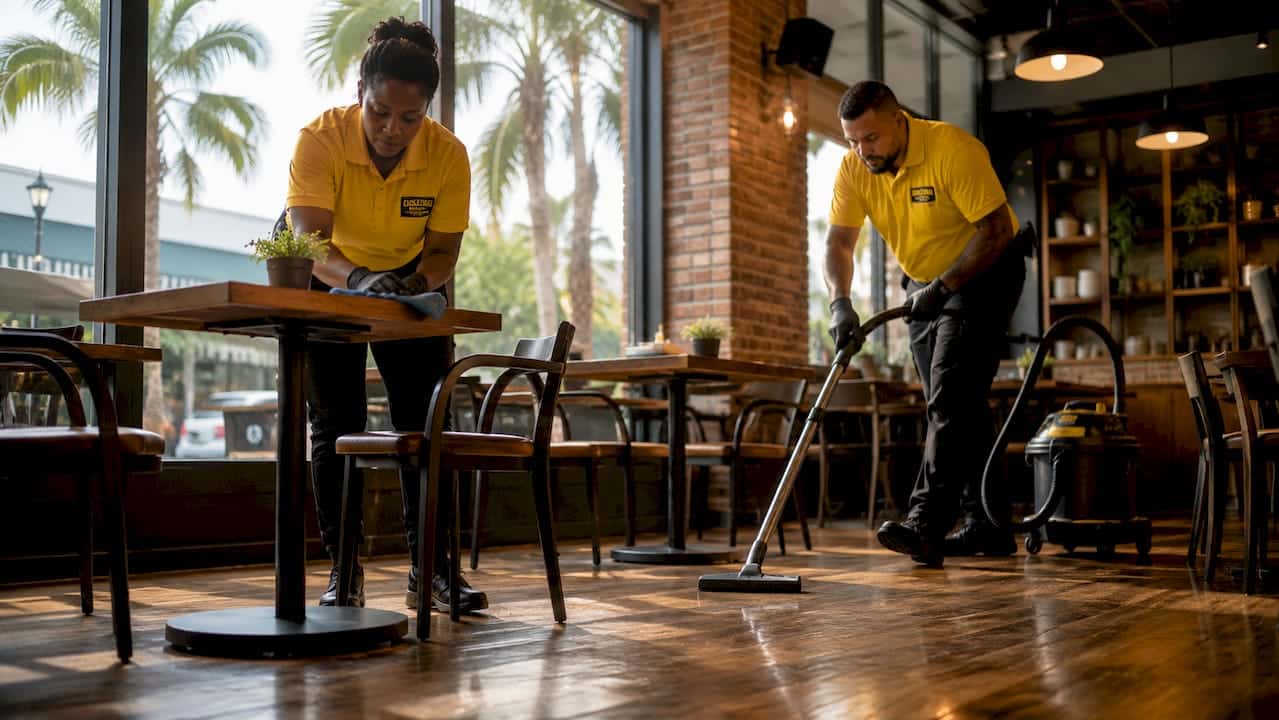
Office cleanliness essentials are the specific supplies, routines, and compliance steps every workplace needs to stay healthy, safe, and professional. OSHA 29 CFR 1910.141 sets the legal baseline for workplace sanitation, covering everything from restroom access to dry floors. Beyond compliance, a clean office directly affects employee health, absenteeism, and the impression you make on clients. Whether you manage a five-person suite in St. Petersburg or a 60-person office in Tampa, getting these fundamentals right is not optional. It is the foundation of a functional workplace.
1. Office cleanliness essentials: the core supply list
Every effective cleaning program starts with the right tools. Without them, even the most disciplined routine falls short.
The non-negotiable supplies for any office include:
- EPA-registered disinfectants for hard surfaces and high-touch points
- Microfiber cloths in a color-coded system (red for restrooms, green for breakrooms, blue for general areas) to prevent cross-contamination
- HEPA-filter commercial vacuums that trap 99.97% of particles down to 0.3 microns
- Heavy-duty trash bags in multiple sizes for desk bins and common areas
- Nitrile gloves and disposable masks for staff handling chemicals
- Mop systems with clean heads for hard floors and restrooms
- Spray bottles, buckets, and caddies for organized product transport
Microfiber cloths outperform cotton rags on pathogen removal. The color-coded approach is not just a best practice. It is the difference between cleaning a surface and spreading bacteria from one room to another.
HEPA-filter vacuums matter more than most managers realize. Standard residential vacuums recirculate dust and allergens back into the air. A commercial HEPA unit captures what a standard vacuum releases, which is critical for staff with allergies or asthma.

Disinfectants only work when applied correctly. Non-respect of a product’s dwell time prevents real disinfection. Proper timing ensures 99.999% pathogen kill rates for a genuinely safe workspace. Always read the label and let the product sit for the recommended contact time before wiping.
Pro Tip: Choose low-odor, eco-friendly cleaning products certified by Green Seal or EPA Safer Choice. They perform at the same level as conventional products and reduce respiratory irritation for staff working in the space during or after cleaning.
For a deeper breakdown of which products actually deliver results, the office cleaning supplies guide from Floridacc covers the specifics by surface type and use case.
2. Structured cleaning routines and recommended frequencies
A cleaning routine for offices only works when it is scheduled, documented, and matched to the actual traffic level of the space. Ad hoc cleaning misses critical areas every time.
Daily tasks target the highest-risk zones. High-touch surfaces like doorknobs, light switches, elevator buttons, and shared keyboards require daily disinfection to reduce pathogen transmission. Restrooms need daily attention as well: replenishing soap, cleaning fixtures, and mopping floors.
Weekly tasks go deeper. Detailed dusting of shelves, monitors, and baseboards, cleaning appliance exteriors in the breakroom, and vacuuming carpets all belong on the weekly list. These tasks prevent buildup that becomes harder and more expensive to address later.
Monthly and quarterly tasks protect your long-term assets. HVAC filters should be replaced every 30–90 days depending on occupancy and air sensitivity. Professional carpet deep cleaning is recommended quarterly to maintain fiber integrity and indoor air quality.
| Task | Daily | Weekly | Monthly | Quarterly |
|---|---|---|---|---|
| Disinfect high-touch surfaces | ✓ | |||
| Clean and restock restrooms | ✓ | |||
| Empty trash bins | ✓ | |||
| Vacuum carpets and rugs | ✓ | |||
| Dust surfaces and equipment | ✓ | |||
| Clean breakroom appliances | ✓ | |||
| Replace HVAC filters | ✓ | |||
| Deep clean carpets professionally | ✓ | |||
| Clean interior windows | ✓ |
Cleaning frequency also depends on office size. Standard offices typically need professional cleaning 2–3 times per week. Offices with 50 or more employees, or those with high client traffic, require daily service to maintain hygiene standards. That gap matters. A 60-person office cleaned twice a week will accumulate bacteria and odors faster than the schedule can address.
Pro Tip: Schedule deep cleaning tasks after business hours or on weekends. This avoids disrupting staff, allows disinfectants to reach full dwell time without foot traffic, and gives surfaces time to dry completely before the next workday.
For offices that need a ready-to-use framework, the busy office cleaning routines guide from Floridacc walks through scheduling by team size and traffic pattern.
3. Compliance and legal obligations every manager must know
Workspace hygiene essentials are not just about appearances. They carry legal weight. OSHA 29 CFR 1910.141 requires employers to keep work areas clean and dry, provide stocked hand soap, and maintain functioning restrooms and handwashing stations. Violations include wet floors left unaddressed, inaccessible restrooms, and missing sanitation supplies.
Common compliance failures include:
- Wet floors without signage or immediate cleanup
- Restrooms that lack soap, paper towels, or functioning fixtures
- Cleaning chemicals stored without accessible Safety Data Sheets (SDS)
- Cleaning staff working without proper PPE (gloves, masks)
- No documented cleaning log to verify tasks were completed
OSHA inspectors routinely check for SDS binders and PPE compliance during workplace audits. An SDS binder is not a formality. It is a legal requirement that protects both your staff and your business from liability.
Documented cleaning checklists are what separate a legally compliant workspace from one that only looks clean. A checklist creates a paper trail. That paper trail is your defense during an OSHA inspection.
Integrating compliance into daily routines is straightforward. Assign a staff member or cleaning vendor to sign off on a daily log. Keep SDS sheets in a labeled binder near the cleaning supply storage area. Review the log weekly to catch gaps before they become violations.
For Tampa Bay businesses, local compliance nuances are covered in the Tampa Bay cleaning compliance guide, which addresses both OSHA standards and Florida-specific workplace requirements.
4. Tailoring your approach to your specific office type
Not every office needs the same supplies or the same schedule. Foot traffic, employee count, and the nature of the work all determine the right approach. Adjusting cleaning frequency based on size and traffic is the single most effective way to avoid both under-cleaning and wasted budget.
Small offices (under 10 employees)
Small offices with low client traffic can typically maintain hygiene with 2–3 professional cleanings per week, supplemented by daily employee maintenance of high-touch surfaces. The supply list stays lean: microfiber cloths, a quality disinfectant spray, a HEPA vacuum, and restroom supplies cover most needs.
Mid-size and large offices (50+ employees)
Larger offices need daily professional service. The volume of foot traffic, shared equipment, and restroom use creates contamination risks that a twice-weekly schedule cannot address. These offices also benefit from zone-based cleaning plans that assign specific tasks to specific areas, reducing the chance of missed spots.
Client-facing offices
Reception areas, conference rooms, and lobbies require a higher standard of visible cleanliness. Clients judge your business by what they see. These zones need daily attention to floors, surfaces, glass, and seating, not just weekly maintenance.
Shared workspaces and mixed-use properties
Shared offices and mixed-use properties present unique challenges. Multiple tenants mean overlapping cleaning needs and unclear responsibility. Defining service scope clearly in your cleaning agreement prevents disputes. Specify whether appliance interiors are included, which shared areas are covered, and how often common zones are serviced.
For offices in Tampa, Clearwater, and St. Petersburg, humidity adds another variable. High moisture levels accelerate mold growth on carpets, grout, and HVAC systems. Offices in these areas should increase HVAC filter replacement frequency and schedule more frequent restroom and breakroom deep cleans during summer months.
| Office type | Recommended frequency | Key supply additions |
|---|---|---|
| Small, low traffic (under 10) | 2–3 times per week | Basic disinfectants, microfiber cloths |
| Mid-size (10–50 employees) | 3–5 times per week | HEPA vacuum, mop system, SDS binder |
| Large, high traffic (50+) | Daily | Full supply kit, zone-based plan |
| Client-facing (any size) | Daily for public zones | Glass cleaner, floor polish, odor control |
| Mixed-use or shared space | Daily common areas | Defined scope contract, shared restroom kit |
Facility managers who target high-risk transmission zones daily, rather than over-disinfecting low-touch areas, get better results with less product. That approach also reduces chemical exposure for staff and cuts supply costs over time.
For offices in mixed-use buildings, the mixed-use office cleaning guide from Floridacc covers how to define zones and set realistic expectations with your cleaning provider.
When setting up a formal agreement with any vendor, reviewing a cleaning service contract template helps you understand what scope language to include and what to watch out for.
5. Building a clean desk policy that actually sticks
A clean desk policy is a workplace standard requiring employees to clear personal items, food, and clutter from their desks at the end of each workday. The policy matters because cleaning staff cannot properly disinfect a surface buried under papers, cups, and personal items.
The policy works best when it is simple and enforced consistently. Post the expectations in the breakroom and at workstations. Provide each desk with a small caddy for personal items that can be moved quickly. Make it easy to comply, not punitive.
Clean desk policies also reduce the risk of data breaches. Documents left out overnight are a security risk in addition to a hygiene one. Offices in regulated industries, including healthcare and finance, often require these policies under their own compliance frameworks.
The practical benefit for managers is direct. When desks are clear, cleaning staff can disinfect every surface in less time. That means your cleaning budget goes further and your staff works in a genuinely sanitized space every morning.
6. Eco-friendly office cleaning without sacrificing results
Eco-friendly office cleaning means using products and methods that reduce chemical exposure, lower environmental impact, and still meet sanitation standards. The two goals are not in conflict. EPA Safer Choice certified products meet the same efficacy benchmarks as conventional cleaners.
The shift to eco-friendly products also reduces sick days caused by chemical sensitivity. Strong synthetic fragrances and harsh solvents trigger headaches and respiratory issues in a meaningful share of office workers. Switching to low-VOC (volatile organic compound) formulas addresses that problem without changing your cleaning outcomes.
Concentrated cleaning products reduce plastic waste and lower cost per use. A single concentrated bottle of all-purpose cleaner, diluted correctly, replaces multiple ready-to-use spray bottles. That is a supply chain simplification and a cost reduction in one step.
Microfiber cloths are themselves an eco-friendly choice. They require less chemical product per cleaning cycle than disposable paper towels and last hundreds of wash cycles before replacement. Pairing them with a color-coded system keeps them hygienic and extends their useful life.
Pro Tip: Ask your cleaning vendor for a list of the products they use and verify at least one carries EPA Safer Choice or Green Seal certification. If they cannot provide that list, that is a signal worth noting before you sign a contract.
7. Weekly office cleaning checklist: what to cover every time
A weekly cleaning checklist for offices creates consistency. Consistent cleaning is what prevents the slow accumulation of grime, bacteria, and odor that ad hoc cleaning misses. Documented checklists differentiate safe spaces from merely clean-looking ones.
A complete weekly checklist covers:
- Workstations: Wipe down monitors, keyboards, mice, and desk surfaces with a disinfectant-dampened microfiber cloth
- Common areas: Vacuum all carpeted areas, mop hard floors, clean glass doors and partitions
- Breakroom: Wipe appliance exteriors, clean the inside of the microwave, sanitize the sink and countertops
- Restrooms: Scrub toilets and sinks, disinfect all fixtures, restock soap and paper products, mop floors
- Trash: Remove all bin liners and replace with fresh bags, including recycling bins
- Reception and lobbies: Polish hard floors, wipe down seating, clean glass entry doors
Each item on the list should have a checkbox and a staff or vendor signature. That signature creates accountability and gives you a record if a complaint or inspection arises. A checklist without sign-off is just a suggestion.
Key Takeaways
A well-maintained office requires the right supplies, a frequency-matched schedule, and documented compliance steps working together as a system.
| Point | Details |
|---|---|
| Match frequency to traffic | Offices with 50+ employees or high client traffic need daily professional cleaning. |
| Use color-coded microfiber cloths | A color-coded system prevents cross-contamination between restrooms, breakrooms, and workstations. |
| Respect disinfectant dwell time | Wiping too soon prevents full pathogen kill. Follow label contact times every time. |
| Document everything | Signed cleaning logs and an SDS binder are your protection during OSHA inspections. |
| Customize by office type | Small, client-facing, and mixed-use offices each need a different supply list and schedule. |
What I’ve learned from watching offices get this wrong
Most office managers I talk to think their office is cleaner than it actually is. That is not a criticism. It is a predictable outcome of cleaning done without a system.
The most common oversight I see is treating high-touch surfaces the same as low-touch ones. A conference table gets wiped down daily while the light switch at the door goes untouched for weeks. That switch gets contacted by every person who enters the room. The table gets wiped because it is visible. The switch gets missed because no one thinks about it.
The second pattern I see is over-reliance on smell as a proxy for clean. A space can smell fresh and still harbor bacteria on keyboards, door handles, and shared equipment. Fragrance is not sanitation. The only way to know a surface is actually disinfected is to use an EPA-registered product at the correct dilution and wait the full dwell time.
What actually works is a documented routine tied to real traffic data. If your office has 40 people coming through daily, clean it like a 40-person office. Do not use a schedule designed for 10. The gap between those two approaches shows up in sick days, client impressions, and eventually in your OSHA compliance record.
The managers who get this right are not spending more money. They are spending it in the right places. Daily attention to high-risk zones, weekly deep work on surfaces and carpets, and quarterly professional service on HVAC and flooring. That structure costs less over time than reactive deep cleans after a problem becomes visible.
— Matt
Floridacc’s commercial cleaning services for Tampa Bay offices
Floridacc provides commercial cleaning for small businesses and larger offices across Tampa, Clearwater, and St. Petersburg. Every plan is built around the actual size, traffic level, and compliance needs of your specific space, not a generic package.

Floridacc uses eco-friendly, low-VOC products and follows documented cleaning protocols that align with OSHA 29 CFR 1910.141 requirements. The team is licensed, insured, and trained on proper dwell times, color-coded cloth systems, and SDS compliance. If your office needs a cleaning plan that holds up to an inspection and keeps your staff healthy, you can request a free quote through the Tampa Bay commercial cleaning page. No pressure, no obligation. Just a clear scope and a price that reflects your actual needs.
FAQ
What are the most important office cleanliness essentials?
The core office cleanliness essentials are EPA-registered disinfectants, color-coded microfiber cloths, HEPA-filter vacuums, restroom supplies, and nitrile gloves. These tools cover the majority of daily and weekly cleaning needs for any office size.
How often should an office be professionally cleaned?
Standard offices need professional cleaning 2–3 times per week. Offices with 50 or more employees or high client traffic require daily service to maintain safe hygiene levels.
What does OSHA require for office sanitation?
OSHA 29 CFR 1910.141 requires employers to keep work areas clean and dry, provide functioning restrooms, stock handwashing supplies, and maintain Safety Data Sheets for all cleaning chemicals used on site.
Does dwell time really matter for disinfectants?
Dwell time is the contact period a disinfectant needs to kill pathogens. Wiping a surface before the dwell time is complete prevents full disinfection, regardless of the product used.
How does Tampa Bay’s humidity affect office cleaning needs?
High humidity in Tampa, Clearwater, and St. Petersburg accelerates mold growth on carpets, grout, and HVAC components. Offices in the area should increase HVAC filter replacement frequency and schedule more frequent deep cleans during summer months.