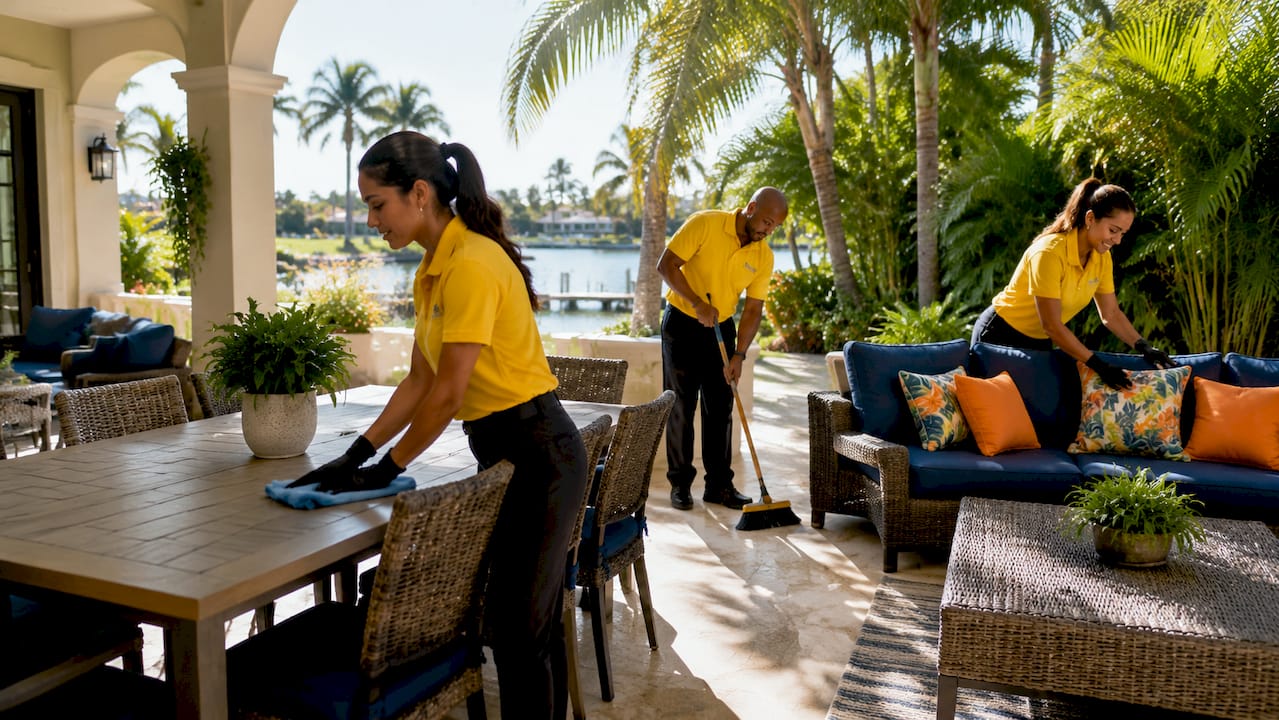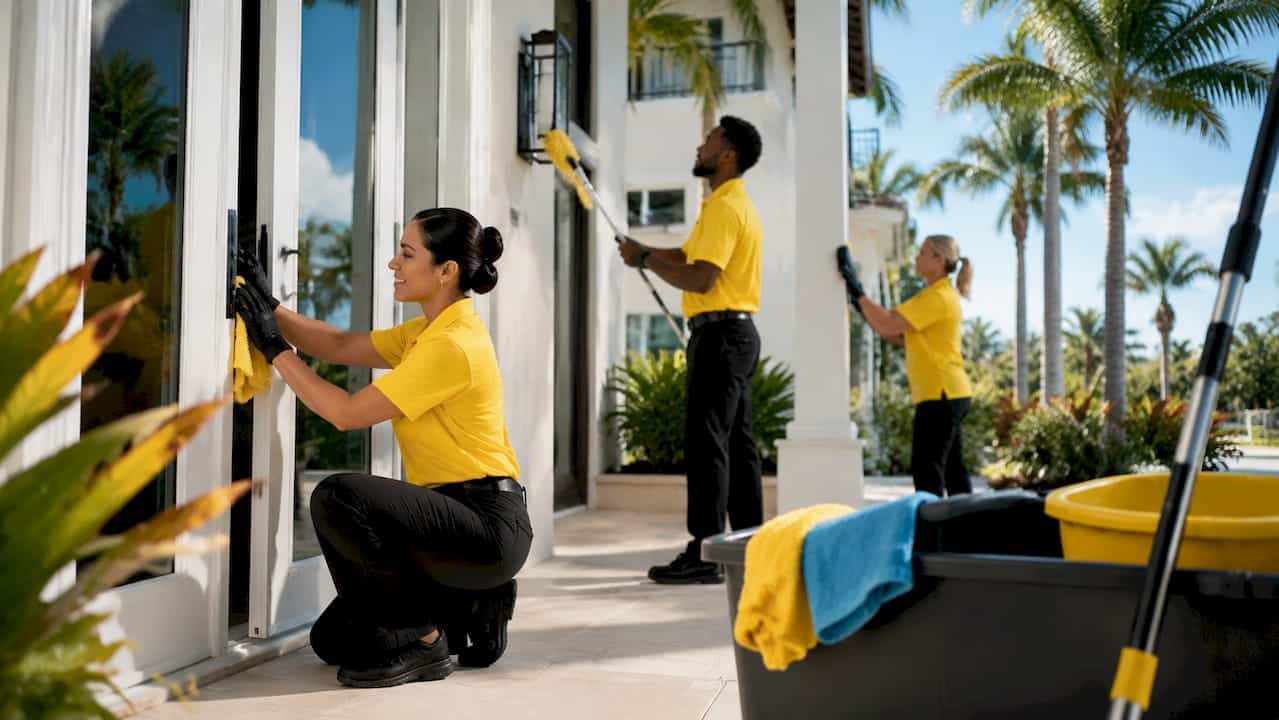
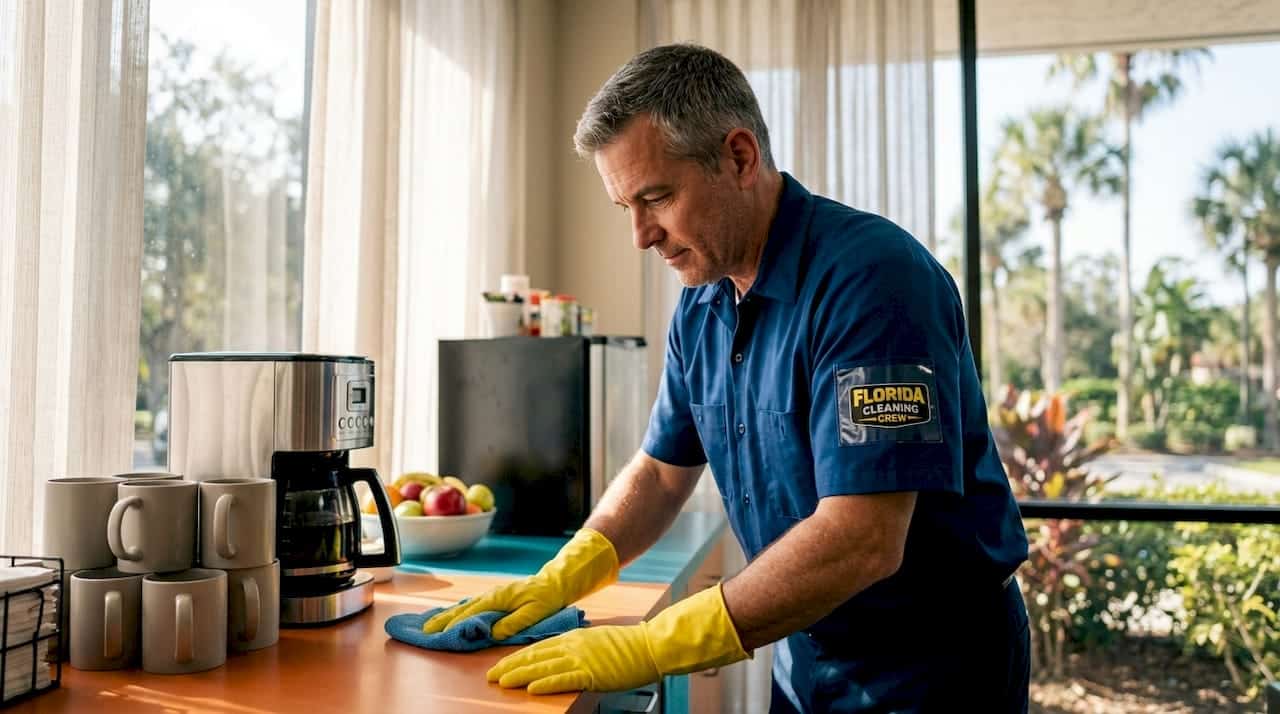
Cleaning routines for busy offices are most effective when built around three frequency tiers: daily, weekly, and monthly tasks, each matched to how fast dirt and germs actually accumulate on specific surfaces. The standard industry term for this approach is a tiered cleaning schedule, and it is the framework professional facility managers use to maintain hygiene without burning out staff or disrupting operations. Splitting daily tasks into two distinct windows, an after-hours deep clean and a midday touch-up patrol, is the single most practical change most office managers can make. This article walks you through every tier, every task, and the exact structure that keeps Tampa Bay offices clean without adding chaos to an already full day.
1. How to structure daily cleaning tasks in busy offices
Daily cleaning in a busy office must prioritize restrooms, trash removal, and high-touch surface disinfection above everything else. These three areas accumulate germs and grime the fastest, and skipping them even once creates compounding hygiene problems. Minimum effective daily cleaning covers exactly this combination: restrooms, trash, and high-touch disinfection. That is the non-negotiable baseline for any office with regular foot traffic.
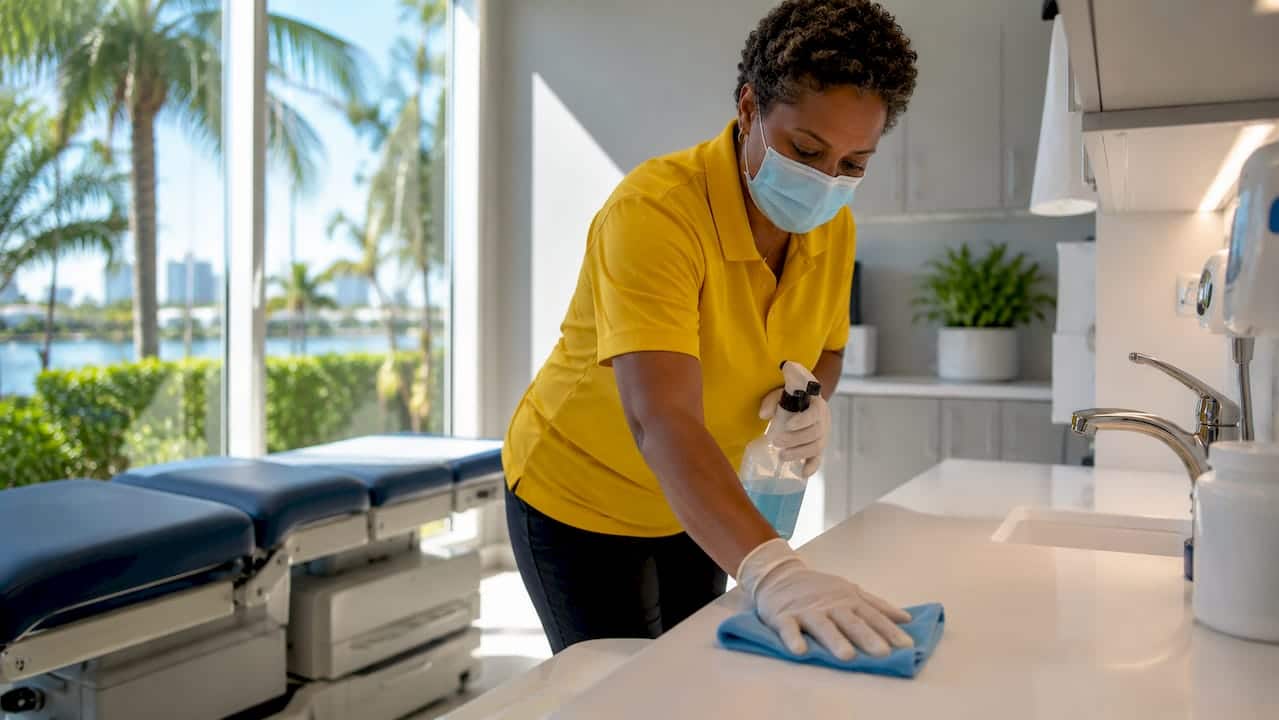
High-touch surfaces include door handles, light switches, elevator buttons, shared phones, keyboard trays, and break room appliance controls. Each of these can transfer pathogens to dozens of people before the end of a single workday. The key to actually disinfecting them, rather than just wiping them, is respecting EPA contact time. Wiping too soon reduces disinfectant effectiveness by up to 90%, which means a surface can look clean while remaining biologically active. Keep the surface visibly wet for the full dwell time listed on the product label, typically one to ten minutes depending on the disinfectant.
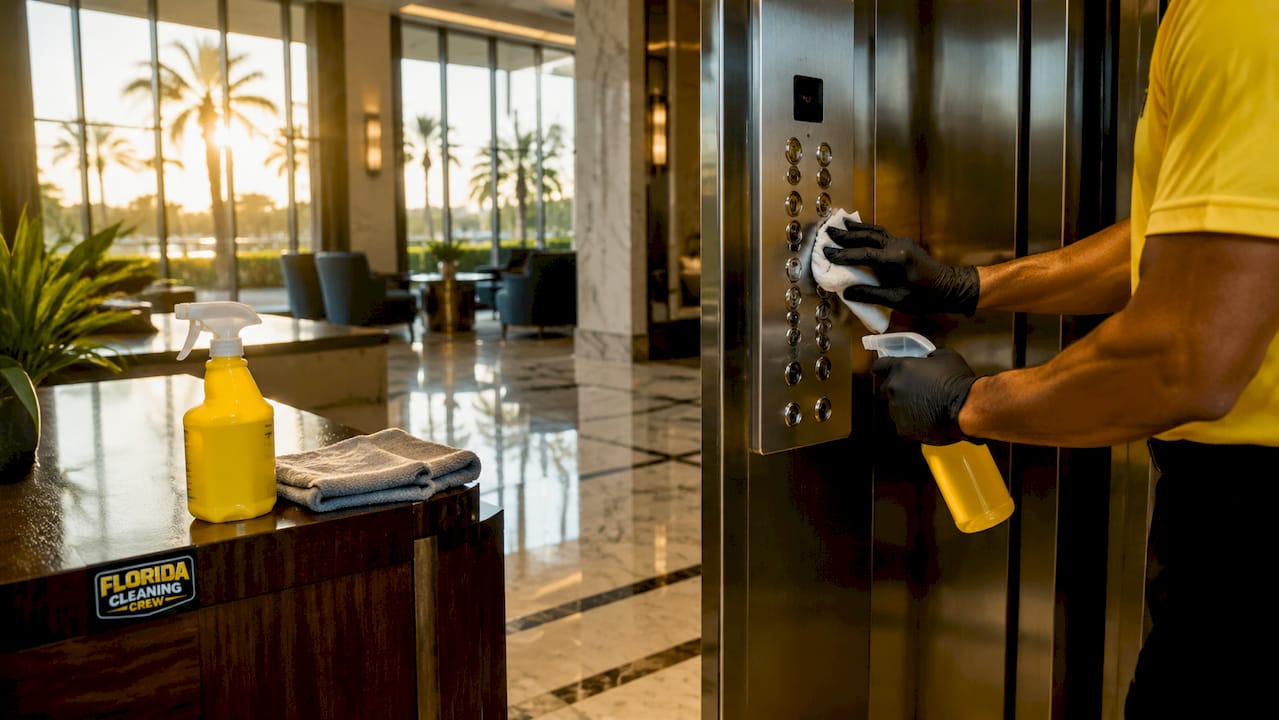
The daily routine works best when split into two windows. After-hours cleaning handles the heavy work: vacuuming, mopping, restroom scrubbing, and trash removal. The midday 15-minute patrol covers restocking paper towels and soap, wiping down break room surfaces, and doing a quick pass on high-touch points. This split prevents cleaning staff from working around employees and eliminates the rework that happens when people track through a freshly mopped floor.
Key surfaces and areas for daily attention:
- Restrooms: Toilets, sinks, faucet handles, door handles, soap and paper towel dispensers
- Break rooms: Countertops, coffee machine controls, microwave door handles, sink faucets, refrigerator handles
- Workstations: Desk surfaces, shared keyboards, phones, and monitor bezels in open-plan areas
- Entry points: Front door handles, reception desk surfaces, elevator call buttons, stairwell railings
- Trash: All bins emptied and relined, recycling sorted
Pro Tip: Use color-coded microfiber cloths to prevent cross-contamination. Assign red cloths to restrooms, blue to general surfaces, and yellow to glass and mirrors. Microfiber removes up to 99% of bacteria with just water, making it a reliable baseline tool before any disinfectant is applied.
2. Weekly cleaning routines: elevating office cleanliness beyond daily basics
Weekly cleaning addresses the dirt and grime that builds too slowly to notice day-to-day but becomes obvious over time. Weekly tasks include dusting skirting boards, window sills, mopping full floors, and cleaning microwave interiors. These tasks do not need daily attention, but skipping them for more than a week creates a visible decline in office appearance that affects both employee morale and client impressions.
Floor care is the most time-intensive weekly task. Vacuuming high-traffic carpet areas daily is reasonable, but a full vacuum of all carpeted zones plus mopping of hard floors belongs in the weekly tier. Glass partitions, interior windows, and whiteboard surfaces also fall here. These surfaces collect fingerprints and smudges that accumulate slowly but make a space look neglected when left unaddressed.
Distributing weekly tasks across multiple days prevents overload. Rather than assigning all weekly tasks to a single Friday session, spread them across the week. Mop floors on Monday and Thursday, clean glass partitions on Wednesday, and address detailed dusting on Tuesday. Scheduling weekly and monthly tasks across visits prevents skipping of laborious tasks and maintains consistent appearance standards.
The table below compares daily and weekly task scope to help you allocate time and staff correctly.
| Task category | Daily | Weekly |
|---|---|---|
| Restroom cleaning | Full clean and restock | Deep scrub of grout, tiles, and fixtures |
| Floor care | Spot clean and entry mat shake-out | Full vacuum and mop of all areas |
| High-touch disinfection | All key surfaces wiped and disinfected | Extended surface list including light switches and shared equipment |
| Dusting | Desk surfaces only | Skirting boards, window sills, vents, and shelving |
| Glass and mirrors | Spot wipe as needed | Full clean of partitions, windows, and mirrors |
| Break room appliances | Exterior wipe-down | Interior microwave, coffee machine descale, refrigerator shelf wipe |
Regular weekly cleaning also supports weekly cleaning benefits that go beyond appearance. Offices that maintain a consistent weekly schedule report fewer sick days and higher employee satisfaction scores compared to those relying on reactive cleaning alone.
3. Monthly maintenance tasks crucial for long-term office hygiene
Monthly cleaning tasks protect the long-term health of your office environment and your physical assets. These are the tasks that do not show immediate results when done but create serious problems when skipped for months at a time. Deep carpet cleaning, HVAC filter inspection, refrigerator defrosting, blind and vent dusting, and ceiling fan cleaning all belong in the monthly tier.
HVAC maintenance is the most consequential monthly task for indoor air quality. ASHRAE recommendations call for monthly inspections with pressure drop indicators guiding replacement schedules, typically quarterly under normal occupancy conditions. The minimum filter rating for commercial offices is MERV 8, but MERV 13 filters capture 99.97% of 0.3-micron particles, significantly improving air quality and reducing airborne pathogen transmission. In Tampa Bay’s humid climate, HVAC systems work harder than in drier regions, which means filter replacement cycles may need to shorten to every four to six weeks during peak summer months.
Neglecting monthly tasks does not just affect air quality. Dust accumulation on vents and blinds recirculates through the office every time the HVAC cycles on. Refrigerators with uncleaned shelves become bacterial reservoirs. Carpets that skip deep cleaning harbor allergens that standard vacuuming cannot reach. Each of these issues compounds over time and eventually requires more expensive remediation than a simple monthly cleaning session would have cost.
| Monthly task | Why it matters | Recommended tool or method |
|---|---|---|
| Deep carpet cleaning | Removes allergens and embedded grime vacuuming misses | Hot water extraction or dry compound method |
| HVAC filter inspection and replacement | Maintains air quality and system efficiency | MERV 8 minimum; MERV 13 preferred |
| Blind and vent dusting | Prevents recirculation of accumulated dust | Microfiber blind duster or vacuum brush attachment |
| Refrigerator deep clean | Eliminates bacterial growth and odors | Remove all contents, wipe shelves with food-safe disinfectant |
| Ceiling fan and light fixture cleaning | Reduces dust redistribution during operation | Extendable microfiber duster |
Pro Tip: Schedule monthly deep cleans for the first Monday of each month and align them with your slowest office period, typically early morning before staff arrive. Pair this with a digital checklist tool like Notion or a shared Google Sheet so every task is logged, assigned, and verifiable.
4. How to implement an efficient cleaning schedule in a busy office
The most common reason office cleaning schedules fail is overloading a single cleaning window with too many tasks. When one session tries to cover daily, weekly, and monthly work simultaneously, the result is rushed work, skipped tasks, and a schedule that collapses within two weeks. Cleaning schedules optimized around accumulation rates yield the best efficiency: daily attention for rapidly soiling surfaces, weekly for moderate accumulation, and monthly for slow-build grime.
The two-window daily structure is the operational backbone of any efficient cleaning schedule. After-hours deep cleaning covers vacuuming, mopping, restroom scrubbing, and trash removal without disrupting staff. The midday patrol, typically 15 minutes during the lunch hour, handles restocking, quick surface wipes, and a visual check of high-traffic areas. This structure means your office never goes a full workday without a hygiene check, and your cleaning staff never have to work around a full room of people.
For offices in Tampa, Clearwater, and St. Petersburg, the local climate adds a layer of complexity. High humidity accelerates mold growth in restrooms and break rooms, and Florida’s sandy soil means entry mats and hard floors need more frequent attention than offices in drier climates. Factoring these local conditions into your Tampa Bay cleaning frequency decisions prevents the reactive scramble that happens when a problem becomes visible before it was addressed.
Designating cleaning roles or outsourcing specific tiers is a practical move for offices with limited internal staff. Many small businesses in Tampa Bay outsource after-hours deep cleaning while handling midday patrols internally. This hybrid model reduces labor costs while maintaining professional hygiene standards. For guidance on what products and tools actually perform in a commercial setting, the Floridacc resource on effective office cleaning supplies is worth reviewing before you stock your supply closet.
Time-saving tips for busy office managers:
- Group tasks by zone, not by type. Clean everything in the restroom before moving to the break room. Zone-based cleaning reduces travel time and prevents cross-contamination.
- Pre-stage supplies the night before. Caddies stocked and ready at the start of each shift cut setup time by five to ten minutes per session.
- Use a printed or digital checklist for every session. Checklists prevent task skipping and create an accountability record. A shared Google Sheet works well for teams of two or more.
- Set a timer for the midday patrol. Fifteen minutes is enough if the scope is defined. Without a timer, patrols expand or contract unpredictably.
- Review the schedule quarterly. Office occupancy and usage patterns change. A schedule built for 15 employees may not serve 30 without adjustment.
- Separate appearance tasks from hygiene tasks. Separating appearance cleaning from hygiene cleaning ensures that when time is short, health-critical tasks are never sacrificed for cosmetic ones.
For offices that want a structured starting point, the Floridacc guide on workplace cleanliness strategies covers practical implementation steps tailored to Tampa Bay’s small business environment.
Key takeaways
Effective cleaning routines for busy offices require separating tasks by accumulation rate, splitting daily work into two windows, and protecting hygiene tasks from being crowded out by cosmetic ones.
| Point | Details |
|---|---|
| Use three frequency tiers | Assign tasks as daily, weekly, or monthly based on how fast each surface accumulates grime. |
| Split daily cleaning into two windows | Run an after-hours deep clean and a 15-minute midday patrol to cover hygiene without disrupting staff. |
| Respect disinfectant contact time | Keep surfaces wet for the full dwell time listed on the product label to achieve actual disinfection. |
| Upgrade HVAC filters to MERV 13 | MERV 13 filters significantly improve air quality and are especially important in Tampa Bay’s humid climate. |
| Separate hygiene from appearance tasks | When time is limited, prioritize restrooms, trash, and high-touch disinfection over cosmetic cleaning. |
What I’ve learned from watching offices skip the basics
I have seen the same pattern repeat itself across small businesses in Tampa Bay. The office starts with good intentions, a cleaning schedule gets written up, and within six weeks it has quietly collapsed into a single weekly blitz that misses half the tasks on the list. The reason is almost always the same: the schedule was built around convenience rather than accumulation rates.
The insight that changed how I think about office cleaning is the distinction between appearance cleaning and hygiene cleaning. Appearance tasks, like vacuuming and dusting, are visible and feel satisfying to complete. Hygiene tasks, like disinfecting door handles and scrubbing restroom fixtures, are invisible when done correctly. That invisibility makes them easy to deprioritize when time gets tight. But they are the tasks that actually protect your employees and your clients.
The midday patrol is underrated. Most office managers I talk to think of cleaning as a before-or-after-hours activity. But a 15-minute midday check, restocking soap, wiping the break room counter, doing a quick pass on the front door handle, keeps the office functional through the afternoon without requiring a full cleaning session. It also signals to employees that the workspace is actively maintained, which affects how they treat shared spaces.
My honest recommendation for any office under 5,000 square feet in Tampa, St. Petersburg, or Clearwater is to outsource the after-hours deep clean and handle midday patrols internally. The cost of professional commercial cleaning is almost always lower than the cost of a sick day, a client complaint about a dirty restroom, or the time your office manager spends trying to coordinate a cleaning schedule on top of everything else they are managing. Short team huddles to align on cleaning priorities, even five minutes at the start of a shift, improve consistency more than any checklist alone.
— Matt
How Floridacc supports busy offices in Tampa Bay
Running a tight office cleaning schedule is harder when you are also managing staff, clients, and daily operations. Floridacc works with small businesses and office managers across Tampa Bay to build customized cleaning plans that fit real schedules, not ideal ones.

Floridacc’s commercial cleaning services cover high-touch disinfection, after-hours deep cleaning, and appearance maintenance tailored to your office size and traffic patterns. Whether you need a full-service cleaning contract or support for specific tiers of your existing schedule, the team at Floridacc can build a plan around your timeline. Explore the commercial cleaning options for small businesses or request a free estimate to get a cleaning plan that actually holds up in a busy office.
FAQ
What should be cleaned daily in a busy office?
Daily cleaning must cover restrooms, trash removal, and high-touch surface disinfection including door handles, phones, and break room appliance controls. These areas accumulate germs fastest and form the non-negotiable baseline of any office cleaning checklist.
How long should disinfectant stay on a surface to work?
Most EPA-registered disinfectants require a contact time of one to ten minutes to be effective. Wiping a surface before the dwell time is complete can reduce disinfectant effectiveness by up to 90%.
How do you clean a busy workplace without disrupting staff?
Split daily cleaning into two windows: an after-hours deep clean for vacuuming, mopping, and restroom scrubbing, and a 15-minute midday patrol for restocking and quick surface wipe-downs. This structure keeps cleaning activity out of peak work hours.
How often should office HVAC filters be replaced?
Under normal commercial occupancy, HVAC filters should be inspected monthly and replaced quarterly at minimum. In high-occupancy offices or humid climates like Tampa Bay, replacement every four to six weeks is more appropriate, especially with MERV 13 filters.
What is the difference between weekly and monthly office cleaning tasks?
Weekly tasks address moderate accumulation: full floor vacuuming and mopping, glass partition cleaning, and detailed dusting of skirting boards and window sills. Monthly tasks cover slow-build maintenance like deep carpet cleaning, HVAC filter replacement, blind dusting, and refrigerator deep cleaning.