A complete office cleaning scope of work is a zone-by-zone task matrix with assigned frequencies, a staffing and schedule attachment, equipment and product specifications, measurable performance standards, a clear exclusions list, and pricing plus change-order rules.
Three documents make it complete:
- Scope matrix: every task mapped to every zone with a daily, weekly, monthly, or quarterly frequency assigned
- Cleaning schedule: shift times, crew size per shift, and supervisor ratios for each facility
- Performance protocols: named KPIs (timeliness, coverage rate, corrective-action window), inspection cadence, and documentation requirements
OSHA 1910.141, CDC high-touch guidance, and the GSA National Custodial Specification each inform specific line items in the SOW. Florida Cleaning Crew serves Tampa Bay offices and can walk you through a site-specific scope before you finalize any contract.
Key Takeaways
A defensible office cleaning scope of work requires a zone-by-task-by-frequency matrix, a staffed cleaning schedule, named KPIs with corrective-action timelines, and explicit exclusions that prevent mid-contract disputes.
| Point | Details |
|---|---|
| Build a scope matrix first | Assign every task to every zone with a daily, weekly, monthly, or quarterly frequency before soliciting bids. |
| Require staffing in the schedule | Per GSA guidance, the cleaning schedule must list times, crew size, and supervisor ratios, not just task names. |
| Name restrooms and dispensers explicitly | Vague restroom language is the leading source of disputes; write fixture disinfection and dispenser restock as separate line items. |
| Include KPIs and corrective-action timelines | A 90% inspection pass rate and a 24-hour corrective-action window give you contractual leverage when service falls short. |
| Florida Cleaning Crew | Licensed, insured Tampa Bay provider offering nightly janitorial, day porter, deep cleaning, and green-product options with a satisfaction guarantee. |
Table of Contents
- What is a commercial cleaning SOW and when do you need one?
- What does your office cleaning scope cover, room by room?
- How do you decide cleaning frequency for each area?
- What should be in-scope and what should you exclude?
- How should you specify the cleaning schedule, staffing, and equipment?
- What performance standards and inspections belong in the SOW?
- How is office cleaning priced, and what does a 2,000 sq ft office cost?
- A copyable SOW template and area-task matrix for your RFP
- How do OSHA and CDC guidance shape your SOW requirements?
- A Tampa Bay provider’s honest take on scope problems
- Florida Cleaning Crew covers the full scope, from nightly service to deep cleans
- Sources
- FAQ
What is a commercial cleaning SOW and when do you need one?
A scope of work is a contract attachment that converts cleaning expectations into enforceable line items organized by area, task, and frequency. It is not a one-page brief that says “nightly cleaning included.” It is the document that tells a vendor exactly what to clean, how often, with what products, and to what measurable standard.
The difference matters at bid time. A one-line description lets every vendor interpret the work differently. One bidder prices three nights per week; another prices five. One includes restroom dispenser restocking; another does not. You cannot compare those bids fairly, and the low bid almost always wins on paper while under-delivering in practice.
Use a formal SOW when:
- Issuing an RFP for a building over 50,000 rentable square feet or a multi-tenant property
- Onboarding a new vendor to replace an existing one mid-lease
- Managing a tenant fit-out where cleaning responsibilities are split between landlord and tenant
- Documenting expectations to avoid mid-contract disputes
- Renewing a contract and wanting to reset performance standards
For a small single-tenant office under 5,000 square feet, a detailed checklist attached to a simple service agreement often covers the same ground. The principle is identical: line items by area, not a vague blanket description.
What does your office cleaning scope cover, room by room?
The most practical way to build a commercial cleaning checklist is to walk the building zone by zone and assign tasks at each cadence. Below is a compact daily-task reference, followed by periodic tasks that apply across zones.
Daily task matrix by zone
| Zone | Daily tasks |
|---|---|
| Reception / lobby | Wipe reception desk and counters, empty trash, spot-clean glass entry doors, vacuum or sweep hard floors |
| Private offices | Empty trash, wipe desks and phones, vacuum carpet or sweep hard floor |
| Open-plan workstations | Empty trash at each station, wipe shared surfaces, vacuum aisles |
| Meeting rooms | Wipe table and chairs, empty trash, clean whiteboard ledge, reset furniture |
| Restrooms | Disinfect fixtures (toilets, sinks, handles), mop floor, restock soap, paper towels, and toilet paper, empty trash |
| Breakroom / kitchen | Wipe counters and appliance exteriors, empty trash, clean sink, sweep or mop floor |
| Corridors and common areas | Sweep or vacuum, spot-clean walls and light switches, empty any trash receptacles |
| Elevators | Wipe interior panels and buttons, sweep or mop floor |
| Stairs | Sweep treads and landings, wipe handrails |
Periodic tasks (supplement the daily matrix):
- Weekly: Dust window sills, blinds, and light fixtures; clean interior partition glass; sanitize breakroom microwave interior; damp-mop hard floors in low-traffic areas
- Monthly: Vacuum upholstered furniture, clean interior door frames, detail elevator tracks, scrub grout in restrooms
- Quarterly: Carpet extraction in high-traffic zones, strip and recoat hard floors, clean ceiling vents and diffusers
- Annual: Full carpet extraction building-wide, exterior window washing (where accessible), floor strip and wax
Pro Tip: Phrase disinfection triggers precisely. Per CDC guidance, routine cleaning is sufficient in most situations. Reserve disinfection language for high-touch surfaces on a set cadence and for any surface that is visibly soiled or involved in a confirmed illness event. Writing “clean daily; disinfect high-touch surfaces nightly; disinfect all surfaces within four hours of a confirmed illness report” keeps labor costs predictable and prevents overuse of disinfectants.
Standard office cleaning scopes treat trash removal, restroom servicing, kitchenette reset, high-touch wipe-downs, vacuuming, and hard-floor care as baseline nightly tasks. Carpet extraction, window washing, floor strip-and-wax, and day porter services are typically priced as separate line items.
How do you decide cleaning frequency for each area?
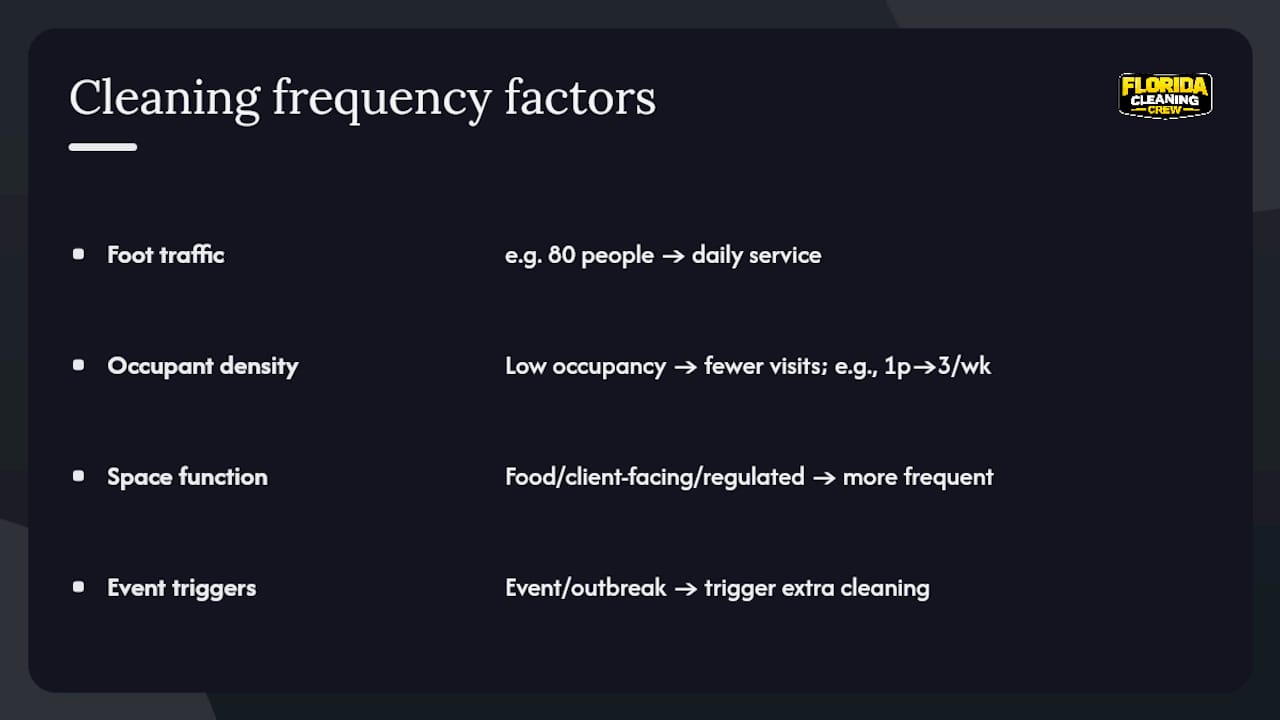
Frequency decisions come down to four variables: foot traffic volume, occupant density, function of the space (food, client-facing, or regulated), and any event or outbreak triggers. A restroom serving 80 people needs daily service regardless of how clean it looks. A private office used by one person two days a week may need only three visits per week.
Frequency decision matrix
| Zone / task type | Traffic / risk level | Recommended cadence |
|---|---|---|
| Restrooms | High (any occupancy) | Daily minimum; 2x daily for 100+ users |
| Reception / lobby | High, client-facing | Daily |
| Open-plan workstations | High, dense | Daily |
| Meeting rooms | Variable | Daily reset; deep clean weekly |
| Breakroom / kitchen | High, food service | Daily; weekly deep clean |
| Private offices | Low to medium | 3x weekly or daily depending on density |
| Corridors and stairs | Medium | Daily sweep; weekly mop |
| Elevators | High, high-touch | Daily; wipe buttons 2x daily in dense buildings |
| Carpet (extraction) | Periodic | Quarterly high-traffic; annually building-wide |
| Hard floors (strip/wax) | Periodic | Annually or as finish degrades |
| Windows (interior) | Periodic | Monthly spot; quarterly full |
Factors that shift the cadence up:
- Food service or catering in the building
- Client-facing spaces where appearance affects business outcomes
- Seasonal events, trade shows, or high-occupancy periods
- A confirmed illness incident (triggers a one-time disinfection run)
Factors that allow a lighter cadence:
- Low-density private offices with infrequent occupancy
- Storage rooms or server rooms with no regular foot traffic
- Conference rooms booked fewer than three times per week
For event-driven surges, write change-order language directly into the SOW: “Contractor shall provide surge staffing within 24 hours of written notice for events exceeding [X] attendees. Surge pricing shall be calculated at the hourly rate stated in Exhibit B.” That clause prevents a renegotiation every time the office hosts a client dinner.
The GSA National Custodial Specification treats the cleaning schedule as a living document that must be updated when contract changes or performance issues require adjustments. Build that expectation into your SOW from day one. For practical scheduling templates, cleaning routines for busy offices offers a useful starting framework.
What should be in-scope and what should you exclude?
Vague scope language is where contracts fall apart. The fix is two explicit lists: what the contractor is responsible for, and what they are not. Both belong in the SOW as named line items.
In-scope items to specify by name:
- Trash removal from all receptacles, including liner replacement
- Restroom servicing: fixture disinfection, floor mopping, and dispenser restocking (soap, paper towels, toilet paper)
- Daily high-touch wipe-downs: door handles, light switches, elevator buttons, shared equipment controls
- Floor care routine: vacuuming carpeted areas, sweeping and mopping hard floors
- Kitchenette reset: counter wipe, sink clean, appliance exterior wipe, trash removal
- Interior partition glass and lobby glass at reachable height
- Whiteboard cleaning in meeting rooms
Common exclusions to spell out:
- Heavy furniture moves (beyond repositioning chairs after a meeting)
- Biohazard remediation (blood, bodily fluids, hazardous materials)
- HVAC duct cleaning and filter replacement
- Interior window cleaning above reachable height without lift equipment
- Interior refrigerator cleanouts unless specifically requested and priced separately
- Pest control
- Exterior grounds, parking lots, or building facade cleaning unless listed
For breakroom deep cleaning specifics, commercial kitchen deep clean guidance covers what to include when food prep areas are part of the scope. Window cleaning add-ons are covered in detail in this office window cleaning guide.
Client responsibilities to state explicitly:
- Provide after-hours access (keys, fobs, alarm codes) and update the contractor within 24 hours of any access change
- Maintain a stocked janitorial closet or designate a supply storage area
- Remove or secure confidential documents before cleaning shifts begin
- Designate restricted areas (server rooms, executive suites, secure storage) and provide written access protocols
- Notify the contractor of any illness events within four hours so disinfection can be triggered
The restroom line item deserves extra attention. Industry checklists consistently flag vague restroom language as the leading source of mid-contract disputes. Write it as: “Contractor shall disinfect all toilet fixtures, sinks, and faucet handles; mop floors with an approved disinfectant; and restock soap, paper towels, and toilet paper to full capacity at each visit.”
How should you specify the cleaning schedule, staffing, and equipment?
A cleaning schedule is not just a list of tasks. Per the GSA National Custodial Specification, it must identify activities, locations, times, and associated staffing for each facility. If your SOW does not require times and staffing, bidders can under-resource by estimating fewer hours than the work actually takes.
Sample staffing structure by shift type
| Shift type | Coverage | Crew size | Notes |
|---|---|---|---|
| Night janitorial | After hours (6 PM to 10 PM) | 1 FTE per building or floor | Standard for most offices |
| Day porter | Business hours | 1 FTE per building or floor | Restroom checks, spills, lobby upkeep |
| Event coverage | As scheduled | Add 1 FTE per 50 attendees | Priced per event in Exhibit B |
| Periodic deep clean | Monthly or quarterly | Full crew + supervisor | Carpet, floors, high-level dusting |
Day porter vs. janitorial is a distinction worth writing into the SOW explicitly. Janitorial work happens after hours and covers the full nightly scope. A day porter works during business hours, handling restroom checks, spill response, lobby upkeep, and trash runs between the nightly visits. They are not interchangeable. A building with heavy daytime foot traffic, a food service area, or a client-facing lobby often needs both.
Equipment and product specifications to require:
- Vacuum class: HEPA-filtered commercial upright or backpack vacuum for carpeted areas
- Disinfectants: EPA-registered products appropriate for the surface type; SDS sheets available on request
- Microfiber policy: color-coded microfiber cloths by zone (restrooms, kitchen, general surfaces) to prevent cross-contamination
- Green product options: contractor must be able to provide a product list using Green Seal or EPA Safer Choice certified products on request
- Mop system: flat microfiber mop with clean-head-per-floor policy, or single-use mop heads for restrooms
Require vendors to submit a labor methodology answer with their bid: how many FTEs per shift, supervisor ratio, and how they calculate hours from the scope matrix. RFP best practice identifies this as the single most effective way to reveal whether a bidder can actually staff the account. For a broader look at what products actually perform in office settings, this office cleaning supplies guide is worth reviewing before you finalize your product spec.
What performance standards and inspections belong in the SOW?
Performance language without a measurement mechanism is just aspiration. Your SOW needs named KPIs, an inspection regime, and a corrective-action path with specific timelines.
KPIs to include:
- Timeliness: Contractor completes all scheduled tasks within the designated shift window on at least 95% of service visits.
- Coverage rate: All zones listed in the scope matrix are serviced on their assigned cadence, verified by inspection log.
- Supply restock compliance: Dispensers (soap, paper towels, toilet paper) are at full capacity at the end of each restroom service visit.
- Inspection pass rate: Scheduled walkthroughs result in a pass score of 90% or higher on the agreed inspection checklist.
- Corrective-action response time: Contractor addresses any failed inspection item within 24 hours of written notice; critical items (restroom out of service, safety hazard) within four hours.
Inspection regime:
- Scheduled walkthroughs: Buyer or property manager conducts a formal walkthrough monthly using the agreed checklist; contractor supervisor attends.
- Random QA checks: Buyer may conduct unannounced spot checks at any time; results are logged and shared with the contractor within 48 hours.
- Tenant feedback loop: A simple digital form (Google Forms or equivalent) sent to building occupants quarterly; results shared with contractor.
- Required documentation: Contractor maintains daily service logs, supply consumption logs, and an updated cleaning schedule; all documents available to buyer within 24 hours of request.
Corrective-action template language:
“Upon written notice of a missed or substandard task, Contractor shall remedy the deficiency within 24 hours at no additional charge. Failure to remedy within 24 hours entitles Buyer to a service credit equal to one day’s prorated contract value for each day the deficiency persists. Three uncorrected deficiencies within a 30-day period constitute grounds for contract termination with 10 days’ written notice.”
Pro Tip: Build the inspection checklist into the SOW as Exhibit C rather than leaving it to the contractor. A contractor-supplied checklist will almost always pass. A buyer-supplied checklist tied to the scope matrix holds the contractor to the actual line items they agreed to deliver.
How is office cleaning priced, and what does a 2,000 sq ft office cost?
Pricing is built from labor hours, not square footage alone. Square footage is a starting estimate; the actual cost comes from how many hours the scope requires, the local wage rate, supply costs, and any specialty services.
Primary cost drivers:
- Hours required: derived from the scope matrix (tasks × time per task × frequency per month)
- Local wage and benefit costs: varies by market; Tampa Bay rates reflect Florida’s labor market
- Frequency: nightly service costs roughly twice as much as three-nights-per-week service
- Specialty services: carpet extraction, floor strip-and-wax, and window washing are priced separately
- Supply costs: typically a markup on consumables (liners, paper products, cleaning chemicals)
- Insurance and bonding: general liability, workers’ compensation, and bonding premiums are built into the rate
Worked example: 2,000 sq ft small office, nightly service
Specialty services like quarterly carpet extraction or annual floor refinishing are quoted separately.
Bid-comparison guidance: Require every vendor to respond against the same scope matrix and submit a labor methodology write-up. RFP best practice shows that a wide bid spread almost always signals that bidders interpreted the scope differently. When you supply a scope matrix, the spread narrows and the low bid is far more likely to reflect actual staffing rather than optimistic guessing. For more on ROI and hiring considerations, this commercial office cleaning guide covers the full picture. Property managers can also find practical contract framing in this property management cleaning contracts guide.
A copyable SOW template and area-task matrix for your RFP
Use the preamble and matrix below as Exhibit A in your contract or RFP. Edit the bracketed fields for your building.
SOW preamble (editable):
“This Scope of Work governs janitorial and cleaning services for [Building Name], located at [Address], comprising approximately [X] rentable square feet across [X] floors. The term of this agreement is [start date] through [end date], renewable annually. Contractor shall perform all tasks listed in the Area-Task-Frequency Matrix (Exhibit A) at the frequencies specified, using the equipment and products described in Exhibit B. Contractor shall submit a cleaning schedule per the GSA National Custodial Specification format within five business days of contract execution and update it within 48 hours of any scope change.”
Area-task-frequency matrix (Exhibit A):
Suggested contract clauses:
- Labor floor: Contractor shall staff a minimum of [X] FTEs per shift as specified in the cleaning schedule; substitutions require 24-hour written notice.
- Insurance minimums: General liability $1,000,000 per occurrence; workers’ compensation per Florida statutory limits; contractor provides certificates within five days of execution.
- Performance measurement: Buyer conducts monthly inspections using Exhibit C checklist; contractor must achieve 90% pass rate.
- Change-order protocol: Any scope addition or reduction requires written change order signed by both parties before work begins; pricing per Exhibit B unit rates.
- Termination for repeated failures: Three uncorrected inspection failures within 30 days entitle Buyer to terminate with 10 days’ written notice.
For mixed-use buildings where scope responsibilities are split across tenants, this guide on office space cleaning for mixed-use properties covers how to structure the scope attachments.
How do OSHA and CDC guidance shape your SOW requirements?
Regulatory guidance does not write your SOW for you, but it does tell you which line items are non-negotiable and how to phrase them defensibly.
OSHA 1910.141 requires that all places of employment be kept clean to the extent the nature of the work allows and that floors be maintained in a dry condition as far as practicable. The standard also requires that washing facilities and supplies (hand soap, running water, towels or dryers) be provided and maintained. That language directly supports three SOW requirements: a named restroom servicing line item, a floor-dryness standard for mopped areas, and a dispenser restock obligation. OSHA 1910.141 is the citation to include in your RFP when explaining why restroom servicing is a mandatory scope item rather than an optional add-on.
The practical translation: write “Contractor shall mop restroom floors with an EPA-registered disinfectant and leave floors dry at the end of each service visit” rather than copying OSHA text verbatim. OSHA says “practicable”; your SOW says exactly what that means for your building.
CDC guidance recommends focusing routine cleaning on high-touch surfaces and reserving disinfection for visibly soiled areas or illness events. Higher-traffic spaces may warrant more frequent cleaning or added disinfection. The CDC’s facility cleaning guidance lists examples of high-touch surfaces and advises scheduled cleaning of those points over indiscriminate disinfection of every surface.
SOW translation for CDC guidance:
- “Contractor shall clean high-touch surfaces (door handles, light switches, elevator buttons, shared equipment controls, restroom fixtures) on every service visit.”
- “Contractor shall disinfect high-touch surfaces nightly using an EPA-registered disinfectant.”
- “Contractor shall initiate a full-surface disinfection of any affected zone within four hours of written notice of a confirmed illness event.”
- “Routine disinfection of low-touch surfaces (walls, ceilings, floors in non-restroom areas) is not required unless visibly soiled.”
That four-line block converts CDC guidance into enforceable trigger conditions without importing the entire CDC document into your contract. For historical context on how cleaning protocols evolved around illness response, this overview of cleaning in COVID-19 protocols explains the operational shift that shaped current best practices.
A Tampa Bay provider’s honest take on scope problems
Most scope disputes I see come from three places: a vague daily line that says “clean offices,” a missing dispenser restock obligation, and no stated limit on interior glass.
“Clean offices” means nothing enforceable. One contractor vacuums and empties trash. Another wipes every surface and sanitizes phones. Both are technically compliant. The fix is a task list per zone, not a zone name with no tasks attached.
Dispenser restock is the most commonly dropped line item in small-office contracts. The contractor cleans the restroom but leaves an empty soap dispenser because restocking was never written in. OSHA requires those supplies to be maintained. Write it in.
Interior glass limits matter in Tampa Bay buildings with floor-to-ceiling windows or high atriums. If you do not specify “interior glass at reachable height only,” you will get a dispute when the contractor refuses to clean the 20-foot atrium glass without a lift, and you will have no contractual ground to stand on.
For local hiring, always ask for references from accounts in Tampa, Clearwater, or St. Petersburg specifically. A vendor with a strong track record in Orlando may not have the local crew depth to cover a St. Pete office park reliably. Check general liability and workers’ compensation certificates before the first visit, not after. Florida requires workers’ compensation for most employers, and a contractor without it exposes your business to liability if a worker is injured on your property.
Request a walkthrough before finalizing any scope. A good provider will flag things you missed: a janitorial closet that needs a mop sink, a restroom with a broken dispenser mount, or a floor finish that needs stripping before any maintenance program will work. That walkthrough is free information. Use it.
Florida Cleaning Crew covers the full scope, from nightly service to deep cleans
If you have built your scope matrix and are ready to get bids from a vetted local provider, Florida Cleaning Crew handles the full range of services that belong in a commercial SOW: nightly janitorial, day porter coverage, event cleanup, periodic deep cleaning, commercial carpet extraction, window washing, and green-product options on request.

The crew is licensed and insured, carries the required Florida workers’ compensation coverage, and backs every job with a satisfaction guarantee. For Tampa Bay businesses in Tampa, Clearwater, and St. Petersburg, that means you get a local team that knows the market, can provide local references, and will show up for a scope walkthrough before you sign anything.
The commercial cleaning contract guide on the Florida Cleaning Crew site walks through contract-level language for SOW attachments, KPI clauses, and change-order terms. When you are ready to move from template to signed contract, request a free quote for commercial cleaning services and ask for a walkthrough at the same time.
Sources
These primary sources are worth citing directly in your RFP or contract when you need regulatory backing for specific line items.
- 1910.141 – Sanitation. | Occupational Safety and Health Administration
- When and How to Clean and Disinfect a Facility | CDC
- Office Cleaning Checklist: What’s in a Scope of Work – Avanti Green Eco Cleaning
When citing these in a contract, reference the specific section or page rather than the document title alone. “Per OSHA 1910.141(a)(1)” is enforceable language. “Per OSHA guidelines” is not.
FAQ
What is included in an office cleaning scope of work?
A complete office cleaning scope of work includes a zone-by-task-by-frequency matrix, a staffed cleaning schedule, equipment and product specifications, performance KPIs, a corrective-action protocol, and an explicit exclusions list. Standard baseline tasks include trash removal, restroom servicing with dispenser restock, high-touch wipe-downs, vacuuming, and hard-floor care; carpet extraction, window washing, and day porter services are typically priced separately.
How much should I expect to pay to clean a 2,000 sq ft office?
For a 2,000 sq ft office on a nightly five-day schedule, a realistic monthly estimate accounts for labor, supplies, insurance overhead, and supervisor time. Specialty services like quarterly carpet extraction are quoted as separate line items.
What is the difference between a day porter and a janitorial service?
Janitorial service happens after hours and covers the full nightly scope: trash, floors, restrooms, and surface cleaning. A day porter works during business hours handling restroom checks, spill response, lobby upkeep, and trash runs between nightly visits. Dense offices, food service areas, and client-facing lobbies often need both.
How do OSHA and CDC guidance affect what goes in the scope?
OSHA 1910.141 requires workplaces to be kept clean and floors maintained dry, which supports naming restroom servicing and floor-dryness standards as mandatory SOW line items. CDC guidance recommends focusing routine cleaning on high-touch surfaces and reserving disinfection for visibly soiled areas or illness events, which informs how you write trigger language in the scope.
How do I make sure bids are comparable when I send out an RFP?
Provide every bidder with the same scope matrix (task × zone × frequency) and require a labor methodology answer that explains FTEs per shift and how hours are calculated. RFP best practice shows that a missing scope matrix is the primary reason bids vary widely and low bids under-deliver; a shared matrix narrows the spread and makes staffing verifiable before you sign.