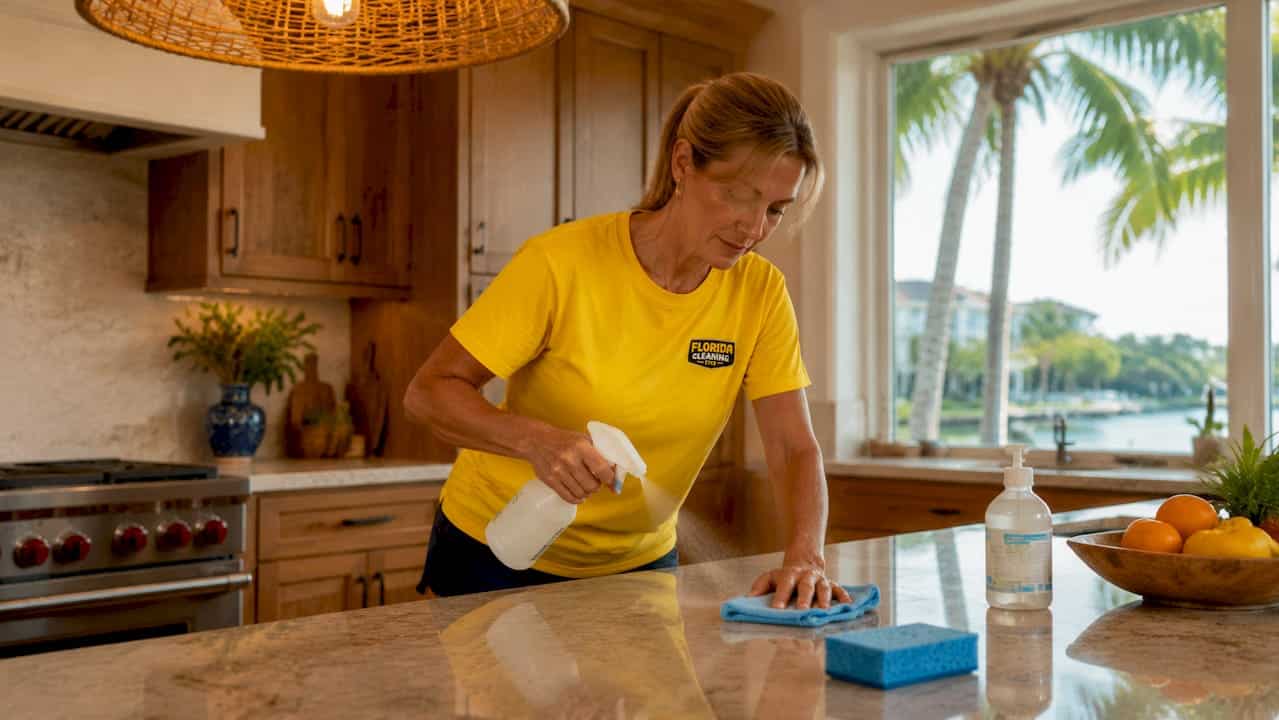
Cleaning and disinfecting surfaces is a proven method for reducing SARS-CoV-2 transmission, and the role of cleaning in COVID-19 protocols goes well beyond wiping down counters. Research confirms that viable virus can survive on high-touch surfaces near infected individuals, making targeted surface decontamination a direct line of defense. The EPA and CDC have both published authoritative frameworks, including the EPA’s List N and CDC’s Project Firstline, that define exactly which products work and how to use them. For Tampa Bay homeowners and small business owners, understanding these guidelines is not optional. It is the foundation of any credible health and safety plan.
What is the role of cleaning in COVID-19 protocols?
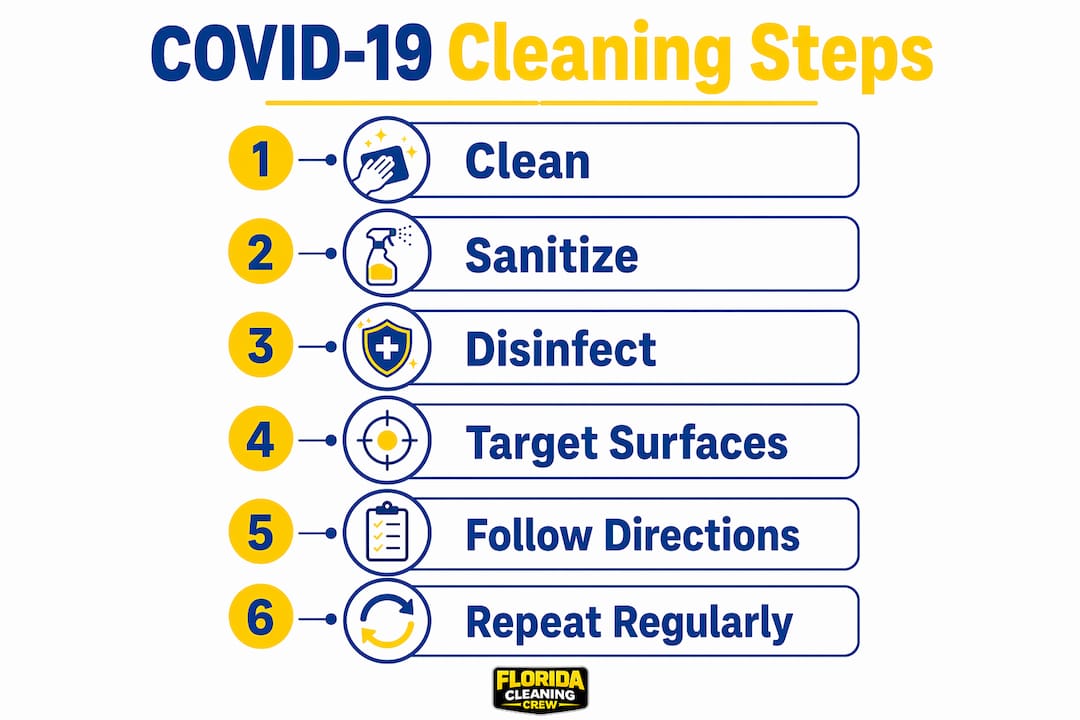
Cleaning, sanitizing, and disinfecting are three distinct steps, and confusing them is one of the most common reasons COVID-19 cleaning protocols fail. Each term describes a different level of pathogen removal, and the order in which you perform them determines whether your effort actually works.
Cleaning physically removes dirt, grease, and organic matter from surfaces using soap or detergent and water. It does not kill viruses. What it does is strip away the biological debris that would otherwise block a disinfectant from reaching the surface. Cleaning before disinfecting is not optional. Skipping this step is like applying sunscreen over a layer of sand. The product cannot do its job.
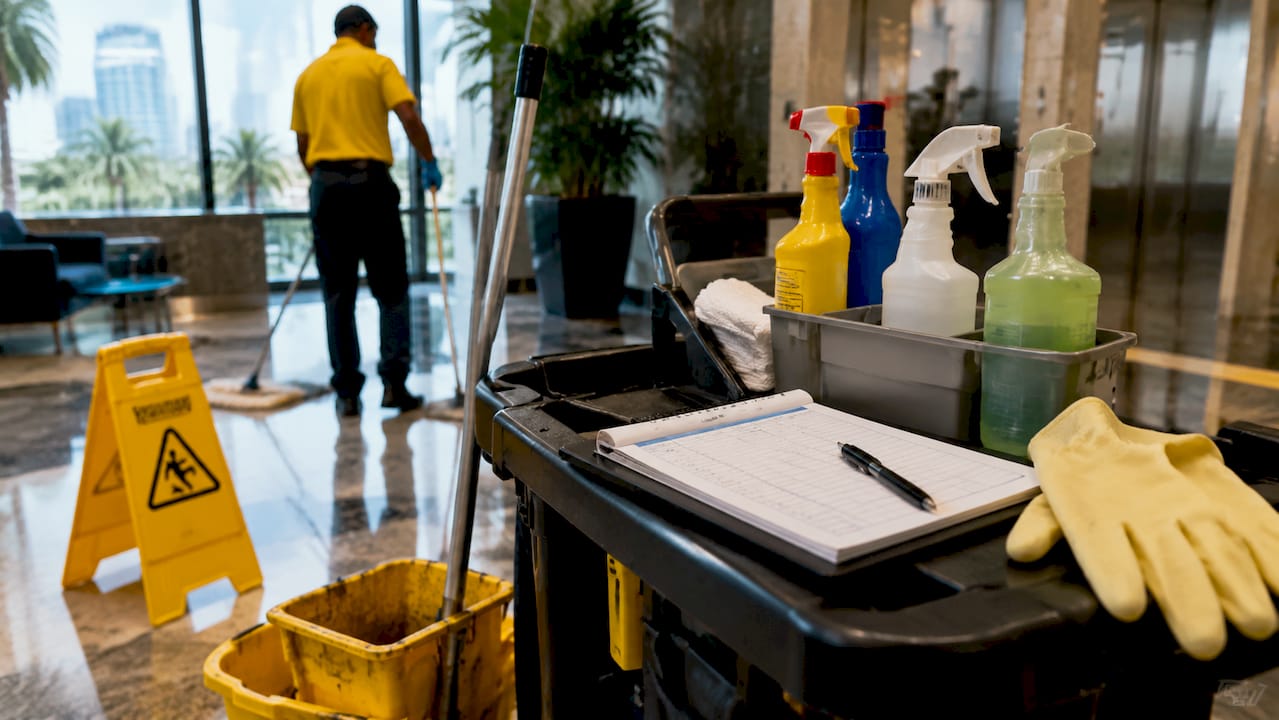
Sanitizing reduces the number of germs on a surface to levels considered safe by public health standards. It is appropriate for food-contact surfaces and lower-risk areas. However, sanitizing does not necessarily eliminate all viruses, including SARS-CoV-2, which is why it is not a substitute for disinfection in higher-risk situations.
Disinfecting kills viruses and bacteria on surfaces using EPA-registered chemical agents. It requires the right product, applied to the right surface, left wet for a specific contact time. Miss any one of those variables and the disinfectant does not perform as tested.
- Cleaning removes physical debris and organic matter
- Sanitizing reduces germs to safe levels for general use
- Disinfecting kills pathogens, including SARS-CoV-2, when used correctly
- The correct sequence is always: clean first, then disinfect
Pro Tip: When someone in your home is sick, increase disinfection to at least once daily on all high-touch surfaces. Do not wait for visible dirt. The virus is invisible, and so is the risk.
Which cleaning products are proven effective against SARS-CoV-2?
Product selection is where many people make costly mistakes. Not every spray bottle labeled “antibacterial” or “disinfecting” is registered to work against SARS-CoV-2. The EPA’s List N is the authoritative reference for this.
The EPA’s List N tool provides a searchable database of disinfectants that meet EPA criteria for use against SARS-CoV-2. Every product on the list has an EPA Registration Number printed on its label. You can enter that number into the List N search tool to confirm the product qualifies. This is the only reliable way to verify a disinfectant’s effectiveness against the virus.
Three categories of disinfectants appear most frequently on List N:
- Sodium hypochlorite (bleach-based solutions): Effective at concentrations of 0.1% for general surfaces and 0.5% for blood or bodily fluid spills. Always dilute according to label instructions and never mix with ammonia or other cleaners.
- Alcohol-based solutions: Products containing at least 70% isopropyl or ethyl alcohol are effective on hard, non-porous surfaces. They evaporate quickly, so contact time is critical.
- Hydrogen peroxide-based products: Effective and generally safer for use around people and pets when used at appropriate concentrations. Many commercial formulations are on List N.
Following label directions is not a suggestion. Disinfectants only work when the surface stays wet for the full contact time specified. That time ranges from 30 seconds to 10 minutes depending on the product. Wiping a surface dry immediately after application defeats the purpose entirely.
Pro Tip: Check your office or home supply cabinet against the EPA’s List N before your next cleaning session. Many popular store-brand sprays are not registered for SARS-CoV-2. Swap them out for a verified product and keep the label on file for compliance documentation.
For Tampa Bay business owners who want a clear breakdown of what to stock, the office cleaning supplies guide from Floridacc covers product categories that hold up in commercial settings.
How does targeting high-touch surfaces improve COVID-19 cleaning protocols?
Not all surfaces carry equal risk. Research published in 2025 found that nearly half of surface samples collected near COVID-19 patients tested positive for SARS-CoV-2 RNA, and viable virus was isolated in 3% of those samples. That 3% matters because viable virus titers on high-touch surfaces can exceed the human infectious dose. This means the risk is real, not theoretical, and it concentrates in predictable locations.
Targeting those locations is more effective than cleaning every surface uniformly. The surfaces that carry the highest contamination risk in homes and businesses share one characteristic: frequent hand contact.
| Surface type | Setting | Recommended frequency |
|---|---|---|
| Doorknobs and handles | Home and office | At least once daily; more if occupancy is high |
| Light switches | Home and office | Once daily minimum |
| Countertops and desks | Kitchen, bathroom, workspace | After each use when someone is sick; daily otherwise |
| Shared electronics (keyboards, phones) | Office | After each user; daily at minimum |
| Bathroom fixtures | Home and office | Once daily; twice daily when someone is ill |
| Elevator buttons and handrails | Commercial buildings | Every 2 to 4 hours in high-traffic settings |
Cleaning and disinfecting high-touch surfaces works best as part of a layered defense that also includes hand hygiene and ventilation. No single measure eliminates all risk. Cleaning reduces the viral load on surfaces. Hand hygiene prevents transfer from surfaces to mucous membranes. Ventilation dilutes airborne particles. All three work together. Removing one weakens the others.
The impact of cleaning on indoor air quality is also worth considering. Cleaning products that release volatile compounds can degrade air quality, which is why ventilating the space during and after cleaning is a practical step, not just a health precaution.
What are best practices for executing cleaning protocols at home and at work?
Preparation determines whether a cleaning protocol actually gets followed. The CDC’s Project Firstline training program makes this explicit: effective cleaning starts with preparation, including supply readiness, staff training, and workflow planning before anyone picks up a mop or spray bottle. This principle applies equally to a Tampa homeowner and a Clearwater restaurant owner.
Here is how to build a protocol that holds up in practice:
- Gather supplies before you start. Running out of disinfectant mid-clean means surfaces get missed. Keep a dedicated cleaning kit stocked with EPA List N products, microfiber cloths, gloves, and a spray bottle for diluted solutions.
- Work from clean to dirty. Start in lower-risk areas and move toward higher-risk zones. In a home, that means bedrooms before bathrooms. In an office, that means private workspaces before shared restrooms.
- Segregate cleaning zones. Use separate cloths or mop heads for different areas. Cross-contamination from a bathroom cloth used on a kitchen counter is a real and avoidable problem.
- Handle laundry carefully. Soft surfaces like towels, bedding, and upholstered furniture can harbor the virus. Wash laundry at the warmest setting the fabric allows and avoid shaking items before washing to reduce airborne dispersal.
- Increase frequency when someone is sick. Daily disinfection of all high-touch surfaces is the standard when a household member or employee has COVID-19. Return to routine cleaning once the sick person has recovered and the space has been thoroughly disinfected.
For residences, the cleaning approach differs from commercial settings primarily in scale and documentation. A home does not need a written log, but a small business in St. Petersburg serving the public does. Documentation protects you legally and operationally.
Pro Tip: Set a recurring phone reminder for your high-touch surface disinfection routine. Consistency matters more than intensity. A surface disinfected daily at 70% effectiveness beats one disinfected weekly at 100% effectiveness.
Floridacc’s guide on how to prepare for deep cleaning walks through the supply and workflow setup in detail, which is useful before any intensified cleaning effort.
What common cleaning mistakes undermine COVID-19 protocols?
Even well-intentioned cleaning routines fail when specific errors go uncorrected. These are the mistakes that appear most often in both residential and commercial settings.
- Skipping the cleaning step before disinfecting. Applying a disinfectant to a dirty surface is the single most common protocol failure. Organic matter physically blocks the active ingredient from contacting the surface. Clean first, always.
- Not respecting contact time. A disinfectant wiped off after five seconds has not had time to kill anything. Label directions must be followed precisely for the product to perform as tested. Read the label and time it if necessary.
- Using the wrong product for the surface. Some disinfectants damage porous materials or electronics. Using a bleach solution on a touchscreen or a fabric-safe sanitizer on a hard surface produces inconsistent results. Match the product to the surface type as specified on the label.
- Over-relying on cleaning without ventilation or hand hygiene. Cleaning alone is not sufficient for comprehensive COVID-19 prevention. The CDC’s infection control guidance for high-risk settings specifically coordinates cleaning with HEPA filtration and indoor air quality improvements.
- Insufficient training or inconsistent execution. A 2026 study found that ATP testing and targeted education measurably improved surface cleanliness in COVID-19 units. The implication is clear: training and feedback loops matter. Assuming staff know how to clean correctly without verification is a gap that costs you.
For Tampa Bay business owners, the business cleaning compliance guide from Floridacc addresses these gaps with protocols built for local commercial environments.
Key takeaways
Effective COVID-19 cleaning protocols require the right products, the correct sequence, targeted surface prioritization, and integration with hand hygiene and ventilation to meaningfully reduce transmission risk.
| Point | Details |
|---|---|
| Sequence matters | Always clean with soap and water before applying any disinfectant. |
| Use verified products | Only EPA List N products are confirmed effective against SARS-CoV-2. |
| Prioritize high-touch surfaces | Doorknobs, switches, and shared electronics carry the highest contamination risk. |
| Layer your defenses | Cleaning works best when combined with hand hygiene and proper ventilation. |
| Training closes the gap | Consistent technique and staff education improve cleaning outcomes more than product choice alone. |
Why cleaning alone is not the whole answer
I have worked with enough Tampa Bay homeowners and small business owners to know that cleaning anxiety is real. When COVID-19 protocols became a requirement rather than a recommendation, a lot of people responded by buying more products and cleaning more often. That instinct is understandable, but it misses the point.
The research is clear that surface contamination is a genuine risk, particularly near infected individuals. But the same research shows that viable virus was isolated in only 3% of surface samples, even in high-risk hospital environments. That number does not mean cleaning is unimportant. It means cleaning is one layer of a system, not the whole system.
What I have seen work in practice is a protocol that treats cleaning as non-negotiable but does not treat it as a substitute for ventilation or hand hygiene. A Clearwater restaurant that disinfects tables between every seating but runs poor air circulation is not as protected as one that does both. A Tampa homeowner who scrubs every surface daily but never opens a window is working harder than necessary without getting the full benefit.
The other thing I would push back on is the idea that more product means more protection. Applying a disinfectant at double the concentration does not double the effectiveness. It often damages surfaces and creates a false sense of security. Following label directions exactly, including contact time, is more effective than any improvised approach.
If you are a business owner in the Tampa Bay area, the smartest move is to document your protocol, train whoever executes it, and review it periodically. Cleaning quality degrades over time without feedback. That is not a criticism. It is just how routines work without accountability built in.
— Matt
Professional cleaning support for Tampa Bay homes and businesses
Floridacc provides professional cleaning services across Tampa, Clearwater, and St. Petersburg, with protocols built around current COVID-19 cleaning guidelines. Whether you are a homeowner managing a household with vulnerable occupants or a small business owner responsible for staff and customer safety, having a trained team execute your cleaning protocol removes the guesswork and the compliance risk.
Floridacc’s residential cleaning services are designed for Tampa Bay homeowners who want consistent, thorough cleaning without managing the process themselves. For business owners, the commercial cleaning for small businesses service covers the documentation, product verification, and frequency requirements that local compliance demands. Request a free estimate and let a licensed, insured team handle the execution.
FAQ
What is the difference between cleaning and disinfecting for COVID-19?
Cleaning removes dirt and organic matter using soap and water, while disinfecting kills viruses using EPA-registered chemical agents. Both steps are required for effective COVID-19 surface decontamination, and cleaning must always come first.
How do I know if a disinfectant works against SARS-CoV-2?
Check the EPA’s List N database using the EPA Registration Number printed on the product label. Only products on this list are verified to meet EPA criteria against SARS-CoV-2.
Which surfaces should I prioritize when cleaning for COVID-19?
Doorknobs, light switches, countertops, shared electronics, and bathroom fixtures carry the highest contamination risk. Research shows viral RNA concentrates on high-touch surfaces near infected individuals, making these areas the priority for daily disinfection.
How often should I disinfect my home or business during COVID-19?
Routine cleaning once daily is adequate for low-risk settings. When someone is sick, increase disinfection of all high-touch surfaces to at least once daily, and conduct a thorough disinfection of the entire space after recovery.
Does cleaning alone protect against COVID-19 transmission?
Cleaning and disinfection reduce surface-based transmission risk but do not eliminate all exposure pathways. The CDC and Canadian public health guidance both recommend combining surface cleaning with hand hygiene and ventilation for comprehensive protection.