

Efficient junk removal from a rental property means selecting the right disposal method, following Florida’s abandoned property laws, and clearing the unit before cleaning and repairs begin. Whether you’re a Tampa Bay landlord preparing for a new tenant or a renter trying to leave a clean unit behind, knowing how to remove junk from a rental saves money, protects your deposit, and prevents legal disputes. The core options are curbside pickup, full-service junk removal, dumpster rental, and DIY hauling. Each carries different costs, timelines, and legal implications. Getting this right from the start is the difference between a two-day turnover and a two-week headache.
What are the best junk removal methods for rental properties?
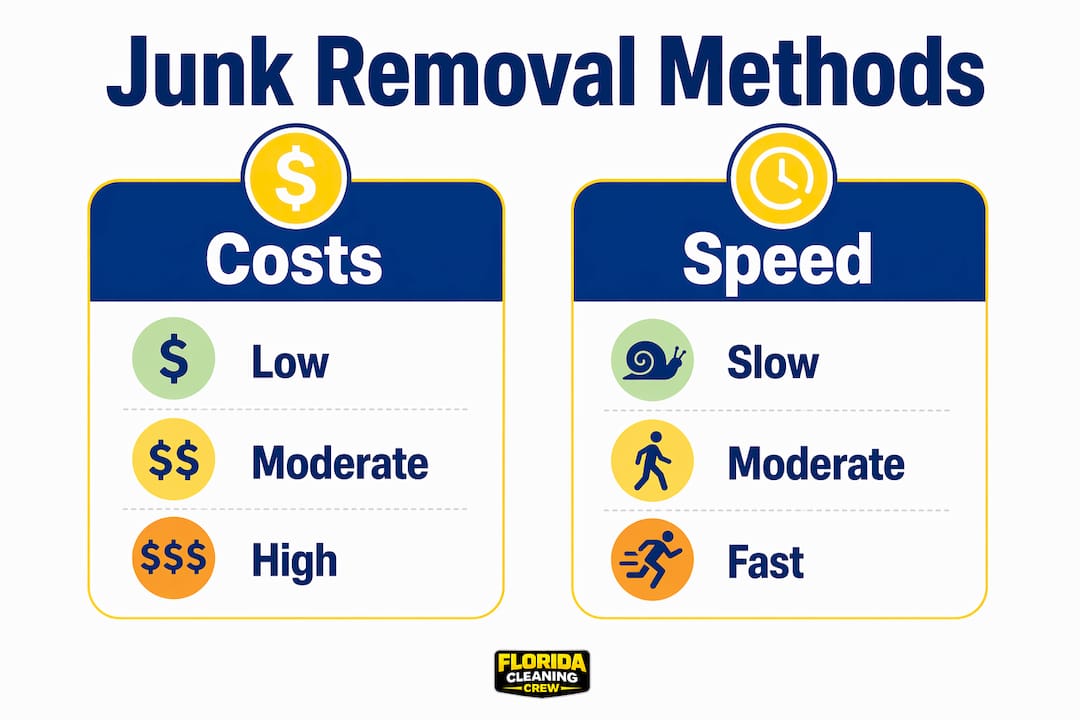
Junk removal for rental properties falls into four main categories, and the right choice depends on how much you have, how fast you need it gone, and who is responsible for removing it.
Curbside pickup is the lowest-cost option. Most Tampa Bay municipalities offer bulk trash pickup on scheduled days, and curbside services start at about $79. This works well for small amounts of furniture or bagged debris, but it requires you to haul items to the curb yourself and wait for the scheduled pickup date. That waiting period can stall your entire turnover timeline.
Full-service junk removal is the fastest option for landlords managing a turnover on a tight schedule. A crew arrives, loads everything, and hauls it away. The tradeoff is cost. Full-service removals cost 2 to 3 times more than curbside options, sometimes exceeding $800 for a heavily loaded unit. For a landlord losing rental income every day the unit sits vacant, that cost often pays for itself.
Dumpster rental suits larger properties or multi-unit cleanouts where debris accumulates over several days. You rent a container, fill it at your own pace, and the company hauls it away. Pricing typically falls between curbside and full-service rates. The limitation is that you still need to do the physical loading, which adds labor time.
DIY hauling works best for tenants clearing out before move-out or landlords with access to a truck and a free Saturday. The cost is low, but the time investment is high. Renting a cargo van or pickup from U-Haul or Home Depot and making a run to the Hillsborough County Solid Waste facility in Tampa is a practical option for small loads.
| Method | Estimated Cost | Time to Clear | Best For |
|---|---|---|---|
| Curbside pickup | $79 and up | 1 to 7 days | Small loads, budget-conscious |
| Full-service removal | $300 to $800+ | 2 to 4 hours | Fast turnovers, large loads |
| Dumpster rental | $200 to $500 | 1 to 3 days | Multi-unit or large properties |
| DIY hauling | $50 to $150 | Half to full day | Tenants, small loads |
Pro Tip: If your unit needs to be ready within 48 hours, full-service junk removal is the only method that reliably meets that deadline. Book it the same day keys are returned.
For Tampa Bay landlords managing properties in St. Petersburg or Clearwater, local providers familiar with Pinellas and Hillsborough County disposal regulations will handle permits and recycling compliance without you having to research it yourself. You can explore Tampa Bay junk removal options that cover same-day scheduling for urgent turnovers.
What legal requirements apply to junk removal in rental turnovers?
Florida law treats abandoned tenant property as a specific legal category, and landlords who skip the required steps before disposing of items risk lawsuits, even when the tenant clearly left the property.
The legal process landlords must follow before disposing of any tenant belongings is not optional. Florida Statute 715.10 through 715.111 governs abandoned personal property in rental units. Before touching anything, you must photograph every item left behind. That photo record establishes what existed and its condition at the time of move-out. Without it, a tenant can claim you disposed of valuable property without evidence to the contrary.
The required steps for legal disposal are:
- Document everything. Photograph all abandoned items immediately after the tenant vacates, with timestamps.
- Send written notice. Notify the tenant via certified mail at their last known address and any forwarding address they provided. The notice must describe the property and state where it is being held.
- Wait the legal holding period. Florida law requires landlords to hold abandoned property for a reasonable period, typically 10 days for items with low value and longer for items of significant value.
- Store items properly. If the property has value, you may need to store it off-site during the holding period. Document storage costs.
- Dispose or sell. After the holding period, you can dispose of low-value items or sell higher-value property to recover storage costs.
Landlords should never dispose of abandoned property immediately. Skipping the notice and holding period exposes you to claims of conversion, which is the legal term for wrongfully taking someone else’s property.
On the financial side, junk removal costs can be deducted from security deposits if you keep itemized receipts and comply with Florida’s notice requirements. Tenant turnover costs in Florida commonly run between $1,000 and $5,000 when you factor in cleaning, repairs, and removal. Proper documentation turns those expenses into recoverable costs rather than losses.
Including junk removal clauses in leases is the most underused protection available to landlords. A clause that explicitly states tenants are responsible for removing all personal property by the lease end date, and that any items left behind will be removed at the tenant’s expense, gives you both legal cover and a clear basis for deposit deductions.
Pro Tip: Add a specific dollar amount to your lease clause, such as “Tenant will be charged a minimum of $250 for any junk removal required after vacating.” Specific figures deter tenants from leaving items behind far more effectively than vague language.
How can tenants declutter a rental before moving out?
Clearing out a rental before move-out is not just about avoiding charges. It directly affects how quickly you get your security deposit back and whether your landlord gives you a positive reference for your next rental.
The most effective framework for clearing a rental is the Four-Box Method: Keep, Donate, Trash, and Store. You assign every item in the unit to one of those four boxes before anything gets moved. The method works because it forces a decision on every object rather than allowing a “maybe” pile to form. That maybe pile is where decluttering stalls. Tenants who skip this step spend twice as long on move-out day because they are still making decisions while trying to load a truck.
A few practical strategies that work specifically in Tampa Bay rental units:
- Start four weeks before move-out. Tackle one room per week. Trying to clear an entire apartment in a single weekend leads to rushed decisions and items left behind.
- Donate first, trash second. Goodwill Industries in Tampa, the Salvation Army in St. Petersburg, and Habitat for Humanity ReStores in Clearwater all accept furniture, appliances, and household goods. Donating reduces what you have to haul and may qualify for a tax deduction.
- Use vertical storage to consolidate. Vertical storage solutions like shelf risers and over-door organizers can create up to 30% more usable closet space in small rentals. Consolidating what you are keeping into organized vertical stacks makes it easier to identify what is actually excess.
- Avoid buying storage containers before purging. Many renters buy storage solutions before decluttering, which preserves clutter rather than reducing it. Purge first, then organize what remains.
- Schedule a bulk pickup or junk removal service before your final walkthrough. Do not leave this for move-out day. Book it at least three days in advance.
For a detailed checklist covering what to clean and remove before handing back keys, the end-of-lease cleaning guide covers the full scope of what landlords inspect during a final walkthrough.
Pro Tip: Photograph every room after you have cleared and cleaned it. If a deposit dispute arises, timestamped photos taken on move-out day are your strongest evidence.
What steps should landlords take to coordinate junk removal for fast turnovers?
Speed is money in rental property management. Every day a unit sits vacant after a tenant moves out is a day of lost income. Coordinating junk removal correctly cuts that vacancy window significantly.
Scheduling junk removal within 24 hours of key handover is the single most effective step a landlord can take to accelerate turnover. Once the unit is clear, cleaning crews and repair contractors can enter simultaneously rather than waiting for each other. That parallel scheduling is what separates a two-day turnover from a five-day one.
Here is the sequence that works for Tampa Bay landlords managing single-family homes and multi-unit properties:
- Conduct a move-out walkthrough immediately. Walk the unit with the tenant present if possible. Document every item left behind with photos and a written inventory.
- Contact your junk removal service the same day. Book a slot for the following morning. Full-service providers like those serving the Tampa, Clearwater, and St. Petersburg areas typically offer next-day availability.
- Notify the tenant in writing. Send a certified letter or email documenting what was left and what will be removed. This satisfies Florida’s notice requirements and protects your deposit deduction.
- Schedule cleaning immediately after removal. Professional junk removal clears a 1 to 3 bedroom unit in 2 to 4 hours. Book your cleaning crew to arrive the same afternoon.
- Coordinate repairs in parallel. Painters, carpet cleaners, and handymen can often work in different rooms while cleaning is underway. Do not sequence these tasks when they can overlap.
Common mistakes that slow landlords down:
- Waiting days before calling a junk removal service, assuming the tenant will return for items
- Disposing of items before completing the legal notice process
- Failing to get itemized receipts from the junk removal company, which makes deposit deductions harder to defend
- Booking cleaning before junk removal is complete, forcing the cleaning crew to work around debris
For a broader look at how to coordinate the full turnover process, the rental turnover scheduling guide covers timing, vendor coordination, and how to minimize days between tenants.
Pro Tip: Ask your junk removal provider about same-day service. Many Tampa Bay providers offer it for an additional fee that is almost always worth paying when you are losing a day of rent.
Key takeaways
Removing junk from a rental property efficiently requires the right method, proper legal documentation, and coordinated scheduling to minimize vacancy time.
| Point | Details |
|---|---|
| Choose the right method | Full-service removal is fastest; curbside is cheapest. Match the method to your timeline and load size. |
| Follow Florida’s abandonment laws | Photograph items, send certified notice, and wait the legal holding period before disposing of anything. |
| Document costs for deposit deductions | Keep itemized receipts from junk removal services to support lawful security deposit deductions. |
| Use the Four-Box Method | Tenants who sort items into Keep, Donate, Trash, and Store categories clear out faster and leave less behind. |
| Schedule removal within 24 hours | Booking junk removal the day keys are returned keeps cleaning and repairs on track for a fast turnover. |
What I have learned from Tampa Bay rental turnovers
After working with landlords and tenants across Tampa, St. Petersburg, and Clearwater, the pattern I see most often is not a lack of effort. It is a lack of sequence. Landlords call for cleaning before the junk is gone. Tenants try to pack and purge on the same day. Both scenarios create delays that compound into lost income or lost deposits.
The lease clause piece is where I think most landlords leave the most money on the table. A vague “leave the unit clean” clause does almost nothing. When the lease specifies that any items left behind will be removed at the tenant’s expense, with a minimum charge stated clearly, tenants take it seriously. I have seen that single change reduce post-move-out junk removal calls by a significant margin for property managers who adopted it.
On the tenant side, the biggest mistake I see is treating decluttering as a moving task rather than a pre-moving task. Clearing junk from a rental is something you do in the weeks before you move, not the day of. The Four-Box Method works, but only if you start it early enough that you are not making rushed decisions under pressure.
One more thing worth saying plainly: the DIY route is not always cheaper when you factor in your time. Renting a truck, making multiple dump runs, and spending a full weekend on it often costs more in real terms than a $300 full-service removal. For landlords especially, that time has a direct dollar value tied to how quickly the unit gets back on the market.
— Matt
Ready to clear your Tampa Bay rental fast?
Floridacc provides junk removal in Tampa Bay for landlords and tenants who need units cleared quickly and correctly. The team handles everything from single-item pickups to full property cleanouts, with same-day and next-day availability across Tampa, Clearwater, and St. Petersburg.

After the junk is gone, Floridacc’s residential cleaning services step in to get the unit move-in ready. One call covers both steps, which means fewer vendors to coordinate and faster turnovers. Request a free quote through the Floridacc website and get your unit back on the market without the back-and-forth.
FAQ
How much does junk removal from a rental property cost?
Curbside junk removal starts around $79, while full-service removal for a 1 to 3 bedroom unit typically runs between $300 and $800 or more depending on volume. Dumpster rental falls in the middle range and works best for larger or multi-day cleanouts.
Can a landlord charge a tenant for junk left behind?
Yes. Landlords can deduct reasonable junk removal costs from a security deposit if they provide itemized receipts and comply with Florida’s written notice requirements. Clear lease language stating tenant responsibility for removal strengthens the landlord’s position in any dispute.
How long does professional junk removal take for a rental unit?
A standard 1 to 3 bedroom unit can be cleared in 2 to 4 hours by a professional crew. That timeline makes same-day booking practical for landlords who need cleaning and repairs to start the same day.
What is the best way for tenants to declutter before moving out?
The Four-Box Method is the most effective framework: sort every item into Keep, Donate, Trash, or Store before moving anything. Starting four weeks before move-out and donating usable items to local Tampa Bay organizations reduces what needs to be hauled and speeds up the entire process.
What happens if a landlord disposes of a tenant’s belongings without notice?
Disposing of abandoned property without following Florida’s notice and holding period requirements exposes the landlord to a conversion claim, which is a civil lawsuit for wrongfully taking someone’s property. Photographing items and sending certified mail notice before any disposal is the required legal step, not an optional one.