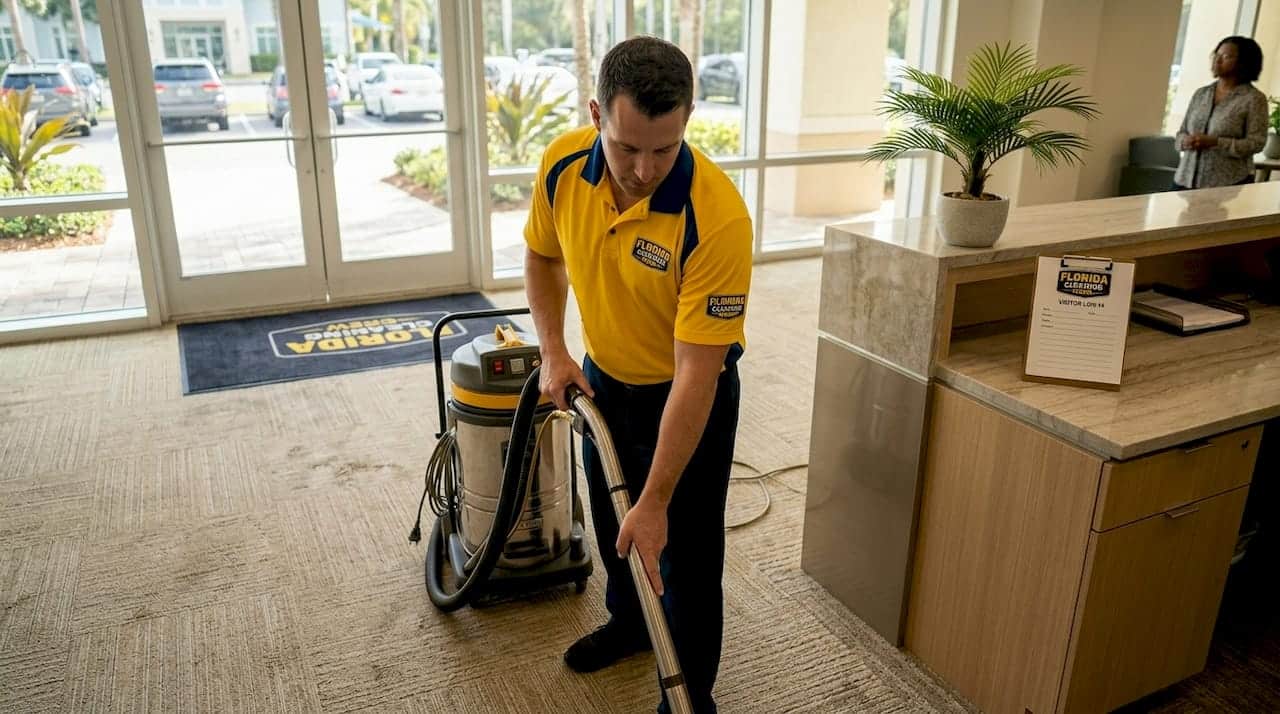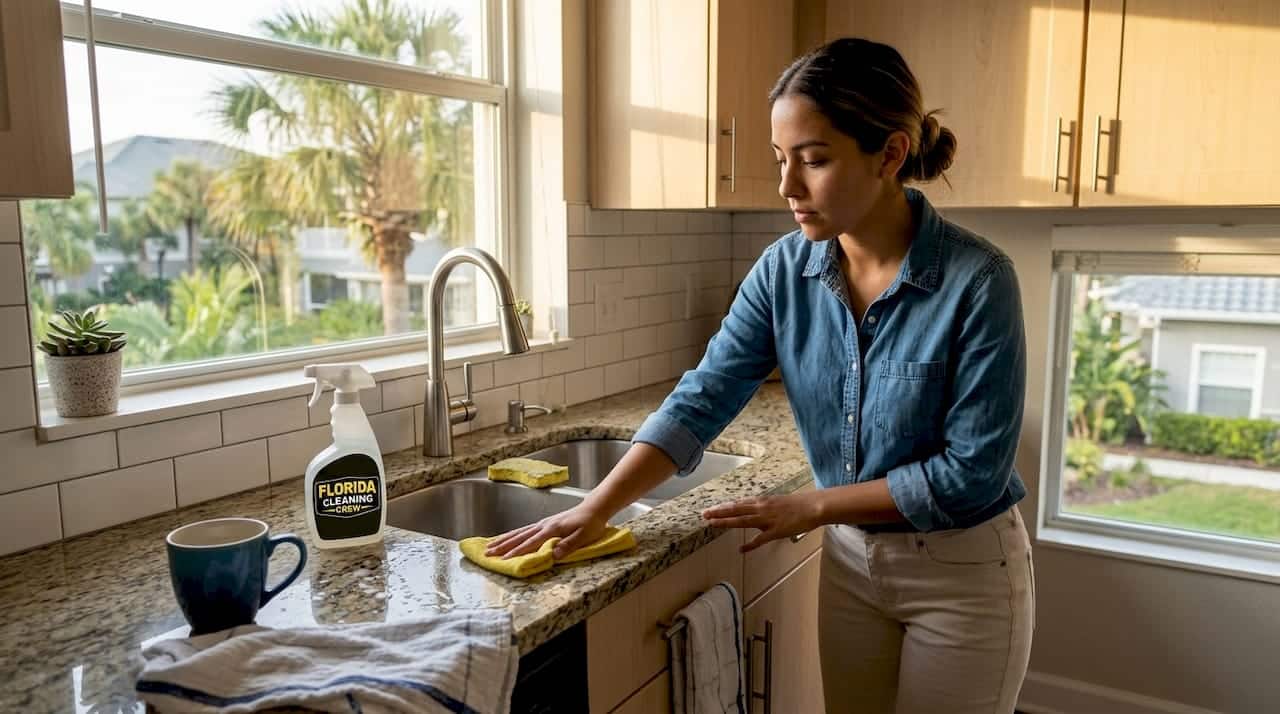

Walk into any business in Tampa Bay and within 30 seconds, you’ve already formed an opinion. That reaction, often unconscious, is shaped almost entirely by how clean the space looks, smells, and feels. The role of cleaning in business reputation is not a side conversation for facility managers. It belongs at the center of how any owner thinks about customer experience, online reviews, and long-term brand loyalty. This article breaks down exactly how cleanliness shapes perception, what the data says about its effect on ratings, and how to use cleaning as a deliberate reputation strategy.
Table of Contents
- Key Takeaways
- How cleanliness shapes customer and employee perceptions
- Cleanliness, online reviews, and your star rating
- Traditional vs. green cleaning: which builds better reputation
- Integrating cleaning strategy with reputation management
- Measuring and monitoring cleanliness as a reputation metric
- My take on why businesses underestimate this
- Ready to protect your reputation with professional cleaning?
- FAQ
Key Takeaways
| Point | Details |
|---|---|
| First impressions are non-negotiable | Visible cleanliness shapes customer trust within seconds of entering your business. |
| Cleanliness drives online reviews | Cleanliness and comfort drive over 81% of positive reviews and nearly 70% of negative ones. |
| Green cleaning builds brand credibility | Eco-friendly practices signal social responsibility and improve employee retention. |
| Cleaning feedback is reputation data | Treat every cleanliness-related review as an operational signal, not just a complaint. |
| Consistency outperforms occasional deep cleans | Scheduled protocols with accountability systems produce the reputation results that one-time efforts cannot. |
How cleanliness shapes customer and employee perceptions
There is a concept in consumer psychology called the “halo effect.” When customers see one strongly positive or negative thing, they project that quality onto everything else. A spotless reception area tells a customer: this business is organized, careful, and trustworthy. A sticky counter, a smudged window, or a bathroom that hasn’t been touched since morning tells them the opposite, and that perception bleeds into how they evaluate your products, your staff, and your prices.
This is how cleaning affects business perception in ways that go far beyond aesthetics. The physical environment is a proxy for how much you care. Customers who feel cared for come back. Those who feel neglected go elsewhere and, more often than not, tell people about it.
Here is what cleanliness specifically signals to different groups inside and outside your business:
- New customers use physical cleanliness to gauge whether they can trust you before they’ve experienced your service at all.
- Returning customers measure consistency. If your space was spotless last time and mediocre this time, you have created doubt.
- Employees are deeply affected by their environment. Green cleaning reduces sick days from chemical exposure and improves workplace comfort, which means cleaner spaces produce more engaged, productive teams.
- High-value clients and partners often make decisions about continued business relationships based on what they observe during visits to your facility.
The importance of cleanliness, then, is not just about how the space looks. It’s about what the space communicates about your standards across the board.
Pro Tip: Walk through your business the way a first-time customer would, every single week. You stop noticing problems when you see them daily. A fresh set of eyes, even your own after a weekend away, catches what familiarity hides.
The connection between cleanliness and perceived value is especially relevant for businesses competing on premium positioning. Customers spending more expect more. In Tampa, Clearwater, and St. Petersburg, where tourism and service industries are core to the economy, the physical condition of your space is part of the product, not just the backdrop.
Cleanliness, online reviews, and your star rating
Here is where the data gets genuinely surprising. Most business owners think reviews are primarily about the product or service itself. They’re not, at least not entirely.
Research analyzing customer reviews on TripAdvisor found that cleanliness drives 81.3% of positive reviews and is the leading factor in nearly 70% of negative ones. That is not a small margin. That is the difference between a 4.8 star rating and a 3.2.

When a customer walks out of your business feeling the space was dirty or neglected, they are far more likely to write a review than when the service was simply adequate. Negative cleanliness experiences trigger emotion, and emotion triggers the impulse to warn other people. This is why the impact of cleanliness on reputation compounds over time. One bad month of inconsistent cleaning can produce a cluster of negative reviews that takes six months of great service to dilute.
Here’s the operational side of that problem, broken into clear steps:
- Identify your cleanliness touchpoints. Which areas do customers actually see and interact with? Lobbies, restrooms, checkout counters, waiting areas, and outdoor entrances are almost always on this list.
- Map review language to those touchpoints. Go back through your last 50 reviews and note every cleanliness mention, positive or negative. You will likely find patterns pointing to specific areas or times of day.
- Respond publicly to cleanliness complaints. Responding promptly to reviews improves Google star ratings and demonstrates accountability to future customers reading those responses.
- Encourage satisfied customers to leave reviews. Businesses with strong customer orientation proactively encourage reviews and use the positive feedback to balance and outpace negative mentions.
Stat worth knowing: A study of 251 small businesses found that managing and responding to reviews directly improves Google star ratings and business performance, making online reputation a measurable, manageable asset.
The practical implication is straightforward. If you treat every cleanliness-related review as operational feedback rather than just a PR problem, you create a loop where your physical environment and your online reputation improve together. That is how the role of cleaning in business reputation becomes a system, not an accident.
Traditional vs. green cleaning: which builds better reputation
Most businesses default to whatever cleaning products the supply closet has always stocked. The choice between traditional and green cleaning is rarely made strategically. But it should be, especially if you care about what your brand communicates.
| Factor | Traditional cleaning | Green (eco-friendly) cleaning |
|---|---|---|
| Health impact on employees | Higher chemical exposure, more sick days | Fewer allergens and irritants, reduced sick days |
| Customer perception | Neutral to negative if odors are strong | Positive association with responsibility |
| Brand signal | Standard practice | Signals attention and care |
| Long-term cost | Can be lower upfront | Often comparable or lower over time |
| Environmental impact | Higher waste and chemical runoff | Lower environmental footprint |
| Regulatory risk | Some chemicals face restrictions | Generally lower regulatory exposure |
The reputational angle here is specific: customers increasingly associate eco-friendly practices with businesses that take their responsibilities seriously. For Tampa Bay businesses competing in hospitality, food service, childcare, healthcare, or any setting where health is on customers’ minds, the signal that you use non-toxic, environmentally responsible products matters more than most owners realize.
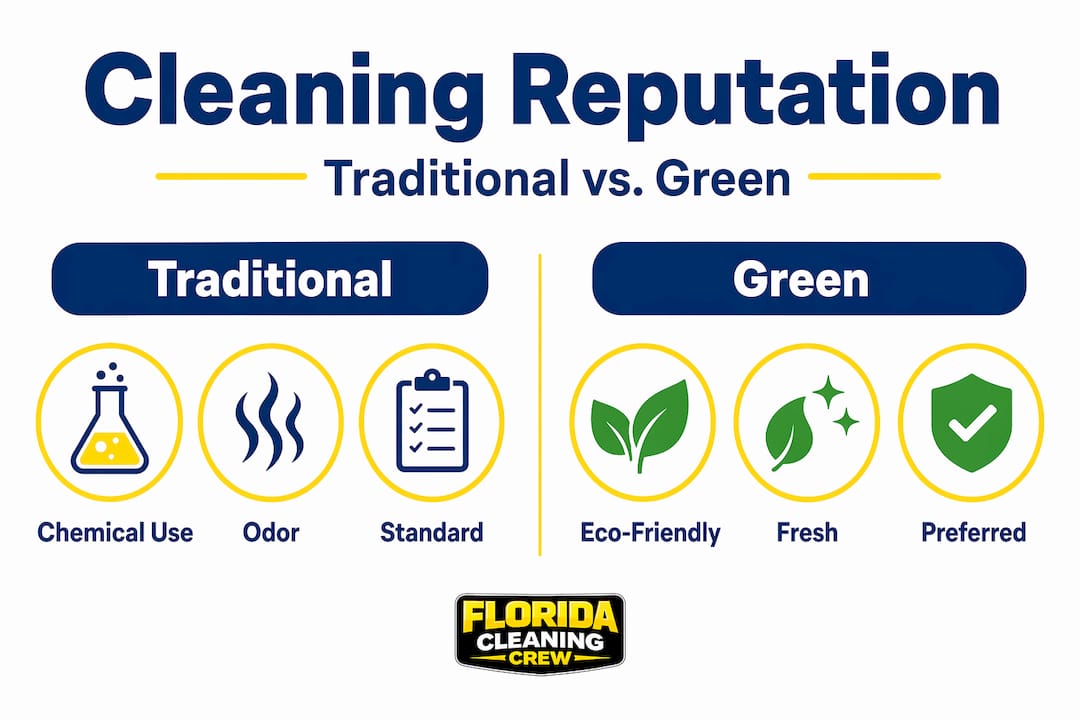
Green cleaning enhances workplace comfort and reduces chemical-related health complaints. That has a direct impact on staff retention and morale, which in turn shows up in the quality of customer interactions. Happy, healthy employees deliver better service. It is that simple.
Pro Tip: If you switch to green cleaning products, tell your customers. A small sign near your front desk or a line in your email communications noting your commitment to non-toxic cleaning costs nothing and gives customers one more reason to trust you.
The role of cleaning in brand perception shifts meaningfully when you can point to specific choices, not just generic claims about caring for the environment. Specificity builds credibility. “We use EPA-certified, non-toxic cleaning agents throughout our facility” lands differently than “we care about your health.”
Integrating cleaning strategy with reputation management
Most business owners treat cleaning as a facilities issue and reputation management as a marketing issue. The businesses that consistently earn strong reviews treat them as the same issue. Here is how to connect the two deliberately.
Build cleaning protocols around high-impact areas
Not every square foot of your business carries equal reputational weight. Restrooms, entrances, and customer-facing surfaces get scrutinized first. Map your space by customer traffic and visibility, then allocate your cleaning schedule accordingly. This is not about doing less in back-of-house areas. It’s about making certain the areas customers see receive consistent, documented attention.
Train staff to own cleanliness standards
Recognizing cleaning as skilled work improves employee retention and service quality across the janitorial industry. The same principle applies to your internal team. When staff understand why cleanliness matters to your business outcomes, not just that it’s a rule, they take more ownership. Brief, specific training on what “clean” means in your space produces better results than a generic “keep things tidy” instruction.
Use cleaning as a differentiator in your marketing
You can mention cleanliness standards in your Google Business Profile, on your website, and in response to reviews without sounding boastful. Something as simple as “our facility is professionally cleaned and sanitized daily” addresses a question many customers have but rarely ask directly. The importance of cleanliness in customer decision-making is high enough that stating your standard directly is a competitive advantage.
- Ask your cleaning service provider for documentation of what was cleaned and when.
- Post cleaning schedules in visible areas, especially in restrooms.
- Respond to positive reviews that mention cleanliness with specific gratitude that reinforces the message.
- Track the frequency and tone of cleanliness mentions in your reviews month over month.
Pro Tip: Set a Google Alert for your business name combined with the word “clean” or “dirty.” You will catch mentions across platforms you may not be actively monitoring, including niche review sites and local Facebook groups where Tampa Bay customers are highly active.
The benefits of a clean workplace extend beyond the customer relationship. Suppliers, inspectors, and potential business partners form impressions during facility visits. When your space is consistently maintained, every interaction carries the implicit message that your operations are well-managed.
Measuring and monitoring cleanliness as a reputation metric
Knowing that cleaning matters is not the same as having a system that proves it’s working. Here is a practical framework for measuring the connection between your cleaning practices and your reputation outcomes.
- Establish a baseline. Pull your last three months of reviews and categorize every mention related to cleanliness, positive or negative. Count them. That is your starting point.
- Set a cleaning schedule with documented completion. Whether you use an internal team or an outside service, every cleaning task should be logged by area, time, and responsible party.
- Track review language on a monthly cadence. A simple spreadsheet comparing the volume of cleanliness mentions month over month tells you whether your improvements are registering with customers.
- Connect cleaning incidents to review response. When a cleanliness complaint comes in, log what happened, what was addressed, and how the public response was handled. Linking cleaning incident logs to review responses drives long-term improvement in star ratings.
| Metric | What it measures | Review cadence |
|---|---|---|
| Cleanliness review mentions | Volume of positive and negative cleaning feedback | Monthly |
| Average star rating trend | Overall reputation direction | Monthly |
| Incident response time | Speed of addressing cleanliness complaints | Per incident |
| Cleaning completion rate | Percentage of scheduled tasks logged as done | Weekly |
| Employee sick day frequency | Indirect indicator of cleaning environment quality | Quarterly |
Using this kind of structured monitoring means you are no longer guessing whether your cleaning investment is working. You are watching it in the data, which also gives you something concrete to show staff, partners, or cleaning contractors when results need to improve.
My take on why businesses underestimate this
In my experience working with business owners across different industries, cleaning almost never comes up in strategic conversations. It gets delegated, budgeted at the lowest acceptable number, and revisited only when something goes wrong. That is exactly backwards.
I’ve seen businesses spend thousands on a logo refresh or a new social media strategy while their restrooms consistently generate complaints in reviews. The logo does not show up in a one-star rating. A dirty bathroom does. Every time.
What I’ve learned is that online reputation is a non-substitutable resource that compounds. Positive reviews build on each other. So do negative ones. And cleanliness is one of the fastest, cheapest levers you can pull to shift that trajectory.
The businesses I’ve seen do this well share one habit: they read their reviews looking for operational signals, not just feedback. A comment about a “musty smell near the entrance” is not just a gripe. It is a facilities report. Treat it that way, fix the problem, respond publicly, and your next cluster of reviews will look different.
My honest advice is to stop treating your cleaning budget as overhead and start treating it as a reputation investment. Because that is exactly what it is.
— Matt
Ready to protect your reputation with professional cleaning?
If what you’ve read here has you thinking about how your current cleaning setup actually measures up, that is a fair and worthwhile question to sit with.
Floridacc serves businesses across Tampa, Clearwater, and St. Petersburg with commercial cleaning for small businesses that is reliable, documented, and built around the areas that matter most to your customers. Licensed, insured, and focused on results, the Floridacc team handles everything from daily maintenance cleaning to deep-clean turnovers for commercial properties. If cleanliness is showing up in your reviews and you want it to show up the right way, a free estimate from Floridacc is the clearest next step. Reach out through floridacc.com and see what a consistent, professional cleaning program looks like for your specific space.
FAQ
How does cleanliness affect business reputation?
Cleanliness shapes customer trust before a single interaction with staff or product. Research shows cleanliness drives over 81% of positive hospitality reviews and is cited in nearly 70% of negative ones.
Can poor cleaning hurt your Google star rating?
Yes. Studies of small businesses confirm that cleanliness complaints in reviews drag down overall ratings, while proactively managing and responding to reviews improves star ratings and business performance over time.
What areas should businesses prioritize for cleaning?
Restrooms, entrances, checkout counters, and waiting areas carry the most reputational weight because customers interact with and remember them most. Focus your workplace cleanliness strategy on high-traffic, high-visibility zones first.
Does green cleaning make a difference to customers?
Yes, particularly in industries where health and safety are top of mind. Eco-friendly cleaning signals responsibility and care, while also reducing employee sick days, which improves service quality and brand perception.
How often should a business schedule professional cleaning?
That depends on traffic volume and industry, but most customer-facing businesses benefit from daily cleaning of high-touch areas and weekly or bi-weekly deep cleaning of secondary spaces. Consistency matters more than frequency alone.