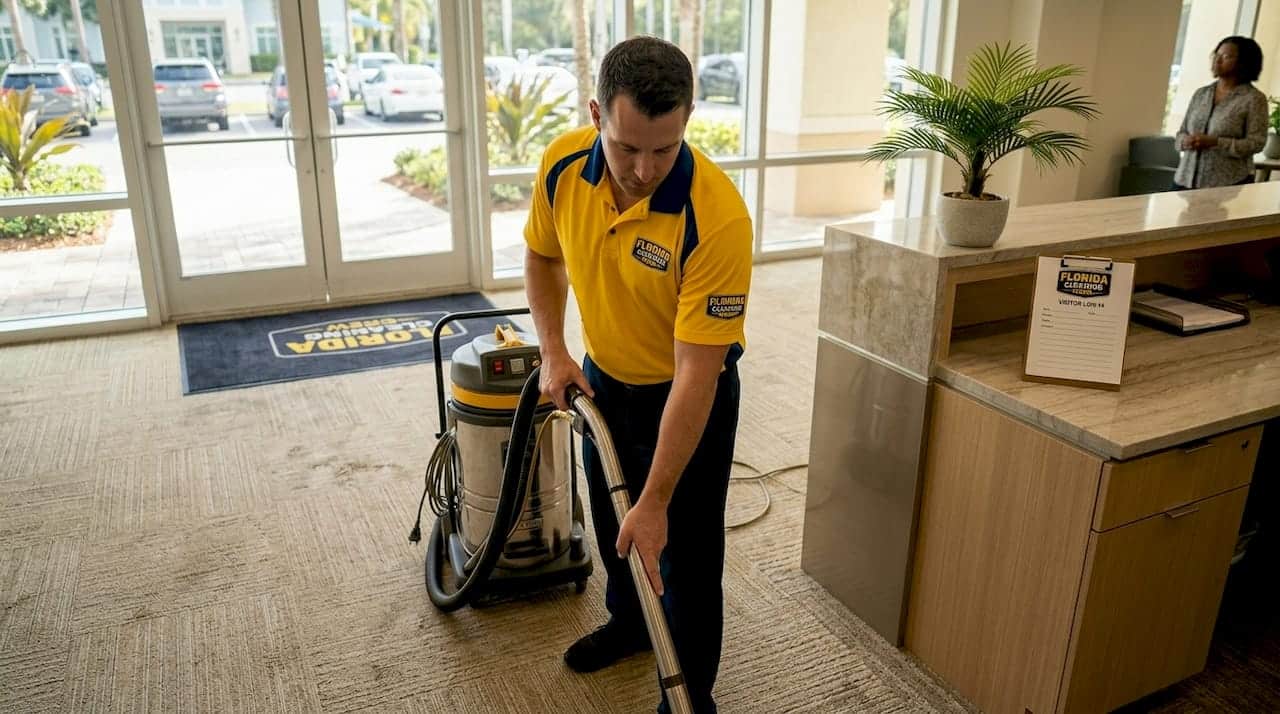
Commercial carpet maintenance is defined as a structured program combining daily vacuuming, immediate spill response, entrance mat systems, and scheduled professional deep cleaning to protect flooring investment and sustain a professional appearance. For business owners and property managers in Tampa, Clearwater, and St. Petersburg, applying consistent business carpet care tips is not optional. It is the difference between carpets that last 10 years and carpets that need replacement in five. The practices covered here are drawn from commercial facility management research and tailored to the realities of high-traffic Tampa Bay properties.
1. Establish a vacuuming schedule based on traffic zones
The single most impactful daily habit in office carpet maintenance is vacuuming, and frequency must match foot traffic. Zoning your building into high, medium, and low-traffic areas lets you assign cleaning routines that match actual wear. This prevents over-servicing quiet zones while neglecting the areas that need daily attention.
The recommended schedule for commercial settings breaks down like this:
- High-traffic zones (lobbies, hallways, reception areas): vacuum daily
- Medium-traffic zones (conference rooms, shared workspaces): vacuum 2 to 3 times per week
- Low-traffic zones (private offices, storage areas): vacuum weekly
Vacuuming technique matters as much as frequency. Slow, overlapping passes lift embedded soil that fast passes miss entirely. Proper vacuum maintenance includes using commercial-grade equipment, cleaning bags and filters regularly, and adjusting brush height to match carpet fiber type. A vacuum with a full bag loses suction by up to 50%, meaning you are moving dirt around rather than removing it.
Pro Tip: Run your vacuum in two directions, north to south and then east to west, over high-traffic areas. This cross-pattern technique lifts fibers from multiple angles and removes significantly more embedded soil than single-direction passes.
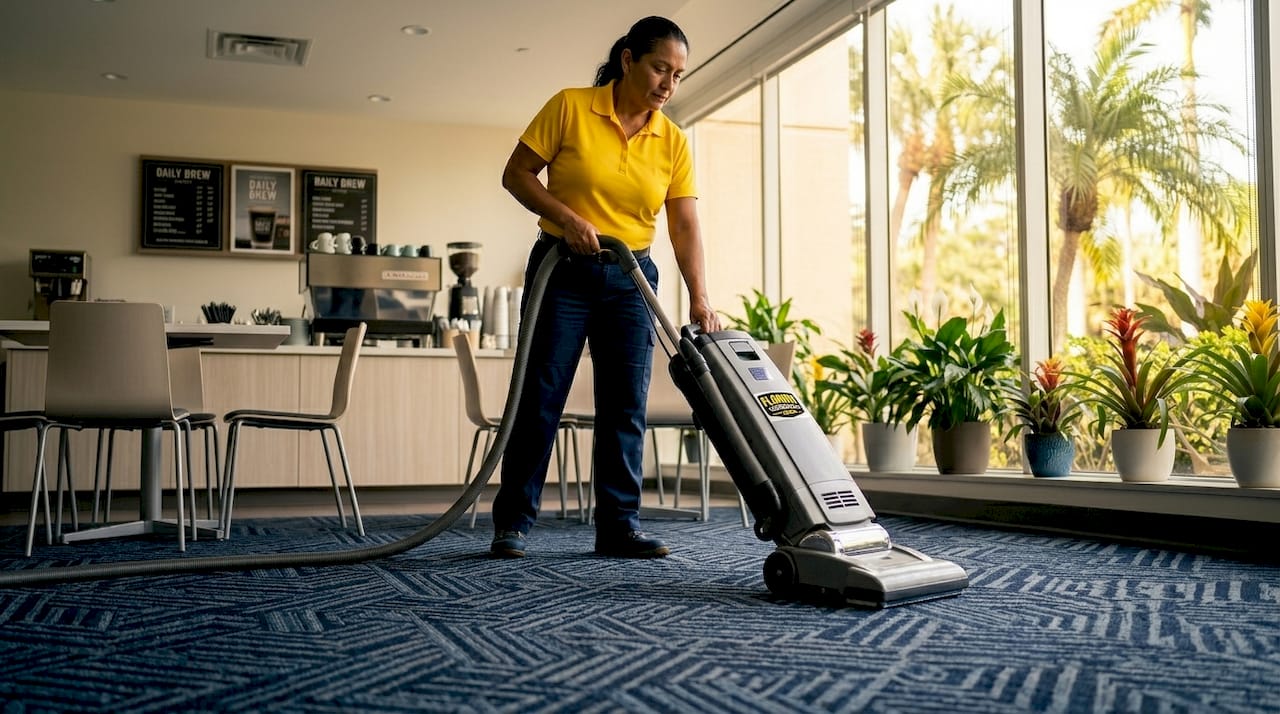
Fiber abrasion is one of the leading causes of premature carpet aging in commercial settings. Grit and soil particles act like sandpaper against carpet fibers every time someone walks across them. Consistent vacuuming removes that abrasive material before it can cut into the pile, which directly extends the usable life of the carpet.
2. Respond to spills immediately and correctly
Spill response is the most time-sensitive element of any carpet cleaning advice program. The longer a liquid sits in carpet fibers, the deeper it penetrates and the harder it becomes to remove without professional intervention. A spill treated within two minutes has a far better outcome than one addressed 20 minutes later.
The correct spill response protocol follows this sequence:
- Blot the spill immediately using a clean white cloth or paper towel. Press firmly and lift. Never rub.
- Work from the outer edge of the spill toward the center to prevent spreading.
- Apply a neutral spot cleaner appropriate for your carpet type. Avoid alkaline or acidic products on synthetic fibers unless the manufacturer specifies otherwise.
- Blot again to lift the cleaner and the dissolved stain. Repeat if needed.
- Place a dry towel over the area and weight it down for 15 to 30 minutes to absorb residual moisture.
- Allow the area to dry fully before foot traffic resumes.
Correct spill management requires blotting instead of rubbing, using neutral spotters, avoiding over-wetting, and thorough drying to prevent stains and wicking damage. Over-wetting is a common mistake that causes moisture to wick back up through the carpet backing as it dries, pulling dissolved soil with it and creating a new stain at the surface.
Pro Tip: Keep a dedicated spot-cleaning kit in each building zone. Stock it with clean white microfiber cloths, a pH-neutral spotter like Prochem Stain Pro or Chemspec Spot and Stain Remover, and a small spray bottle of clean water. Fast access is the difference between a clean carpet and a permanent stain.
Train every staff member who works in or near carpeted areas on this protocol. Staff training on spill response prevents costly early carpet damage that custodians often underestimate. A 30-minute training session for your maintenance team can save thousands in premature carpet replacement.
3. Install entrance walk-off mat systems at every entry point
Walk-off mats are the most underutilized tool in commercial carpet care. They stop soil at the source before it ever reaches your carpet, which is the most cost-effective protection available. Installing both outside and inside entrance mats with 10 to 15 feet of combined coverage reduces tracked-in dirt by up to 80%. That number represents a dramatic reduction in the soil load your carpet absorbs every day.
An effective mat system at each entrance includes:
- Outdoor scraper mat: A coarse-textured mat placed outside the door to remove heavy debris, mud, and moisture from shoe soles before entry
- Indoor moisture-absorbing mat: A softer, absorbent mat placed just inside the door to capture fine particles and residual moisture
- Combined coverage of 10 to 15 feet: This length gives shoes enough contact with mat surfaces to transfer the majority of soil before reaching the carpet
In Tampa Bay’s climate, moisture management at entries is especially important. Humidity and afternoon rain mean wet shoes are a daily reality from May through October. Mats that absorb moisture prevent wet soil from being ground into carpet fibers, which is far harder to remove than dry dirt.
The mats themselves require regular maintenance. A mat that is saturated with soil becomes a soil source rather than a soil barrier. Vacuum outdoor mats daily in high-traffic buildings and launder or deep-clean indoor mats weekly. Replace mats that are worn flat, since a compressed mat loses its scraping and absorbing function entirely.
A preventive program including daily vacuuming in high-traffic lanes, prompt spill response, and entrance walk-off mats of 10 to 15 feet effectively reduces soil before it reaches carpet pile. This combination is the foundation of every successful commercial carpet care program.
4. Schedule professional deep cleaning at the right intervals
Professional deep cleaning is not a luxury for commercial carpets. It is a scheduled maintenance requirement. Deep cleaning every 12 to 18 months with interim low-moisture cleaning, like encapsulation, sustains carpet appearance and controls soil buildup between major services. Without it, embedded soil accumulates below the surface where vacuuming cannot reach, degrading fiber structure from the inside out.
The two primary professional cleaning methods for commercial carpets each serve a different purpose:
| Method | Best use case | Dry time | Frequency |
|---|---|---|---|
| Hot water extraction | Deep restorative cleaning, heavy soil removal | 4 to 8 hours | Every 12 to 18 months |
| Encapsulation | Interim maintenance, continuous-use areas | 30 to 60 minutes | Every 3 to 6 months |
Hot water extraction provides deep restorative cleaning but requires scheduling to avoid operational disruption due to longer dry time. For Tampa Bay businesses that cannot close during business hours, scheduling hot water extraction on a Friday evening or over a weekend eliminates the downtime problem entirely.
Encapsulation uses a crystallizing polymer chemistry that surrounds soil particles and suspends them in the carpet until the next vacuuming. Encapsulation chemistry changes fiber bonding and reduces the soiling rate, but it requires repeated cleaning and does not replace regular professional deep cleaning. Think of it as a maintenance layer between deep cleans, not a substitute for them.
Pro Tip: Treat your facility like an ROI portfolio. Assign cleaning methods by zone and downtime tolerance. Use encapsulation in your lobby and main corridors where you cannot afford extended dry time, and schedule hot water extraction in conference rooms and private offices where you can control access for a full day.
5. Use protective furniture pads and rotate layouts periodically
Heavy furniture concentrates weight on specific carpet fibers, causing permanent compression and localized wear patterns. A desk that sits in the same position for three years will leave visible indentations that no amount of cleaning can reverse. Periodic rotation of desks, chairs, and workstations distributes wear more evenly across the carpet surface and extends the time before any single area shows visible degradation.
Protective pads placed under chair legs, desk feet, and heavy equipment spread the load across a larger surface area. Felt pads work well for static furniture. For rolling office chairs, use a chair mat on carpet to prevent the repeated rolling motion from grinding fibers down to the backing. Without a chair mat, the area under a desk chair typically shows visible wear within 18 months in a busy office.
Rearranging office layouts every one to two years also gives heavily used zones a recovery period. This is a low-cost strategy that most property managers overlook entirely, yet it can add years to carpet life without any additional cleaning expense.
6. Train staff on carpet care basics
Staff behavior is a direct variable in carpet longevity, and most businesses never address it formally. The largest gains in carpet cleanliness come from controlling soil at the source, maintaining clean mats, and using correct blotting techniques to avoid deep fiber contamination. None of that happens reliably without deliberate training.
A basic carpet care training program for custodial and maintenance staff should cover:
- Correct vacuuming technique, including speed, direction, and equipment settings
- Spill response protocol, with emphasis on blotting and approved spotters
- How to identify when a stain requires professional intervention rather than in-house treatment
- Proper mat cleaning and replacement schedules
- What cleaning products are approved for use on your specific carpet type, and which chemicals to avoid
Common mistakes that staff make without training include using dish soap or all-purpose cleaners on carpet stains. These products leave sticky residues that attract more soil, creating a re-soiling cycle that makes the stain appear to return. Using too much water is equally damaging. Over-wetting saturates the carpet backing and creates conditions for mold growth, which is a serious concern in Tampa Bay’s humid climate.
Investing two hours in staff training pays back in reduced professional cleaning costs and longer carpet replacement cycles. A commercial cleaning contract guide can also help you set clear expectations with any outside cleaning vendors you bring in.
7. Choose the right cleaning products for your carpet type
Not all carpet spotters and cleaning solutions work on all carpet types. Using the wrong product can bleach fibers, leave residue, or permanently set a stain. Commercial carpets in Tampa Bay offices typically fall into three categories: nylon, olefin (polypropylene), and polyester. Each responds differently to cleaning chemistry.
Nylon is the most durable and stain-resistant commercial fiber. It tolerates a wider range of cleaning products, including mild alkaline solutions. Olefin is oil-loving, meaning it attracts oily soils and requires solvent-based spotters for grease or food stains. Polyester is soft but prone to oil-based staining and should be treated with water-based spotters for most spills.
For general spot cleaning across all fiber types, a pH-neutral spotter is the safest default. Products like Prochem Stain Pro, Chemspec Spot and Stain Remover, or Bridgepoint Systems spotters are widely used in commercial settings and are formulated to clean without leaving residue. Always test any new product on an inconspicuous area before applying it to a visible stain.
Check your office cleaning supplies against your carpet manufacturer’s care specifications. Many commercial carpet warranties specify approved cleaning methods and products. Using non-approved chemicals can void the warranty and leave you with no recourse if the carpet degrades prematurely.
Key takeaways
Effective commercial carpet maintenance combines daily prevention, fast spill response, and scheduled professional cleaning to protect flooring investment and sustain a professional appearance across every zone of your facility.
| Point | Details |
|---|---|
| Zone-based vacuuming | Vacuum high-traffic areas daily, medium zones 2 to 3 times weekly, and low-traffic areas weekly. |
| Immediate spill response | Blot spills at once using a neutral spotter and dry thoroughly to prevent wicking and mold. |
| Entrance mat coverage | Install 10 to 15 feet of combined mat coverage at every entry to cut tracked-in soil by up to 80%. |
| Scheduled professional cleaning | Deep clean every 12 to 18 months and use encapsulation every 3 to 6 months for interim maintenance. |
| Staff training | Train custodial staff on correct technique and approved products to prevent costly cleaning mistakes. |
What I’ve learned from watching businesses neglect their carpets
I’ve seen the same pattern repeat itself in commercial properties across Tampa Bay. A business owner invests in quality carpet during a renovation, skips the maintenance program to cut costs, and then calls for emergency professional cleaning 18 months later when the carpet looks five years old. The cleaning helps, but the fiber damage from embedded grit is already done. That carpet will need replacement years ahead of schedule.
The businesses that get the most out of their flooring investment treat carpet care the way a good facility manager treats HVAC maintenance. It is scheduled, documented, and assigned to specific people with specific responsibilities. They use a Tampa Bay cleaning frequency guide to build realistic schedules based on actual traffic patterns rather than guessing.
What I find most undervalued is the entrance mat system. Most offices have a single small mat at the front door. That mat is overwhelmed by the first 20 people who walk through it. Extending mat coverage to 10 to 15 feet and maintaining those mats properly is the single highest-return investment in any carpet care program. It costs almost nothing compared to a professional deep clean, and it reduces the frequency of those deep cleans significantly.
My honest recommendation for any property manager in Clearwater, St. Petersburg, or Tampa is this: build your carpet care program around prevention first, then maintenance, then professional intervention. In that order. The businesses that reverse this sequence spend far more money and get far worse results.
— Matt
Keep your business carpets looking their best with Floridacc
Running a business in Tampa Bay means your carpets take a beating from daily foot traffic, humidity, and the occasional Florida afternoon storm tracked in on shoe soles. Floridacc provides commercial cleaning services designed around your schedule, not ours. Whether you need recurring office carpet maintenance, interim encapsulation cleaning, or a full hot water extraction service, we build a plan that fits your operations without disrupting your business day.

Our team is licensed, insured, and experienced with commercial properties across Tampa, Clearwater, and St. Petersburg. We use eco-friendly products that are safe for your staff and effective on your carpets. Request a free estimate and get a carpet cleaning plan tailored to your facility’s traffic zones and cleaning schedule.
FAQ
How often should business carpets be professionally cleaned?
Commercial carpets should receive professional deep cleaning every 12 to 18 months, with interim encapsulation cleaning every 3 to 6 months for high-traffic areas. Facilities with heavy daily foot traffic may require more frequent deep cleans.
What is the best way to remove a fresh spill from office carpet?
Blot the spill immediately with a clean white cloth, working from the outer edge inward, then apply a pH-neutral spot cleaner and blot again. Never rub the spill, as rubbing spreads the stain and damages carpet fibers.
How much walk-off mat coverage does a business entrance need?
A combined coverage of 10 to 15 feet using both an outdoor scraper mat and an indoor absorbent mat reduces tracked-in soil by up to 80%. Both mats must be cleaned regularly to remain effective.
What vacuuming schedule works best for commercial carpets?
Vacuum high-traffic zones like lobbies and hallways daily, medium-traffic areas 2 to 3 times per week, and low-traffic spaces weekly. Use commercial-grade equipment with clean filters and adjust brush height to match your carpet fiber type.
Is encapsulation cleaning a replacement for hot water extraction?
Encapsulation is an interim maintenance method, not a replacement for deep cleaning. It reduces soiling rates and extends the appearance of carpets between deep cleans, but hot water extraction is still required every 12 to 18 months to remove embedded soil from the carpet backing.