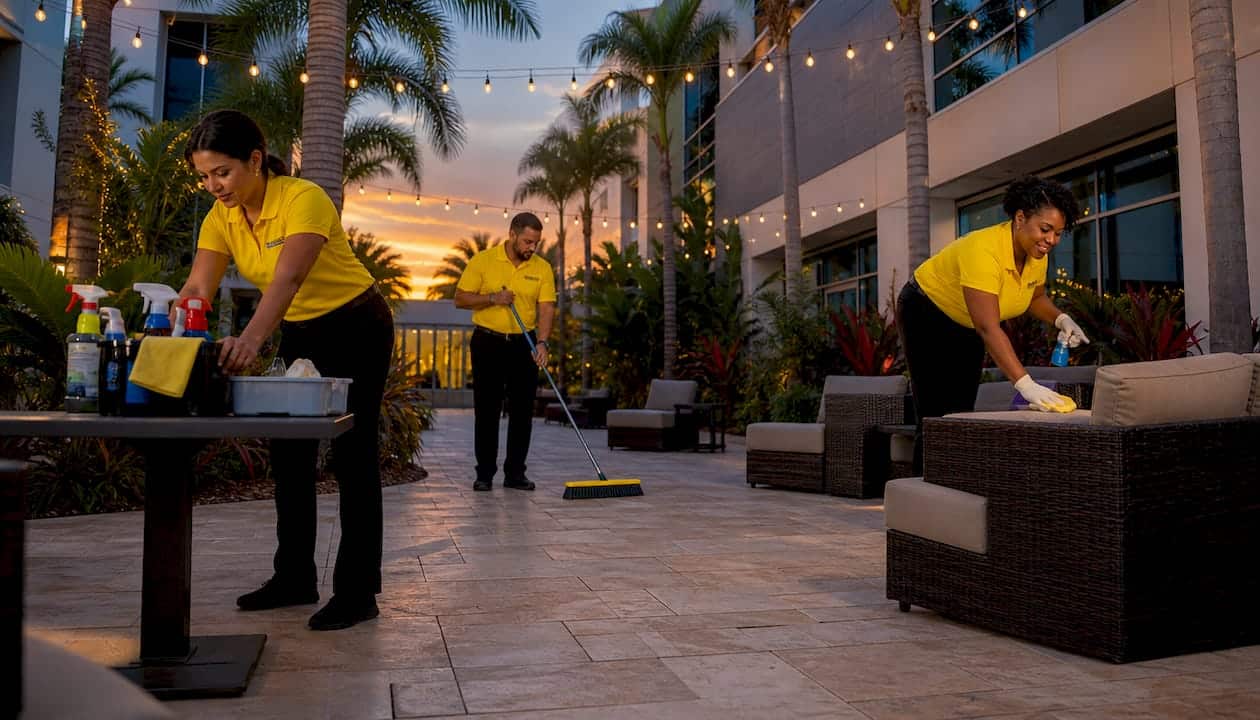
After-hours office cleaning is defined as professional cleaning performed outside standard business hours, typically evenings or overnight, when the office is fully unoccupied. This approach gives cleaning crews complete access to every surface, workstation, and shared space without navigating around employees or interrupting operations. The industry term for this service is “after-hours commercial cleaning,” and it covers everything from nightly janitorial routines to periodic deep cleaning of carpets, restrooms, and break rooms. For business owners and property managers in Tampa, Clearwater, and St. Petersburg, understanding this model is the first step toward maintaining a workspace that looks professional every single morning.
What is after-hours office cleaning and why does it matter?
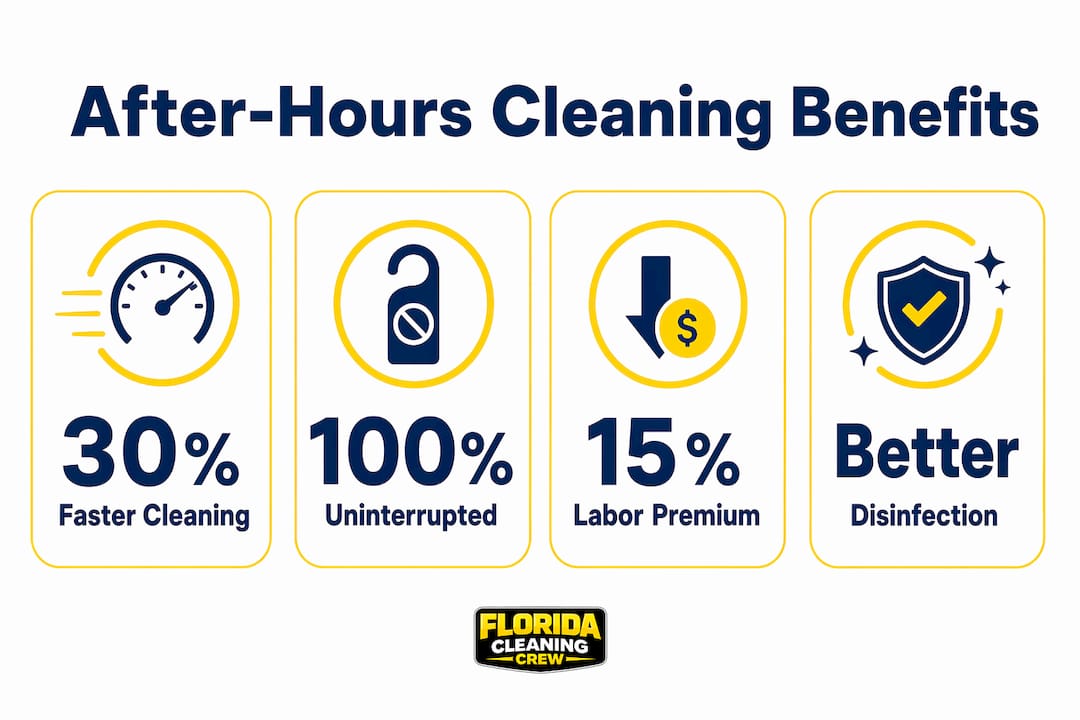
After-hours office cleaning delivers 100% uninterrupted service because crews work in a fully vacated building. That single fact changes everything about cleaning quality. When no one is at their desk, cleaners can move furniture, sanitize every surface, and run equipment without stopping to apologize or wait for someone to step aside.
The model also solves a problem that daytime cleaning never fully addresses: chemical exposure. Cleaning chemical vapors dissipate completely before staff arrive the next morning, which improves air quality and reduces health complaints. This matters especially in offices where employees spend eight or more hours breathing recirculated air.
For property managers overseeing multi-tenant buildings in the Tampa Bay area, after-hours scheduling also protects tenant relationships. Cleaning crews are not blocking hallways during business hours or creating noise during client calls. The building simply resets overnight, ready for the next day.
What are the main benefits of after-hours cleaning for businesses?
The practical advantages of scheduling office cleaning services after hours go well beyond convenience. Here is where the real operational value shows up:
- Thoroughness: Crews clean every desk, chair, and floor surface without working around occupied spaces. Deep cleaning tasks like carpet extraction, floor buffing, and restroom disinfection take half the time in an empty building.
- Hygiene compliance: Higher-strength disinfectants can be applied safely when no occupants are present. This is critical for medical offices, law firms, and financial services companies with strict sanitation standards.
- Employee morale: Staff arrive to a clean, fresh workspace each morning. Research consistently links clean work environments to lower absenteeism and higher reported job satisfaction.
- Client impressions: A spotless reception area and conference room signal professionalism before a single word is spoken.
- Asset longevity: Regular after-hours cleaning extends the life of carpets, upholstery, and hard floors by preventing the buildup that causes premature wear.
Pro Tip: Ask your cleaning provider to include carpet and upholstery spot treatment as part of the nightly routine, not just as an add-on service. Catching stains early costs far less than full replacement.
The benefits of after-hours cleaning are especially pronounced for Tampa Bay businesses that host clients regularly. A law office in downtown Tampa or a financial advisory firm in St. Petersburg cannot afford a conference room that smells like yesterday’s lunch. Nightly cleaning eliminates that risk entirely.
What operational standards and security measures should you consider?
After-hours cleaning is as much about secure site management as it is about cleaning. The most common failures in after-hours programs are not cleaning failures. They are security failures caused by informal arrangements and poor documentation.
Formal service level agreements
A Service Level Agreement, or SLA, is the foundation of any reliable after-hours program. A well-written SLA specifies:
- Exact arrival and departure times for the cleaning crew
- A room-by-room checklist with task descriptions and frequencies
- Mandatory background check requirements for all staff
- Escalation contacts for security incidents or property damage
- Documentation requirements such as digital sign-in logs and photo records
Contracts typically require a 7-year criminal history check and a sex offender registry check for every cleaning team member. That standard exists for good reason. Your cleaning crew has unsupervised access to sensitive documents, equipment, and personal belongings. Skipping this step creates liability you cannot afford.
Access frameworks and alarm management
A formal access framework is the single most important document in your after-hours cleaning program. Informal key hiding or verbal instructions are the leading causes of security failures in after-hours programs. A written framework covers alarm codes, entry and exit sequences, who to call if something goes wrong, and how to handle unexpected situations like a triggered motion sensor.
Pro Tip: Never hand over alarm codes verbally. Provide them in writing through a secure channel, and update them any time a cleaning team member leaves the company.
Consistent staffing
Named cleaning teams reduce security incidents and missed service areas by building site-specific knowledge over time. A crew that cleans your office every week knows which supply closet sticks, which bathroom exhaust fan needs extra attention, and where the recycling bins are stored. Rotating staff resets that knowledge every visit and increases the chance of an accidental alarm trigger or a missed task.
How do costs and efficiencies compare to daytime cleaning?
The most common misconception about commercial cleaning at night is that it always costs more. The reality is more nuanced.
Shift differentials for after-hours labor add a 10–15% premium to base rates. That is a real cost, and any honest provider will include it in their quote. However, the efficiency gains from working in an empty building often offset that premium by reducing total cleaning hours.
| Factor | Daytime cleaning | After-hours cleaning |
|---|---|---|
| Labor rate | Standard base rate | 10–15% shift differential |
| Cleaning speed | Slower due to occupied spaces | Faster with full access |
| Task completion | Partial access to some areas | Full access to all areas |
| Chemical use | Limited to low-odor products | Full-strength disinfectants allowed |
| Disruption to staff | Moderate to high | None |
The table shows that after-hours cleaning trades a modest labor premium for significant gains in speed and thoroughness. For most Tampa Bay offices, the net cost difference is small. The quality difference is not.
Working in an empty building allows faster, more thorough cleaning because crews do not stop and start around people. A task that takes 90 minutes during business hours often takes 50 minutes after hours. That time savings adds up across a weekly schedule and can bring total monthly costs in line with or below daytime alternatives.
For long-term budgeting, factor in asset preservation. Carpets and hard floors that receive consistent professional care last significantly longer than those cleaned sporadically. The cost of replacing commercial carpet in a mid-size Tampa office far exceeds years of professional cleaning fees.
What practical tips help you schedule and manage after-hours cleaning?
Scheduling after-hours maintenance services effectively requires more than picking a time slot. It requires a system that keeps your cleaning program running without constant supervision.
-
Set a fixed cleaning window. Most Tampa Bay offices schedule cleaning crews between 6:00 PM and 10:00 PM on weeknights. This window gives crews enough time to finish before midnight while keeping costs manageable. Buildings with early-morning staff arrivals should target the earlier end of that range.
-
Require digital shift hand-offs. Facility managers rely on digital summaries with time-stamped photos to maintain oversight without being on-site. Ask your provider to send a completion report after every visit. This creates accountability and gives you a record if a dispute arises.
-
Establish a direct communication channel. Your cleaning crew needs a single point of contact for questions, and you need a direct line to the crew lead. A group text thread or a shared messaging app works well for small offices. Larger facilities benefit from a dedicated facility management platform.
-
Consider a hybrid schedule. Hybrid cleaning models combine day porter coverage of common areas like lobbies and restrooms with after-hours crews handling private offices and conference rooms. This approach works especially well for mixed-use buildings in Clearwater or St. Petersburg where tenant traffic varies throughout the day.
Pro Tip: Review your cleaning checklist quarterly. Office layouts change, headcounts shift, and high-traffic areas evolve. A checklist that matched your office six months ago may miss critical zones today.
Floridacc recommends pairing your after-hours schedule with a written office cleaning routine that documents task frequencies, responsible parties, and escalation steps. This document becomes your reference point when evaluating service quality or onboarding a new provider.
How do you select a reliable after-hours cleaning service in Tampa Bay?
Choosing the right provider for after-hours office cleaning is not just about price. It is about finding a team you can trust with your building, your equipment, and your clients’ first impressions.
Evaluate every candidate against these criteria:
- Background checks: Confirm that every team member undergoes a 7-year criminal history check and a sex offender registry check before stepping foot in your building.
- Insurance and licensing: The provider must carry general liability insurance and workers’ compensation coverage. Ask for certificates before signing anything.
- SLA clarity: A reliable provider offers a written SLA with specific task lists, arrival times, and escalation contacts. Vague contracts produce vague results.
- Named team assignment: Insist on a consistent crew rather than rotating staff. Consistent teams build site knowledge and reduce security risks.
- Local experience: A provider familiar with Tampa Bay commercial environments understands the humidity, the building types, and the expectations of local property managers. That local context matters.
Red flags to watch for include providers who cannot produce insurance certificates on request, contracts that lack specific task descriptions, and companies that cannot tell you who will be cleaning your office on any given night. Verbal promises about staffing or scheduling are not enforceable. Get everything in writing.
Ask prospective providers these direct questions: How do you handle an accidental alarm trigger? What happens if a team member calls in sick? How do you document completed work? The answers reveal whether a company has real systems or just good sales skills.
Pairing your commercial cleaning for small business needs with a provider who offers transparent contracts and consistent staffing protects you from the most common pitfalls in after-hours programs. You can also review what a solid cleaning contract should include before you sign anything.
For offices that also need organized storage solutions alongside their cleaning program, office storage systems can reduce clutter that makes thorough cleaning harder and slower.
Key Takeaways
After-hours office cleaning delivers better results than daytime cleaning because full building access, stronger disinfectants, and uninterrupted workflows combine to produce a cleaner, safer workspace every morning.
| Point | Details |
|---|---|
| Full access equals better results | Crews clean every surface without stopping for occupied spaces, cutting task time significantly. |
| Security requires written protocols | A formal access framework with alarm codes and escalation contacts prevents most after-hours incidents. |
| Background checks are non-negotiable | Require a 7-year criminal history and sex offender registry check for every team member. |
| Shift differentials are offset by efficiency | A 10–15% labor premium is typically recovered through faster cleaning in an empty building. |
| Hybrid schedules maximize value | Combining day porters for common areas with after-hours crews for private offices balances cost and coverage. |
What I’ve learned from watching after-hours programs succeed and fail
The businesses that get the most out of after-hours cleaning share one trait: they treat it like a vendor relationship, not a utility. They do not just hand over a key and hope for the best. They invest ten minutes in a proper onboarding conversation, they review the first few completion reports, and they update their checklist when the office changes.
The programs that fail almost always fail on the access side, not the cleaning side. I have seen well-intentioned property managers leave alarm codes on sticky notes by the door. I have seen verbal agreements about entry procedures that nobody remembered the same way six months later. These are not cleaning failures. They are communication failures, and they are entirely preventable with a one-page written protocol.
The cost conversation also trips people up. Business owners hear “shift differential” and assume after-hours cleaning is a luxury. It is not. When you factor in the time saved by working in an empty building, the ability to use full-strength disinfectants, and the reduction in employee disruption, the math usually works out in favor of after-hours scheduling. The offices I have seen resist it longest are often the ones paying more for daytime cleaning that never quite gets the job done.
My honest recommendation: start with a 90-day trial. Set clear expectations in writing, require digital completion reports from day one, and evaluate the results against a specific checklist. If the provider cannot meet those standards in 90 days, they will not meet them in 12 months either.
— Matt
After-hours office cleaning with Floridacc

Floridacc provides after-hours commercial cleaning for offices, retail spaces, and commercial facilities across Tampa, Clearwater, and St. Petersburg. Every team member is background-checked, and every service agreement includes a written task checklist with documented completion reports. Floridacc’s scheduling is flexible, whether you need nightly service, three days a week, or a hybrid model that combines day coverage with after-hours deep cleaning. If you manage a small business or a multi-tenant property and want a cleaning partner you can actually rely on, explore Floridacc’s commercial cleaning services and request a free estimate today.
FAQ
What does after-hours office cleaning include?
After-hours office cleaning typically includes vacuuming, mopping, restroom disinfection, trash removal, surface wiping, and periodic deep cleaning tasks like carpet extraction and floor buffing. The exact scope depends on the service agreement and the size of the facility.
Is after-hours cleaning more expensive than daytime cleaning?
After-hours cleaning carries a 10–15% shift differential on labor rates, but efficiency gains from working in an empty building often offset that premium by reducing total cleaning hours. For most offices, the net cost difference is minimal.
What background checks should a cleaning company provide?
A reputable after-hours cleaning provider conducts a 7-year criminal history check and a sex offender registry check on every team member before they access your building. Always ask for written confirmation before signing a contract.
How do I maintain oversight without being on-site?
Require your cleaning provider to send digital shift summaries with time-stamped photos after every visit. Facility managers use this documentation to verify task completion and maintain accountability without supervising in person.
What is the best time window for after-hours office cleaning in Tampa Bay?
Most Tampa Bay offices schedule cleaning crews between 6:00 PM and 10:00 PM on weeknights. This window allows enough time for thorough cleaning while keeping labor costs manageable and ensuring the space is ready before early-morning staff arrivals.