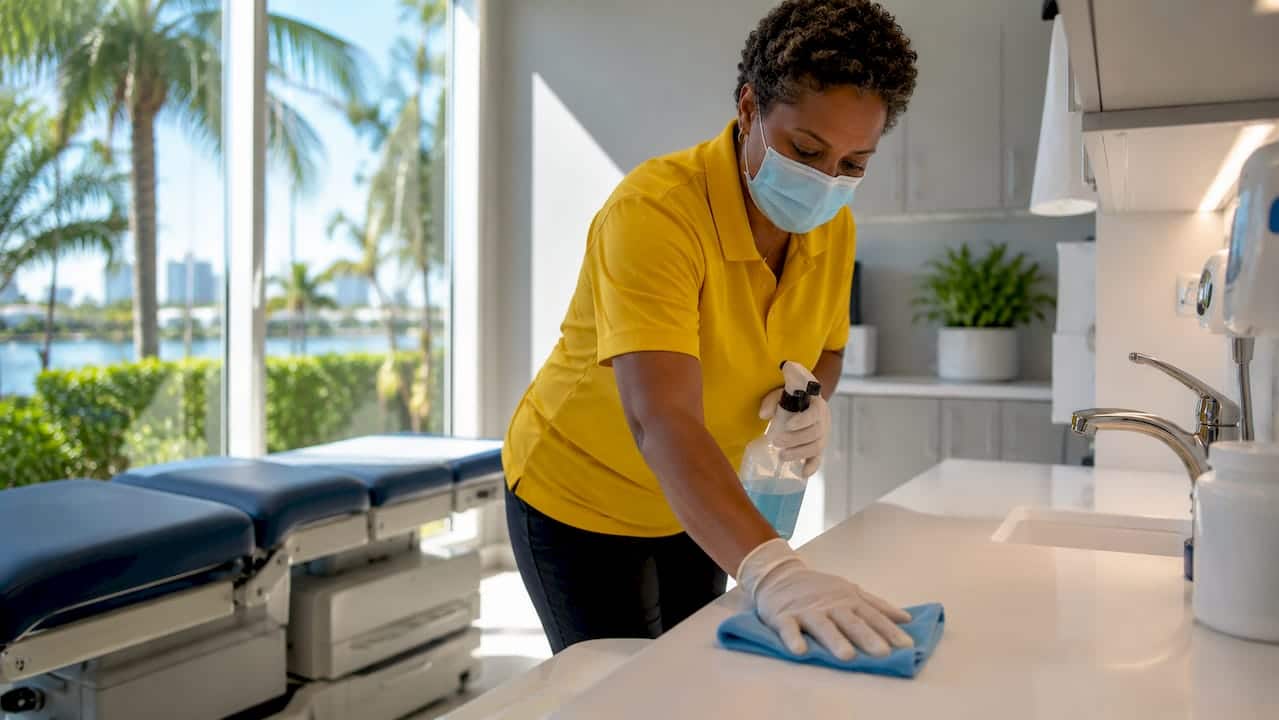
Medical office cleaning is the specialized sanitation process that removes pathogens, prevents cross-contamination, and maintains a safe environment for patients and staff. Unlike standard commercial cleaning, it follows strict protocols governed by CDC and OSHA guidelines, using hospital-grade disinfectants and documented procedures that general janitorial services are not trained to perform. The CDC reports that 1 in 31 hospital patients has at least one healthcare-associated infection on any given day, with 687,000 HAIs occurring in U.S. acute care hospitals annually. That number makes medical office sanitation one of the most consequential decisions a healthcare administrator can make.
What is medical office cleaning and how does it work?
Medical office cleaning is the systematic process of removing biological contaminants, disinfecting clinical surfaces, and maintaining infection-control standards across every area of a healthcare facility. The industry term for this practice is healthcare environmental services, though medical office cleaning is the phrase most administrators use when sourcing providers.
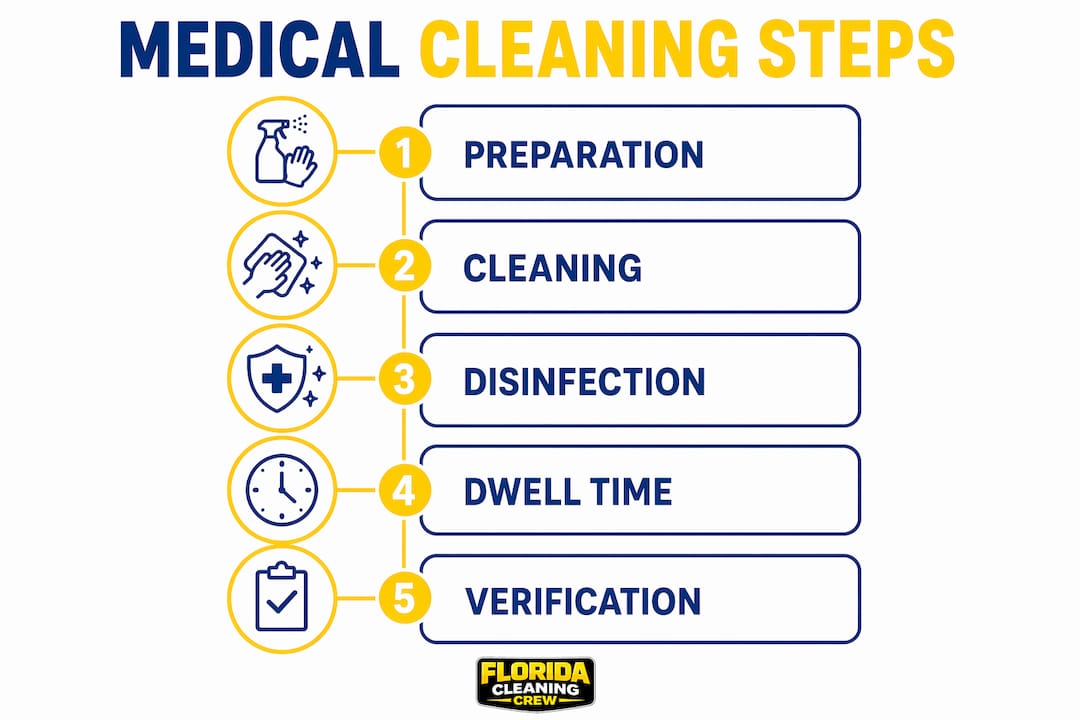
The process separates into two distinct steps: cleaning and disinfection. Cleaning removes visible soil and organic matter from surfaces. Disinfection kills the pathogens left behind. Disinfectants are ineffective if organic soil is not removed first, which is why the sequence matters. Skipping the cleaning step before applying a disinfectant is one of the most common protocol failures in clinical settings.
Dwell time is the other critical variable. Hospital-grade disinfectants require specific dwell times to effectively kill pathogens. Most products require the surface to remain visibly wet for 30 seconds to 10 minutes depending on the pathogen targeted. Staff who wipe a surface dry immediately after application are not completing the disinfection cycle.
Zone-based risk models
Zone-based risk models separate high-risk clinical areas from low-risk administrative spaces to focus cleaning frequency and resources for infection control. A procedure room requires different attention than a billing office. This model prevents over-cleaning in low-risk zones while protecting the areas where patient contact and biological exposure are highest.
Surface classifications follow a similar logic:
- Critical surfaces contact sterile tissue or the bloodstream and require sterilization. Examples include surgical instruments and IV equipment.
- Semi-critical surfaces contact mucous membranes and require high-level disinfection. Examples include examination tables and reusable diagnostic tools.
- Non-critical surfaces contact intact skin and require low-to-intermediate disinfection. Examples include countertops, door handles, and waiting room chairs.
Personal protective equipment is mandatory throughout. Cleaning staff must wear gloves, gowns, and eye protection when handling contaminated materials. OSHA’s bloodborne pathogen standards require documented training before any staff member enters a clinical cleaning environment.
Pro Tip: Always verify that your cleaning provider can produce written proof of OSHA bloodborne pathogen training for every team member assigned to your facility.
How does medical office cleaning differ from regular office cleaning?
The gap between medical office cleaning and standard janitorial service is not about effort. It is about training, products, and accountability. A general cleaning crew may leave a space looking spotless while leaving behind viable pathogens on high-touch surfaces. Visual cleanliness does not equal true sanitation. Medical cleaning prioritizes invisible pathogen elimination over appearance.
Four key differences
-
Specialized training. Medical office cleaning requires specialized training in OSHA-regulated bloodborne pathogen handling and proper hazardous waste disposal, including sharps and gauze. Standard janitorial staff receive no such training by default.
-
EPA-registered, hospital-grade disinfectants. General office cleaners typically use consumer-grade products. Medical facilities require EPA-registered disinfectants with documented efficacy against specific pathogens, including MRSA, C. diff, and norovirus.
-
Color-coded cloth systems. Specialized teams prevent cross-contamination using color-coded cloth systems and strict cleaning sequences. A red cloth used in a restroom never touches an examination table. This single practice eliminates one of the most common vectors for bacterial spread in clinical environments.
-
Documentation and audit readiness. Cleaning logs, Safety Data Sheets, and staff training records are critical for meeting regulatory inspections and audits. Standard janitorial contracts rarely include this level of record-keeping.
The table below shows how these two service types compare across the factors that matter most to medical office administrators.
| Factor | Standard office cleaning | Medical office cleaning |
|---|---|---|
| Disinfectant type | Consumer-grade products | EPA-registered, hospital-grade |
| Staff training | General cleaning skills | OSHA bloodborne pathogen certified |
| Cross-contamination control | Not systematically addressed | Color-coded cloths, zone protocols |
| Documentation | Minimal or none | Cleaning logs, SDS records, audit trails |
| Biohazard handling | Not included | Sharps, gauze, and regulated waste |
Understanding these differences helps administrators ask the right questions when evaluating professional-grade cleaning products and the providers who use them.
How often should a medical office be cleaned?
Cleaning frequency in a medical office is not a fixed schedule. It is a variable determined by patient volume, facility type, and the risk level of each zone. Healthcare cleaning service frequencies are customizable, ranging from daily to weekly or monthly, based on facility size, patient volume, and specialty. That flexibility is what allows a solo-practitioner clinic in St. Petersburg to maintain the same infection-control standards as a multi-specialty group practice in Tampa.
The baseline schedule for most medical offices looks like this:
- Multiple times per day: High-touch surfaces including door handles, light switches, reception counters, exam table surfaces, and restroom fixtures. Ungloved hands become contaminated with pathogenic microorganisms more than 50% of the time after touching surfaces in terminally cleaned rooms. That rate makes mid-day disinfection of high-touch points a non-negotiable practice.
- Daily: Full disinfection of exam rooms, restrooms, waiting areas, and clinical workstations. Floors mopped with appropriate disinfectant solution. Waste bins emptied and relined.
- Weekly: Deep cleaning of administrative areas, thorough disinfection of medical equipment surfaces, and inspection of supply storage areas.
- Monthly: Terminal cleaning of low-traffic clinical spaces, review of cleaning logs, and restocking of PPE and disinfectant supplies.
Specialty practices require schedule adjustments. A pediatric clinic with high patient turnover needs more frequent waiting room disinfection than an adult cardiology practice with scheduled appointments. A dermatology office performing minor procedures needs daily terminal cleaning of procedure rooms. Flexible office cleaning routines that adapt to patient flow protect both patients and staff without disrupting clinical operations.
Pro Tip: Post a visible cleaning log in each exam room. Patients notice it, and it signals that your practice takes sanitation seriously.
What are the benefits of professional healthcare cleaning services?
Hiring a trained healthcare cleaning provider delivers benefits that go beyond a clean-looking office. The most direct benefit is pathogen reduction. Properly trained teams using hospital-grade disinfectants and documented protocols reduce the microbial load on clinical surfaces to levels that general cleaning cannot achieve. For patients with compromised immune systems, that difference is clinically significant.
The compliance benefit is equally important. Providers who understand healthcare regulations and proper disinfectant use help maintain audit-ready facilities with documented cleaning processes. When a state health inspector or accreditation body visits your facility, the cleaning log is one of the first documents they request. A professional provider delivers that documentation automatically.
Other concrete benefits include:
- Biohazardous waste management. Professional teams handle sharps containers, contaminated gauze, and regulated medical waste according to federal and state disposal requirements. This protects staff and removes liability from the practice.
- Patient trust. Cleanliness functions as a visible signal of control and professionalism, directly impacting patient trust and audit outcomes. Patients form impressions of clinical competence from the physical environment before they ever see a provider.
- Staff safety. Consistent disinfection of clinical workstations reduces staff exposure to pathogens. Sick days and occupational exposure incidents both decrease when cleaning protocols are followed correctly.
- Operational continuity. A professional provider works around your schedule, cleaning after hours or between patient blocks so clinical operations are never interrupted.
For medical offices in the Tampa Bay area, including practices in Clearwater and St. Petersburg, working with a locally based provider who understands Florida’s healthcare facility requirements adds another layer of accountability. Local providers are reachable, responsive, and familiar with the specific regulatory environment your practice operates in. Administrators evaluating their options can also review commercial cleaning for small business resources to understand what a structured service agreement should include.
Key Takeaways
Medical office cleaning requires trained staff, EPA-registered disinfectants, documented protocols, and zone-based scheduling to effectively control infection and maintain regulatory compliance.
| Point | Details |
|---|---|
| Cleaning before disinfection | Remove organic soil first; disinfectants fail on uncleaned surfaces. |
| Dwell time compliance | Allow hospital-grade disinfectants to remain wet for the full required contact time. |
| Zone-based scheduling | Assign cleaning frequency by risk level, not by room size or convenience. |
| Documentation is mandatory | Cleaning logs and SDS records are required for audits and regulatory inspections. |
| Professional training matters | Only OSHA-certified staff should handle bloodborne pathogens and biohazardous waste. |
What I’ve learned from watching medical offices get cleaning wrong
Medical office administrators often tell me they already have a cleaning service. What they mean is they have a general janitorial contract. Those are not the same thing, and the difference shows up at the worst possible time: during an audit, after a patient complaint, or when an infection cluster gets traced back to a surface that was wiped but never actually disinfected.
The most persistent mistake I see is treating a visually clean space as a safe one. A surface can look spotless and still carry viable MRSA or norovirus. The pathogens that matter most in a clinical setting are invisible. That is exactly why protocol, not appearance, has to be the standard.
Documentation failures are the second most common problem. Facilities get cited not because their cleaning was poor, but because they cannot prove it was done correctly. A cleaning log takes two minutes to complete. The absence of one can cost a practice its accreditation. Any provider worth hiring will build documentation into the service by default, not as an add-on.
My honest advice: before you sign any cleaning contract, ask for a sample cleaning log, a list of the EPA-registered disinfectants the team uses, and proof of OSHA bloodborne pathogen training. If a provider cannot produce all three within 24 hours, keep looking. The Tampa Bay market has enough qualified providers that you should never have to settle for a general janitorial crew in a clinical space.
— Matt
Floridacc’s commercial cleaning services for Tampa Bay medical offices
Medical offices in Tampa, Clearwater, and St. Petersburg need a cleaning partner who understands the difference between a tidy office and a genuinely safe one.

Floridacc provides commercial cleaning services in Tampa Bay tailored to the specific demands of medical and professional office environments. The team works around your schedule, uses professional-grade products, and delivers the documentation your facility needs to stay inspection-ready. Whether your practice sees 20 patients a day or 200, Floridacc builds a cleaning plan that fits your patient volume, your floor plan, and your compliance requirements. Contact Floridacc for a free estimate and find out what a properly structured medical office cleaning program looks like in practice.
FAQ
What is the difference between cleaning and disinfecting in a medical office?
Cleaning removes visible dirt and organic matter from surfaces. Disinfecting kills pathogens on surfaces that have already been cleaned. Both steps are required; disinfectants do not work effectively on surfaces with organic soil present.
How often should high-touch surfaces be disinfected in a clinic?
High-touch surfaces including door handles, exam tables, and reception counters should be disinfected multiple times per day. Research shows ungloved hands become contaminated more than 50% of the time after touching surfaces in recently cleaned rooms.
What training do medical office cleaning staff need?
Medical cleaning staff must complete OSHA-regulated bloodborne pathogen training before working in clinical environments. This training covers safe handling of sharps, contaminated materials, and regulated medical waste.
Why does documentation matter in medical office cleaning?
Cleaning logs, Safety Data Sheets, and training records are required during regulatory inspections and accreditation audits. Facilities are frequently cited for missing documentation even when their actual cleaning practices are sound.
Can a general janitorial service clean a medical office?
A general janitorial service lacks the training, products, and documentation practices required for medical office sanitation. Medical facilities require EPA-registered disinfectants, OSHA-certified staff, and structured audit trails that standard cleaning contracts do not include.