Most people assume that if someone shows up and cleans on schedule, the job is done right. That assumption is costing homeowners, property managers, and business owners in Tampa Bay more than they realize. Understanding what is a quality cleaning service goes beyond showing up with a mop and a checklist. It means consistent results, documented standards, and accountability at every visit. This guide breaks down the real characteristics that separate a quality cleaning service from one that just looks good on paper, so you can make smarter decisions about who maintains your property.
Table of Contents
- Key takeaways
- What quality cleaning service really means
- Quality control systems and what they actually do
- Real benefits of hiring a quality cleaning service
- How to select a quality cleaning partner in Tampa Bay
- My honest take on what quality cleaning actually requires
- Cleaning services in Tampa Bay that take quality seriously
- FAQ
Key takeaways
| Point | Details |
|---|---|
| Schedules alone don’t equal quality | Showing up on time proves presence, not cleanliness. Inspections and scoring systems verify actual results. |
| Standardized protocols matter | Quality providers use written checklists and trained staff to deliver consistent outcomes every single visit. |
| Inspection systems prevent complaints | Scored zone-by-zone inspections catch failures before clients ever notice, reducing rework and protecting relationships. |
| Quality cleaning protects property value | Consistent cleaning preserves surfaces, materials, and equipment, saving money on repairs and replacements over time. |
| Right questions get better partners | Asking providers about their inspection protocols and documentation habits filters out low-quality options quickly. |
What quality cleaning service really means
There is a wide gap between a space that looks clean and one that is clean. A quality cleaning service delivers measurable, repeatable results rather than effort that varies from visit to visit. That distinction matters more than most clients expect.
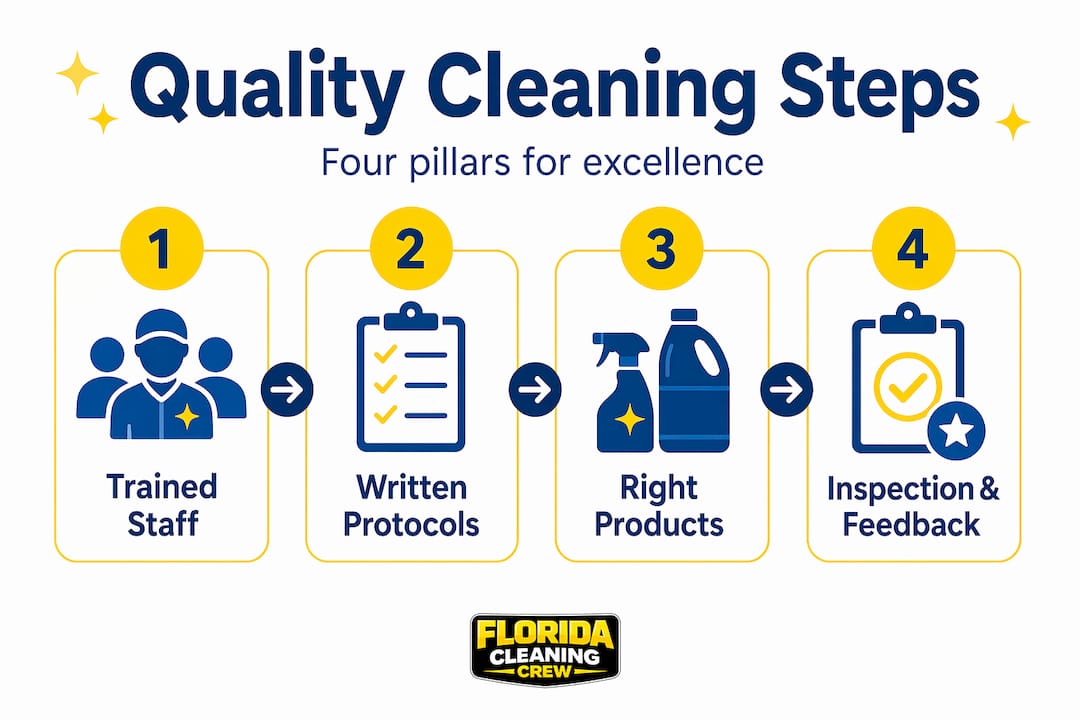
At its core, what makes a cleaning service good comes down to four things: trained people, clear procedures, the right products, and accountability systems. Most services can offer the first two. Far fewer back them up with the third and fourth.
Standardized protocols and written checklists
Standardized checklists make training faster, supervision easier, and client satisfaction more predictable because every task is documented and expected on every visit. Without a written scope of work, tasks get skipped. Not because cleaners are careless, but because nothing is requiring them to complete it. A written checklist removes that ambiguity entirely.
A quality provider defines exactly what gets cleaned in each room, how it gets cleaned, and what standard it should meet after the fact. This is the backbone of consistent cleaning standards: specific, measurable criteria that every team member follows regardless of who is on the job that day.
Vetted, trained staff using appropriate products
Training is not optional at the quality level. A well-trained cleaner knows which products work on which surfaces, how to prevent cross-contamination between zones, and how to work efficiently without missing anything. Reputable providers also background-check their staff, carry liability insurance, and operate with proper licensing. These are non-negotiable features of top cleaning services, not perks.
The products matter too. Eco-friendly, non-toxic cleaning solutions have become standard in quality residential cleaning because they are safer for families, pets, and surfaces. A provider still using harsh chemicals on sealed hardwood floors or granite countertops is cutting corners whether they realize it or not.
Clear, documented scope of work
When a cleaning service quotes you a job, the scope of work should be in writing. That document is your protection. If a task is not on the list, you cannot reasonably expect it to happen. Quality providers welcome this conversation because it helps them deliver exactly what you expect rather than guessing.
Pro Tip: Before signing with any cleaning service, ask them to provide their standard service checklist in writing. If they hesitate or do not have one, that tells you everything about their approach to accountability.
Here is what a quality scope of work typically includes for a residential or commercial property:
- Room-by-room task descriptions with defined cleaning standards
- Frequency of each task (daily, weekly, monthly, or per visit)
- Products and methods approved for specific surfaces
- Notes on restricted areas, special equipment, or materials
- Contact points and escalation process for issues
This level of documentation is what professional cleaning standards look like in practice.
Quality control systems and what they actually do
Here is where most cleaning services fall short, and most clients never find out until something goes wrong. Completing a cleaning schedule only proves that someone visited. It does not prove that the space is actually clean. Routine schedules without inspection only verify presence, not cleaning effectiveness or hygiene standards.
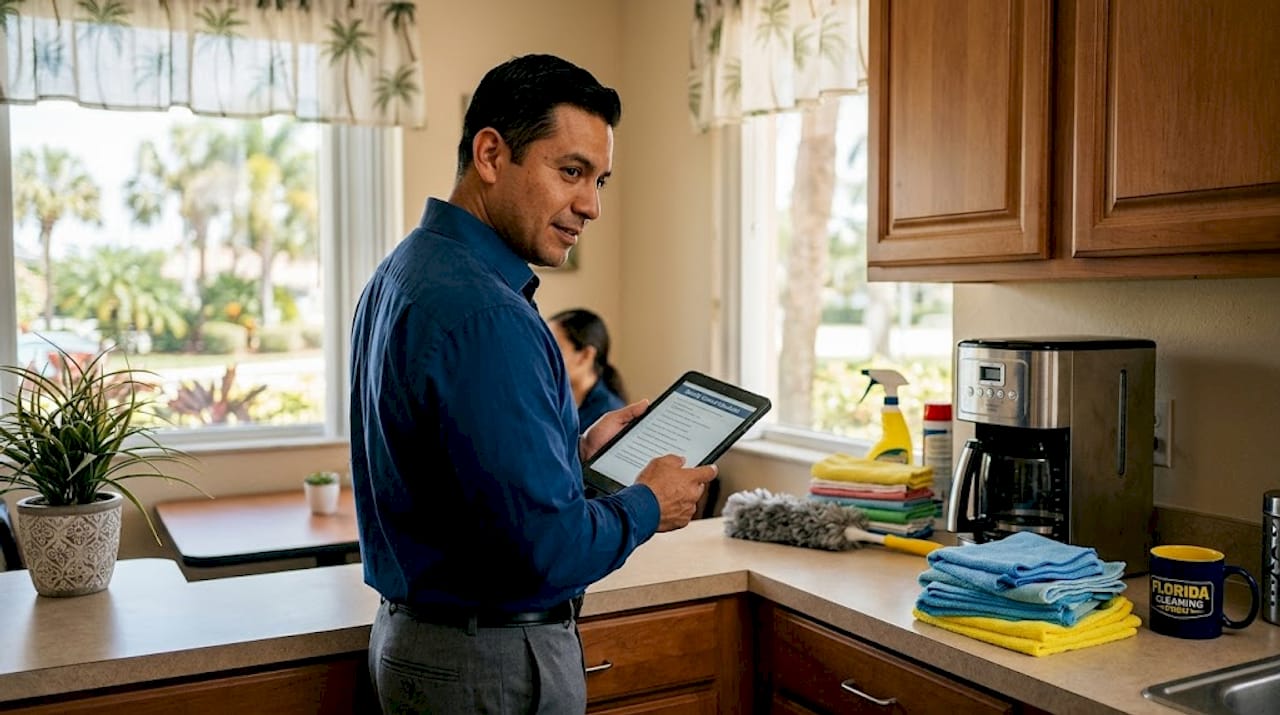
Quality control systems close that gap. They use inspections, scoring criteria, photo documentation, and corrective action protocols to verify results instead of just assuming them.
How scored inspections work
A scored inspection assigns point values to specific tasks or zones and generates a measurable cleanliness score for each visit. One industry checklist uses a 4-point scoring system that triggers an automatic re-service when scores fall below an acceptable threshold. That means problems get corrected before you ever have to make a complaint call.
This approach is not limited to large commercial facilities. Residential and short-term rental properties benefit just as much from zone-by-zone verification. A vacation rental in Clearwater with an inconsistent cleaning score will accumulate negative reviews fast. A scored inspection system catches those failures on the provider’s side, not on yours.
Here is a sample of typical inspection zones and their focus areas:
| Zone | Key inspection points | Frequency |
|---|---|---|
| Restrooms | Fixtures, grout, dispensers, odor control | Every visit |
| Kitchen/breakroom | Appliance surfaces, sink, handles, floors | Every visit |
| Common areas/lobbies | Floors, glass, furniture, trash receptacles | Every visit |
| Offices/bedrooms | Dusting, vacuuming, high-touch surfaces | Every visit |
| Entry points | Mats, glass doors, thresholds | Every visit |
Restrooms consistently show the highest complaint density in commercial facilities, meaning failures there require immediate corrective action to protect tenant or customer satisfaction. Property managers in St. Petersburg and Tampa who skip restroom inspection requirements discover this the hard way.
Digital tools and photo documentation
Technology enhances quality control by enabling real-time reporting, mobile inspection scoring, and photo-based documentation so clients can review results without being on-site. This matters particularly for property managers overseeing multiple units or business owners who are not present during cleaning hours.
Photo documentation creates an auditable record of before-and-after conditions. If a dispute arises, both parties have clear evidence. Quality control systems that include photo verification catch mistakes before clients notice them, which protects the client relationship and the provider’s reputation simultaneously.
Pro Tip: When evaluating cleaning services, ask specifically whether they use digital inspection tools and whether you will receive reports after each visit. Providers who offer this without hesitation operate at a genuinely higher standard.
Digital inspection tools can improve APPA cleanliness scores compared to paper verification, catching hygiene failures significantly earlier than schedule-based tracking alone.
Real benefits of hiring a quality cleaning service
The difference between a quality cleaning service and an average one shows up in ways that go far beyond a tidy appearance. For homeowners, property managers, and business owners, the practical value is measurable.
- Better health outcomes. Proper cleaning reduces allergens, bacteria, and airborne contaminants. This matters most in homes with children or elderly residents and in commercial spaces with high foot traffic.
- Consistent appearance that builds trust. Tenants renew leases in clean buildings. Customers return to clean businesses. A property manager’s approach to turnovers directly affects tenant satisfaction scores and vacancy rates.
- Longer surface and material lifespan. Grout left dirty requires eventual replacement. Hardwood floors neglected of proper maintenance dull and scratch faster. Regular quality cleaning is a form of property maintenance, not just aesthetics.
- Reduced risk of regulatory issues. Commercial properties in Tampa Bay face health and safety inspections. Consistent, documented cleaning helps businesses meet those requirements before an inspector ever arrives. The Tampa Bay business cleaning compliance requirements for food service, healthcare, and hospitality spaces are not suggestions.
- Fewer complaints and rework costs. Without quality systems, cleaning results vary and customer satisfaction drops. Every complaint costs time, money, and trust. Prevention through quality control is always cheaper than correction after the fact.
- Peace of mind through documentation. Knowing that every visit is inspected and recorded removes the mental load of monitoring it yourself. That peace of mind has real value, especially for busy property managers overseeing multiple sites.
Quality assurance systems do not just prevent complaints. They build the kind of long-term client loyalty that turns a one-time booking into a multi-year relationship.
How to select a quality cleaning partner in Tampa Bay
Knowing what quality cleaning looks like is useful. Knowing how to find it locally is what actually solves your problem. Here is a practical process for evaluating and working with cleaning services in Tampa, Clearwater, and St. Petersburg.
-
Verify licensing, insurance, and training credentials. Any legitimate provider in Florida should carry general liability insurance and workers’ compensation coverage. Ask for certificates, not just verbal confirmation. Trained staff with background checks are the minimum standard.
-
Ask directly about their quality control system. The question “How do you verify the quality of each visit?” will quickly separate quality providers from the rest. A strong answer includes inspections, scoring, and documented corrective action. A weak answer is “We have experienced cleaners.”
-
Request a sample inspection report or checklist. The best cleaning services will hand you this without hesitation. If a provider cannot show you what they measure, they are probably not measuring much.
-
Define your scope of work in writing before the first visit. Be specific about rooms, surfaces, frequency, and any special requirements. A vacation rental cleaning checklist or move-in scope, for example, should cover details like appliance interiors and window tracks that general residential cleaning might skip.
-
Evaluate communication habits early. How fast does the provider respond to questions before you book? That responsiveness pattern continues after you become a client. Slow pre-sales communication usually signals slow problem resolution later.
-
Set a review schedule. Even with a quality provider, build in a check-in every 90 days to review inspection reports, discuss any concerns, and adjust the scope if your property’s needs have changed. Improving cleaning routines over time is a collaboration, not a one-time setup.
-
Monitor early visits closely. The first two or three visits tell you most of what you need to know about a provider’s actual standards. Pay attention to areas that are easy to miss, like baseboards, air vents, and the backs of fixtures.
My honest take on what quality cleaning actually requires
I have seen enough cleaning contracts go sideways to know that the problem is almost never the cleaner’s effort. It is the absence of systems. When a client tells me they had a cleaning service for six months and slowly noticed standards slipping, that story follows the same pattern every time. The service started well, had no inspection process to catch gradual decline, and the client only realized the extent of the problem when the smell or the visible buildup became impossible to ignore.
The uncomfortable truth is that most people do not know what quality cleaning looks like until they have experienced it. Surface cleanliness is visible. But the grout between bathroom tiles, the dust on the top of the refrigerator, the film on the inside of a microwave. Those are the things that separate a space that looks clean from one that actually meets hygiene standards.
Documentation and inspection are not bureaucratic extras. They are the only honest way to hold a cleaning service accountable over time. I have found that the providers willing to show you their inspection reports are also the ones confident enough in their work to stand behind it. The ones who resist documentation tend to be the ones with results they would rather not put in writing.
If you are a property manager in Tampa Bay overseeing multiple units, my advice is simple: do not evaluate cleaning services on price or personality alone. Evaluate them on their systems. Ask the hard questions before signing. And if a provider cannot explain how they measure quality, find one who can.
— Matt
Cleaning services in Tampa Bay that take quality seriously
If you have been trying to figure out what separates average cleaning from truly reliable, documented service, Floridacc has built its entire operation around that answer. Every residential and commercial cleaning job follows detailed, zone-specific checklists. Every visit is held to a defined standard, not just a schedule.
Floridacc serves homeowners, property managers, and small business owners across Tampa, Clearwater, and St. Petersburg with services designed to protect your property and your time. Whether you need reliable home cleaning for your residence or consistent commercial cleaning for your business, Floridacc brings the accountability and transparency that quality actually requires. Request a free estimate and see the difference a documented quality standard makes.
FAQ
What is a quality cleaning service?
A quality cleaning service delivers consistent, measurable results using trained staff, written cleaning protocols, and inspection-based accountability systems. It is defined not just by the act of cleaning, but by verifiable standards and corrective processes when those standards are not met.
What makes a cleaning service good vs. just okay?
Good cleaning services use documented checklists, scored inspections, and photo verification to confirm results after each visit. Average services rely on schedules and assumptions, which leads to gradual quality decline without anyone catching it early.
How do quality control inspections work in cleaning?
Inspections assign scores to specific cleaning zones and tasks, then trigger corrective actions when scores fall below an acceptable level. Scored inspection systems are industry best practices in commercial cleaning quality management.
Why is documentation important when hiring a cleaning service?
Documentation creates an auditable record of what was cleaned, to what standard, and on what schedule. It protects you as the client and holds the provider accountable between visits, especially for property managers who are not on-site during cleaning.
What should I ask a cleaning service before hiring them in Tampa Bay?
Ask for their written checklist, proof of insurance, and a description of their inspection process. A quality provider will answer those questions confidently and offer to show you sample inspection reports before you ever sign a contract.