Most Tampa Bay property managers and business owners assume keeping janitorial services in-house gives them more control and a lighter budget. The reality is more complicated. Managing your own cleaning crew means taking on payroll taxes, workers’ compensation exposure, safety compliance, and equipment costs that rarely show up on the first estimate. When you add it all up, the “cheap” in-house option often costs more than a professionally managed outsourcing contract, and carries significantly more legal and financial risk.
Table of Contents
- Understanding the risks and liabilities of janitorial work
- Direct hires vs. outsourcing: a cost and compliance comparison
- The top benefits of outsourcing janitorial services
- How to select a reliable janitorial partner in Tampa Bay
- The truth experts don’t tell you about outsourcing janitorial work
- Get reliable janitorial outsourcing with local expertise
- Frequently asked questions
Key Takeaways
| Point | Details |
|---|---|
| Outsourcing shifts risk | Handing janitorial work to insured professionals transfers compliance and liability away from your business. |
| Saves time and resources | You avoid hiring, payroll, and daily management burdens—freeing your team for higher-priority work. |
| Consistent, quality results | Properly vetted cleaning companies deliver reliable, standards-based service and quick problem resolution. |
| Smart vendor selection matters | Always verify credentials, insurance coverage, and KPIs to avoid costly mistakes. |
Understanding the risks and liabilities of janitorial work
Running an in-house janitorial team feels straightforward until something goes wrong. A slip-and-fall injury, a cleaning chemical misuse incident, or an OSHA violation can turn a routine cleaning schedule into a legal and financial nightmare. Most business owners don’t budget for this exposure because they never see it coming.
The risks fall into a few clear categories. First, there’s workers’ compensation liability. If a member of your internal cleaning crew is injured on the job, your business is directly responsible for medical costs and lost wages. In Florida, workers’ comp rates for janitorial workers are notably high because the work involves physical labor, chemical exposure, and the constant risk of slip-and-fall incidents. Second, there’s general liability exposure. If an in-house employee damages property, causes a fire, or creates a hazardous spill that harms a tenant or customer, your business insurance bears the full weight of that claim. Third, you face regulatory compliance obligations. OSHA standards for chemical storage, handling, and safety equipment apply to every employer, including yours if you have cleaning staff. Failing to meet those standards means fines, audits, and potentially shutting down operations.
When you work with hiring licensed cleaning contractors, you shift a major portion of that exposure onto the contractor’s own insurance policy. As noted by industry compliance experts, outsourcing can shift liability and compliance burdens away from the property owner to the cleaning contractor, provided the contractor is properly insured and vetted.
Common risks that property managers overlook with in-house teams include:
- Unverified worker backgrounds leading to theft or security incidents
- Inconsistent use of safety equipment such as gloves, goggles, and non-slip footwear
- Poor chemical storage practices that violate OSHA or fire code standards
- Gaps in documentation for injuries, incidents, or cleaning logs
- No formal safety training program, exposing you to regulatory fines
- Overtime pay obligations when your team is shorthanded and staff works extra hours
According to research on outsourcing building maintenance, facilities that hand off specialized maintenance work to certified contractors consistently reduce unplanned repair costs and safety incidents. The same principle applies to janitorial work.
“When you hire a cleaning company that carries its own insurance and maintains compliance documentation, you are no longer the first line of defense in a lawsuit. That alone changes the risk profile of your entire operation.” — Florida cleaning compliance experts
Your cleaning compliance guide for Tampa Bay businesses outlines the specific documentation and protocols you need to stay compliant, whether you manage cleaning in-house or outsource it. Reviewing that framework before signing any contract is a smart first step.
Direct hires vs. outsourcing: a cost and compliance comparison
The numbers rarely lie, but they do require honest accounting. When you compare the true cost of direct-hire janitorial staff against a contracted cleaning service, the gap is often larger than most property managers expect.

Here is a side-by-side look at what each approach actually costs and requires:
| Category | In-house staff | Outsourced contractor |
|---|---|---|
| Payroll taxes | You pay employer share | Not your responsibility |
| Workers’ comp insurance | You carry the policy | Contractor carries own coverage |
| General liability | Your policy at risk | Contractor’s policy covers cleaning work |
| Equipment and supplies | You purchase and maintain | Contractor supplies their own |
| HR management | Recruiting, training, managing | No internal HR burden |
| Compliance oversight | Your full responsibility | Shared or shifted to contractor |
| Scheduling flexibility | Requires overtime pay or temp hires | Built into the service contract |
| Termination risk | Unemployment claims possible | Cancel or modify contract |
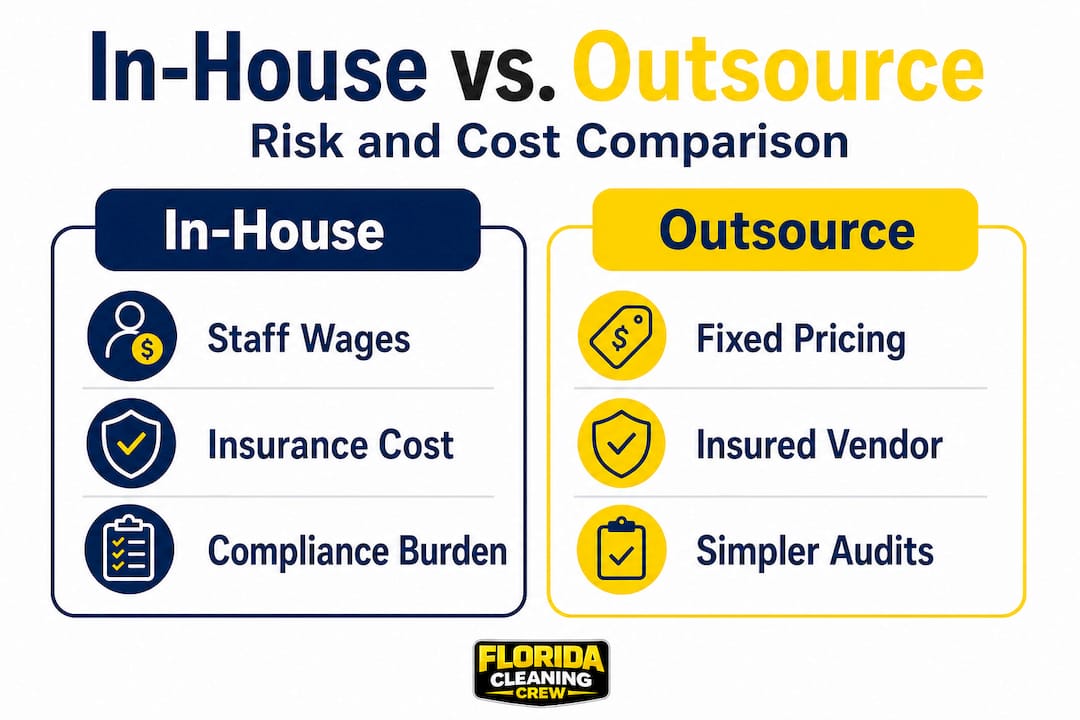
The cleaning company carries its own liability insurance and workers’ compensation coverage, which means your business avoids two of the most expensive recurring costs in the in-house model. That’s not a minor footnote. In Florida, workers’ comp for janitorial employees can run between 8% and 15% of payroll, depending on risk classification. For a small team of three cleaners earning $35,000 each, that’s potentially $10,000 to $15,000 per year in additional costs before you account for equipment, supplies, and benefits.
Here’s a step-by-step breakdown of what you avoid and gain by outsourcing:
- Eliminate payroll tax obligations for cleaning staff immediately upon contract signing.
- Remove workers’ comp exposure because the contractor’s policy covers their employees.
- Avoid HR overhead including job postings, onboarding, training management, and performance reviews.
- Reduce equipment capital costs since the vendor brings commercial-grade tools.
- Gain contract flexibility to scale service up or down as your needs change seasonally.
- Simplify compliance by requiring the vendor to maintain documentation and certifications.
You can explore more about managing risk comparison tips and how investing in professional cleaning protects both health and property value. The financial case for outsourcing becomes even more compelling when you factor in the management hours you currently spend supervising cleaning staff rather than running your core business.
If you operate a smaller facility, small business cleaning needs are often best served by a contract model because you get professional-grade results without the overhead of a part-time employee who may call out sick or quit without notice.
Pro Tip: Always request a certificate of insurance directly from your contractor’s insurer, not just a copy handed to you by the vendor. Certificates can be expired or falsified. A call to the insurance company to verify active coverage takes five minutes and can save you enormous headaches later.
The top benefits of outsourcing janitorial services
Let’s move past the risk and compliance argument and look at the bigger operational picture. The benefits of outsourcing go well beyond avoiding lawsuits. They affect your day-to-day stress levels, your budget predictability, and the quality of your work environment.
Predictable, fixed-cost budgeting is one of the most underappreciated benefits. With an in-house team, expenses fluctuate. Staff turnover forces you to spend on recruiting and training. Sick days mean either a dirty facility or overtime pay for another worker. Equipment breaks down. Cleaning supplies run out at the wrong time. A contracted janitorial service gives you a fixed monthly cost that you can plan around, regardless of what’s happening on the vendor’s side of the operation.
Staying focused on your core business sounds obvious, but property managers consistently underestimate how much time they lose to cleaning-related management. Scheduling changes, supply ordering, performance conversations, and safety monitoring all eat into hours that should be spent on leasing, tenant relations, or facility improvements. Outsourcing hands that entire function to a professional whose whole business is built around doing it well.
Rapid response and scalability matter more than most people expect. Say you manage a Tampa Bay commercial property and you land a new tenant who needs their space cleaned before move-in. Or your facility hosts an event and you need deep cleaning afterward. With an in-house team, scaling up usually means scrambling for temp workers. With an outsourced provider, it’s a phone call or a service request. The vendor handles staffing, scheduling, and coverage.
Consistent service quality is another key differentiator. When you manage cleaning in-house, quality depends heavily on individual employees. High turnover in janitorial work is common, and each new hire brings a learning curve. A professional cleaning company has standardized processes, quality checks, and team leads who ensure results stay consistent regardless of which crew is on-site.
The benefits of recurring cleaning for Tampa Bay offices document how regular, professionally managed schedules reduce employee sick days, improve air quality, and lift workplace morale. Those aren’t soft metrics. Absenteeism has a direct cost, and a cleaner workspace can meaningfully reduce it.
Industry compliance professionals recommend hiring fully insured and licensed providers and tracking safety and compliance KPIs as part of the ongoing vendor relationship. This brings structure to what could otherwise be an informal arrangement with no accountability built in.
Additional outsourcing benefits that often surprise business owners include:
- Access to commercial-grade cleaning products not available in retail stores
- Eco-friendly cleaning options that reduce chemical exposure for staff and tenants
- Professional cleaning logs that document what was cleaned and when, which matters during inspections
- Reduced equipment storage needs since the vendor maintains their own gear
- Insurance claims support if a cleaning-related incident does occur
For a full breakdown of how commercial cleaning benefits apply specifically to Tampa Bay properties, reviewing real-world case examples helps clarify the ROI.
Pro Tip: Insist on vendors who provide written compliance and service-level agreement (SLA) reporting. An SLA outlines what gets cleaned, how often, and to what standard. Without it, quality disputes become he-said/she-said conversations with no resolution path.
How to select a reliable janitorial partner in Tampa Bay
Knowing you should outsource is the easy part. Picking the right partner requires a systematic approach, especially in a market like Tampa Bay where the range of providers varies widely in quality, coverage, and compliance.
Start with a clear evaluation checklist. Here’s what every business owner or property manager should verify before signing any agreement:
| Verification item | Why it matters | How to check |
|---|---|---|
| General liability insurance | Covers property damage and third-party injuries | Request certificate from insurer directly |
| Workers’ comp coverage | Protects you if a worker is injured on your property | Verify with Florida state records |
| State business license | Confirms legal operation in Florida | Check Florida DBPR database |
| References from similar properties | Shows relevant experience | Call references, not just read reviews |
| Written service agreement | Sets expectations and accountability | Review with an attorney if needed |
| Compliance documentation | Proves safety protocols are in place | Ask for training logs and safety records |
| Background check policy | Reduces theft and security risk | Confirm their screening process |
The Florida Cleaning Authority flags missing general liability insurance and absent documentation as primary risk indicators. A vendor who can’t produce insurance certificates on request is a vendor you should not hire, regardless of how low their price is.
Here is a step-by-step process for selecting your janitorial partner:
- Define your scope of work before reaching out to vendors. List every space, frequency, and specific service you need.
- Request proposals from at least three providers to create a real comparison baseline.
- Verify insurance and licensing independently using official databases and direct insurer contact.
- Check references from businesses similar to yours in size and type, not just the references the vendor provides unprompted.
- Review the service agreement in detail, paying attention to cancellation terms, liability clauses, and what happens if quality standards aren’t met.
- Negotiate KPI reporting into the contract from the start so you have a measurable quality benchmark.
- Schedule a trial period or pilot cleaning before committing to a long-term agreement.
- Set up a quarterly review process to evaluate performance and address any gaps before they become serious problems.
Verifying insurance coverage is not optional. It is the most important step in the entire process, and it’s the one most commonly skipped because business owners assume the vendor has handled it. Don’t assume.
Warning signs that should immediately disqualify a vendor include vague answers about insurance, reluctance to provide documentation, no written contract, a price that seems too far below market rate, and no formal background check process for their staff.
Understanding office cleaning tips for Tampa Bay workplaces also helps you set realistic expectations going into vendor conversations. When you know what good looks like, you can evaluate proposals more accurately and push back on anything that seems substandard.
The truth experts don’t tell you about outsourcing janitorial work
Here’s what most articles on this topic won’t say directly. The selection process matters, but it is not the finish line. The biggest failures in outsourced janitorial contracts we hear about don’t happen at the hiring stage. They happen six months in, when communication breaks down, expectations drift, and nobody is actively managing the relationship.
Think about a common scenario. A property manager in Tampa Bay spends several weeks vetting providers, selects a well-reviewed company with solid insurance, signs a contract, and then essentially goes hands-off. No scheduled reviews. No written KPIs. No check-ins beyond responding to complaints. Six months later, the cleaning quality has slipped, tenants are unhappy, and the manager feels burned by outsourcing. The lesson they take away is that outsourcing doesn’t work. But that is the wrong lesson entirely.
The actual problem was a failure of ongoing partnership management, not vendor selection. A cleaning company is not a set-it-and-forget-it solution. It requires structured oversight: monthly quality walkthroughs, quarterly performance reviews, and a clear escalation path when standards aren’t met.
The businesses that get the most out of outsourcing treat their janitorial vendor the way they treat any critical service relationship. They communicate regularly, document expectations in writing, and hold vendors accountable to measurable outcomes. That approach is what separates a genuinely smooth outsourcing experience from the cautionary tales you hear at property management meetings.
The real-world recurring cleaning lessons from Tampa Bay offices confirm this pattern. The properties that see consistent quality year after year are the ones where the property manager stays engaged in the relationship, even if only for a short check-in each month.
Our perspective, after working with a wide range of commercial clients across the Tampa Bay area: make compliance and quality reporting a contractual non-negotiable from day one, not an afterthought you try to add later. Vendors who are confident in their work welcome that accountability. Vendors who resist it are telling you something important.
Get reliable janitorial outsourcing with local expertise
If this article has made one thing clear, it’s that outsourcing janitorial work is a smart business move when done right. And “done right” starts with choosing a fully insured, locally experienced team that understands what Tampa Bay businesses and property managers actually need.

Florida CC offers professional commercial cleaning services across the Tampa Bay area, with licensed and insured teams ready to handle recurring janitorial contracts for offices, retail spaces, and commercial properties. Every service is backed by a satisfaction guarantee, detailed compliance documentation, and flexible scheduling built around your operation. Whether you manage a single office or a portfolio of properties, explore the full range of Tampa cleaning services and find a solution that fits your scope. For smaller operations, small business cleaning solutions are available with the same level of professionalism and accountability. Request your free estimate today and put your janitorial headaches behind you for good.
Frequently asked questions
Do I still need my own cleaning supplies if I outsource janitorial work?
Most professional janitorial companies bring their own commercial-grade supplies and equipment, saving you both money and storage space. You typically won’t need to purchase or stock any cleaning products when working with an established provider.
What documentation should I request from a contractor?
Ask for proof of liability insurance, workers’ compensation coverage, current state licenses, and recent references before signing any agreement. Missing documentation or certifications are flagged as major risk indicators by industry compliance experts.
Can outsourcing really lower my insurance costs?
Outsourcing can reduce your liability and workers’ comp premiums by shifting direct responsibility to the contractor’s own insurance policy. When the liability burden shifts to a properly insured contractor, your own exposure drops accordingly.
How can I compare janitorial providers quickly?
Use a structured checklist covering insurance verification, state licensing, compliance history, client references, and written service agreements to evaluate vendors side by side. Providers who can answer those questions quickly and clearly are almost always more reliable than those who hesitate or give vague responses.
What’s the biggest risk if I don’t properly vet a janitorial company?
Hiring an uninsured or underqualified provider means any accident on your property falls back on your own liability coverage and potentially your business assets. Unverified insurance and absent certifications are the most common red flags that expose property owners to serious legal and financial risk.