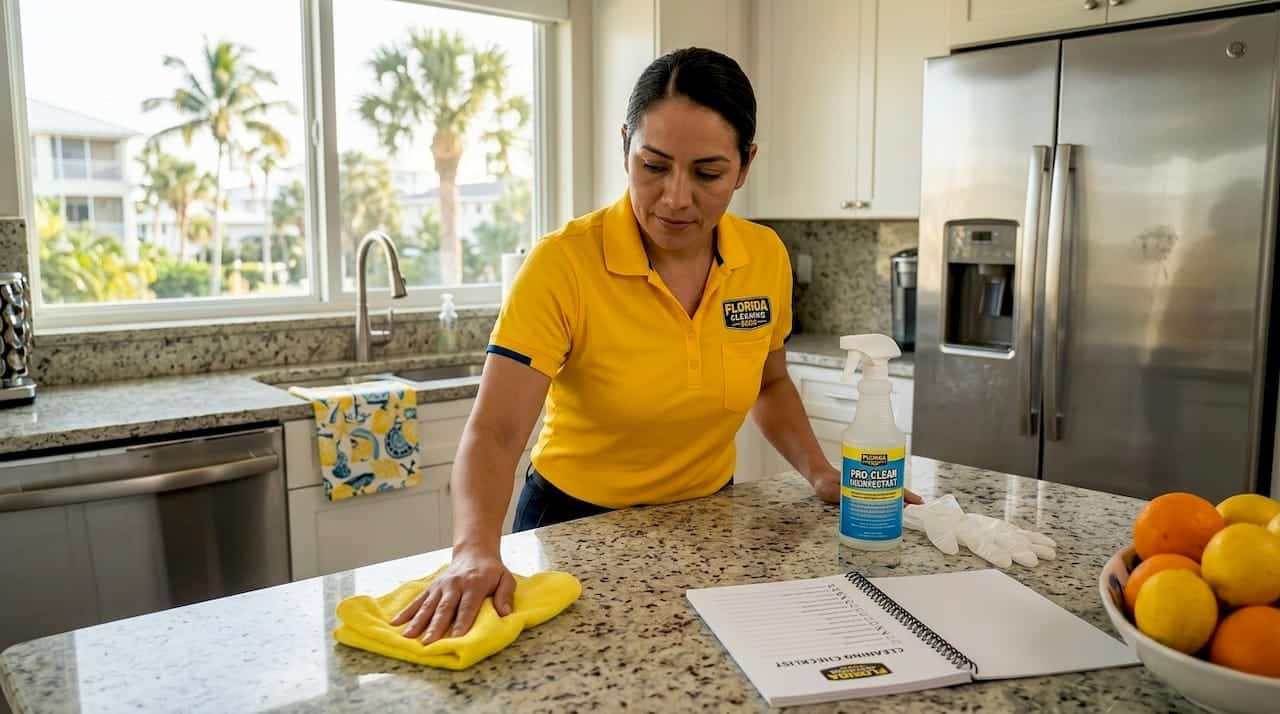
A missed spot under the toilet rim, a remote control still carrying the last guest’s germs, a refrigerator handle no one thought to wipe — these are the details guests notice before they say anything to you. If you own or manage a rental property in Tampa Bay, Clearwater, or St. Petersburg, knowing how to sanitize rental property the right way is what separates five-star reviews from one-star complaints. Surface cleaning is not enough. This guide walks you through preparation, room-by-room execution, verification, and the scheduling decisions that protect your investment and your guests.
Table of Contents
- Key takeaways
- What to prepare before you sanitize your rental property
- How to sanitize each area of your rental property
- Sanitizing mistakes that hurt your ratings
- Verifying and documenting your sanitizing work
- Cleaning frequency and choosing your approach
- My take on sanitizing as an operational system
- Let Floridacc handle the sanitizing for you
- FAQ
Key takeaways
| Point | Details |
|---|---|
| Preparation drives results | Organize EPA-approved disinfectants, PPE, and room checklists before starting any sanitizing work. |
| Sequence and method matter | Clean from top to bottom, room to room, to avoid spreading contaminants across surfaces. |
| Deep cleaning is not optional | Schedule deep cleans every one to three months for high-turnover rentals to protect guest health and ratings. |
| Documentation protects you | Dated photos and room-by-room checklists serve as proof of standards and prevent tenant disputes. |
| Systems beat guesswork | Treating sanitizing as an operational system, not a chore, produces consistent and verifiable results. |
What to prepare before you sanitize your rental property
Walk into a rental turnover without a plan and you will spend twice as long doing half the job. The prep stage is where most property owners skip steps, and it shows up later in guest reviews.
The supplies you actually need
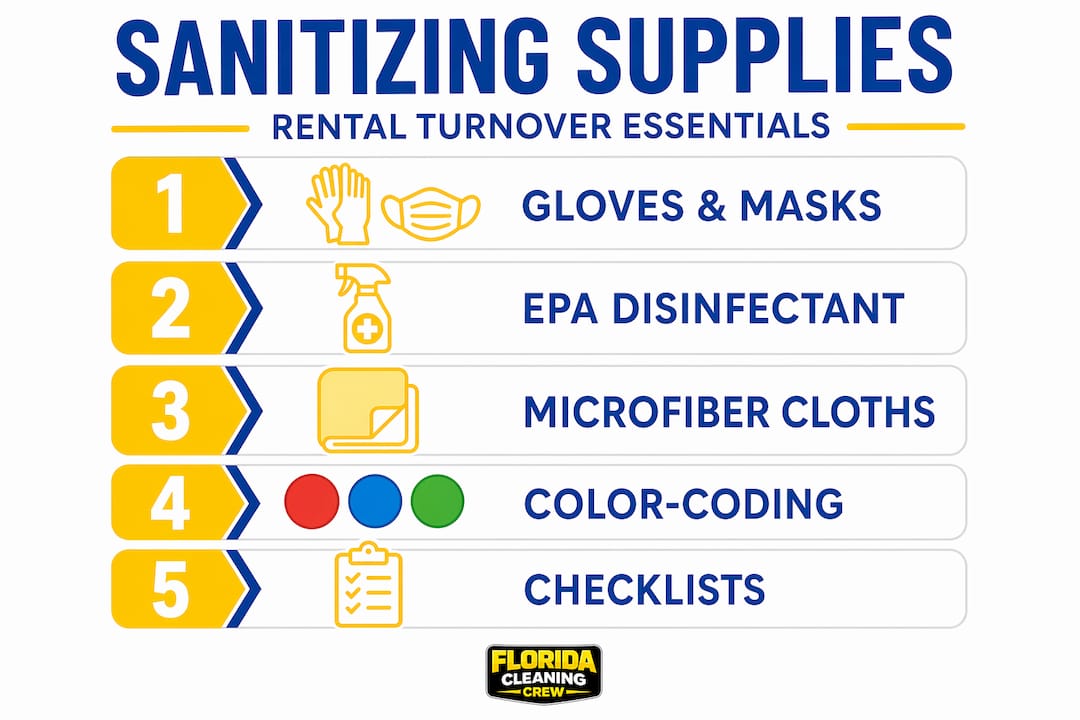
Start with EPA-approved disinfectants. Not every product labeled “cleaner” actually kills pathogens. Look for products registered on the EPA’s List N, which confirms efficacy against a broad range of viruses and bacteria. For a standard rental unit, you will want:
- EPA-registered disinfectant spray or concentrate
- Microfiber cloths in different colors (one set per room to prevent cross-contamination)
- Scrubbing pads and a toilet brush
- Mop with replaceable pads
- Spray bottles for diluted solutions
- Heavy-duty trash bags
- Paper towels for disposable wipe-downs in the bathroom
Personal protective equipment is non-negotiable. Nitrile gloves protect your hands from chemical exposure and stop you from transferring bacteria between surfaces. A disposable mask is worth wearing during bathroom and kitchen sanitizing, especially in properties that have been unoccupied for a stretch.
Pro Tip: Color-code your microfiber cloths by zone: one color for bathrooms, one for kitchen, one for living spaces. It is the simplest way to prevent cross-contamination without any extra cost.
Building your room-by-room checklist
A room-by-room cleaning checklist is not optional if you want consistent results. Properties managed with standardized checklists consistently produce better guest satisfaction scores because nothing gets missed during rushed turnovers. Your checklist should list every surface, fixture, and item in each room, down to light switches and TV remotes.
| Area | High-priority surfaces to sanitize |
|---|---|
| Kitchen | Counters, sink, faucet handles, appliance exteriors, cabinet pulls |
| Bathroom | Toilet (inside and out), faucets, showerhead, door handles, mirror frame |
| Bedroom | Nightstand surfaces, lamp switches, remote controls, closet handles |
| Living room | Coffee table, TV remote, door knobs, light switches, throw pillows |
| Entry/exit | Doorknob, keypad or lockbox, light switches |
How to sanitize each area of your rental property
Rental turnover cleaning must restore the property to a like-new condition, including thorough sanitizing of all high-touch surfaces. Here is how to execute that room by room.
Kitchen
Start by clearing and wiping down the inside of the refrigerator, then move to the oven and microwave interiors. These spots collect grease and food residue that standard turnover cleaning ignores. Spray EPA-approved disinfectant on all countertops and let it sit for the dwell time listed on the label — usually 30 seconds to 10 minutes — before wiping. Most people skip the dwell time and wipe immediately, which defeats the purpose.
Work through the sink basin, faucet handles, garbage disposal flap, and cabinet pulls in sequence. Finish with the stovetop and exterior of all appliances.
Bathroom
The bathroom requires the most deliberate sequencing. Spray the toilet bowl first and let the disinfectant soak while you work on the sink, faucet, and mirror. Then come back to scrub the bowl. Clean the toilet exterior including the base, handle, and seat before moving on.
Shower walls and the showerhead harbor soap scum and mold. Spray, scrub, and rinse thoroughly. Finish with the floor, working from the toilet toward the door.
- Apply disinfectant to toilet bowl interior, let soak
- Wipe sink, faucet handles, and counter
- Clean mirror and medicine cabinet
- Scrub toilet bowl, then wipe exterior and base
- Spray and scrub shower walls and fixtures
- Mop floor from back to door
Pro Tip: Use a dedicated toothbrush to clean around faucet bases and toilet bolt caps. These spots accumulate grime that a cloth cannot reach, and guests absolutely notice them.
Bedrooms and living spaces
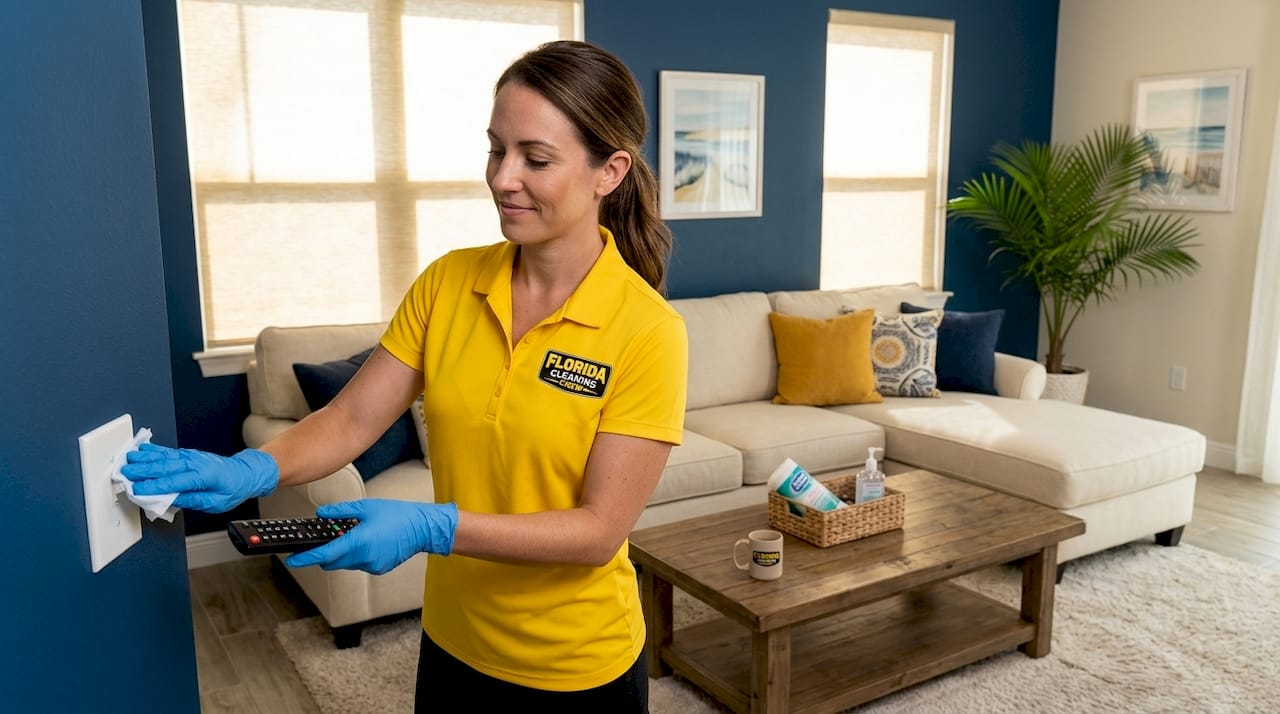
Remote controls, lamp switches, and door handles are high-touch surfaces that carry the highest pathogen transfer risk. Spray a cloth with disinfectant and wipe each one individually. Do not spray electronics directly. Wipe down nightstand surfaces, dresser tops, and windowsill ledges.
Wash all linens at the highest heat setting the fabric allows. If your turnover volume is high, outsourcing laundry is often more cost-effective than running an in-house operation with the hidden costs of machine wear, utilities, and labor.
Floors and a note on ventilation
Vacuum carpets and upholstered furniture before any wet cleaning. Then mop hard floors using a fresh mop pad for each room to avoid dragging contaminants from room to room. For upholstery, use a fabric-safe disinfectant spray and allow it to air dry fully before guests arrive.
If you discover rodent droppings in a rental unit, do not vacuum them. Vacuuming droppings aerosolizes viral particles that can cause serious respiratory disease. The CDC recommends dampening the droppings with an EPA-registered disinfectant, waiting five minutes, then carefully collecting them with paper towels and disposing of them in a sealed bag. Wear gloves and a mask for the entire process.
Sanitizing mistakes that hurt your ratings
Even well-intentioned property owners make errors that compromise the whole process. Understanding where things go wrong is half the fix.
- Wiping before dwell time: Most disinfectants need 30 seconds to several minutes of contact with a surface to actually kill pathogens. Spraying and immediately wiping is essentially just spreading the product around.
- Using the same cloth everywhere: One cloth for all surfaces means bacteria from the toilet bowl can end up on the kitchen counter. Color-coding prevents this entirely.
- Starting with floors: If you mop first and then drop debris while cleaning counters, you mop again. Always clean top to bottom, back to front.
- Skipping appliance interiors: The inside of a microwave or the drip tray under the refrigerator are the first things a detail-oriented guest checks. They are also breeding grounds for bacteria.
- Ignoring odors: Persistent odors signal a sanitation problem that surface cleaning will not solve. Identify the source first. Common culprits are drains, trash cans, and HVAC filters.
Pro Tip: Replace HVAC filters between every deep cleaning cycle, not just annually. Dirty filters recirculate dust and allergens throughout the entire unit, which guests with allergies will notice within an hour of arrival.
Managing high turnover without cutting corners
High-turnover properties in Tampa Bay, Clearwater, and St. Petersburg face real time pressure between checkouts and next-day check-ins. The temptation is to skip steps. The risk of skipping shows up in guest reviews and, in some jurisdictions, in fines. Poor hygiene standards can result in severe financial and licensing consequences for landlords who fail to meet required sanitation standards. Rushed turnovers need a tight, prioritized checklist. Know your must-do items versus your nice-to-do items so that the critical surfaces always get addressed even on a two-hour turnaround.
Verifying and documenting your sanitizing work
Completing the work is one thing. Being able to prove it is another. Documentation protects you in the event of guest disputes and holds your cleaning team accountable.
The verification process
- Walk the unit with your room-by-room checklist and physically check off each item
- Take dated photos of high-priority surfaces — toilet, kitchen sink, stovetop, and floors
- Note any damage discovered during sanitizing so it is not attributed to the next guest
- Confirm all restockables are replenished: soap, toilet paper, paper towels, and trash bags
- Do a final sniff test in each room — odors reveal what eyes miss
Photo documentation is low-effort insurance. Photo audits and scheduled records protect against habitability complaints and tenant disputes related to sanitization. Store photos by date and unit so you can retrieve them quickly if a question arises.
Tracking and staging
Several property management apps allow you to assign cleaning tasks, upload photos, and timestamp completions. This is especially valuable when you manage multiple units across Tampa Bay or operate with a rotating cleaning team. Apps like Properly, TurnoverBnB, and similar tools connect task assignment to checklists, reducing the chance of steps being skipped.
After verification, stage the unit to signal cleanliness to arriving guests. A folded toilet paper end, towels displayed neatly, and a spotless kitchen counter communicate care before anyone reads a single review.
| Verification step | Purpose |
|---|---|
| Room-by-room checklist sign-off | Confirms every surface and item was addressed |
| Dated photo audit | Provides timestamped proof of condition for disputes |
| Odor check by room | Catches hidden sanitation issues that visual checks miss |
| Restock confirmation | Prevents guest complaints about missing basic supplies |
| Damage log | Documents pre-existing damage before next guest arrival |
Cleaning frequency and choosing your approach
Not every turnover requires the same level of effort, and not every owner has the same capacity. Understanding the difference between turnover cleaning and deep cleaning will save you both time and money.
Standard turnover cleaning should happen after every guest, while deep cleaning should be scheduled every three to six months, or monthly for properties with very high occupancy. Deep cleaning targets areas that routine turnover cleaning skips: light fixtures, baseboard edges, inside appliances, behind furniture, HVAC vents, and window tracks.
Outsourcing versus doing it yourself
Here is where most property owners underestimate the math.
- In-house cleaning: Lower upfront cost per turnover, but requires reliable staffing, supply purchasing, and your personal oversight. Time spent managing the process is time not spent managing your rental business.
- Professional cleaning services: The national average cleaning fee for short-term rentals runs around $175 per turnover. For many owners, that fee reflects time saved, consistent standards, and reduced liability.
- Hybrid approach: Handle standard turnovers in-house and schedule professional deep cleaning quarterly. This balances cost control with quality assurance on the jobs that matter most.
For properties with shared spaces or older construction, professional-grade equipment is not a luxury. Industrial degreasing and steam cleaning consistently outperform domestic methods when it comes to removing built-up grime, mold spores, and persistent odors.
| Approach | Best for | Approximate cost | Guest impact |
|---|---|---|---|
| DIY turnover | Low-volume rentals, small units | Low to moderate | Variable, owner-dependent |
| Professional turnover cleaning | High-volume or multi-unit | $100 to $200+ per visit | Consistent and reliable |
| Quarterly deep clean | All rental types | $200 to $400+ | Significantly improves ratings |
| Outsourced laundry | High linen turnover properties | Per-pound or flat rate | Professional appearance and hygiene |
The pattern worth noting: the properties that earn consistently strong reviews are almost never the ones that wing it. They are the ones operating with a system.
My take on sanitizing as an operational system
I have seen a lot of rental owners treat sanitizing as something that gets done when time allows, or something handed off with minimal instruction and a hope it goes well. That approach always catches up with you, usually in the form of a one-star review that mentions “dirty bathroom” or “musty smell,” which is nearly impossible to walk back publicly.
What I have learned from watching Tampa Bay rental operations over time is that the owners with the best track records treat sanitizing the same way a restaurant treats food prep. There is a system. There is a sequence. There is a checklist that gets signed off, not just glanced at. When a new cleaner comes on, they follow the same protocol as everyone else because the system does not depend on any one person’s judgment.
The turnover cleaning standard that separates good properties from great ones is treating every checkout as a reset to like-new condition. That mindset changes how you prep, how you verify, and how you communicate with guests. Proactively telling guests in your welcome message that the property has been professionally sanitized builds trust before they even open the door.
Where owners get into trouble is the turnaround pressure. I understand it. A checkout at 11 and a check-in at 3 leaves very little margin. But that is exactly the moment when a written checklist with clear priorities protects you. You may not deep-clean the oven on a two-hour turnaround, but you should never skip the toilet, the kitchen sink, or the high-touch surfaces. Decide in advance what is non-negotiable, and stick to it every single time.
Partnering with a professional cleaning service for at least the deep cleaning cycles gives you a baseline you can rely on and a paper trail that protects your rental in the event of any sanitation question.
— Matt
Let Floridacc handle the sanitizing for you
If you manage rentals in Tampa, Clearwater, or St. Petersburg and the sanitizing process feels like it is always one step behind, Floridacc is built for exactly that situation. The team at Floridacc specializes in Airbnb and vacation rental cleaning, bringing the same checklist-driven, photo-verified approach described in this article to every turnover. Whether you need a standard turnover cleaned between guests or a quarterly deep clean that gets the baseboards, appliance interiors, and vents that routine cleaning misses, Floridacc’s licensed and insured team covers it.
Tampa Bay rental owners working with Floridacc get consistent results, eco-friendly products safe for families and pets, and the flexibility to schedule around your booking calendar. Request a free quote through residential cleaning services and tell the team what your property needs. No guesswork, no missed spots, and no one-star reviews about the bathroom.
FAQ
What does sanitizing a rental property actually mean?
Sanitizing a rental property means using EPA-approved disinfectants on all surfaces to reduce or eliminate pathogens that could harm guests. It goes beyond wiping surfaces to include proper dwell times and full-room coverage.
How often should I deep clean my rental property?
Deep cleaning should be scheduled every three to six months for most rentals, or monthly if your property has very high occupancy and frequent turnover.
What is the right way to clean rodent droppings in a rental?
Never vacuum rodent droppings because vacuuming aerosolizes viral particles and creates a serious respiratory risk. Dampen droppings with disinfectant, wait five minutes, then remove with paper towels while wearing gloves and a mask.
Should I outsource cleaning or do it myself?
For high-turnover properties, professional cleaning services often pay for themselves through better guest ratings and reduced liability. A hybrid approach works well: handle standard turnovers in-house and bring in professionals for quarterly deep cleans.
How do I prove my rental was properly sanitized?
Take dated photos of all key surfaces after every cleaning session and maintain a signed room-by-room checklist. These records protect you in any guest dispute and demonstrate your commitment to sanitation standards.