
Every vacation rental host eventually faces the same scenario: guests check out, you walk in, and the place looks nothing like how you left it. Dishes in the sink, towels on the floor, trash bags still sitting by the door. Knowing how to handle post-stay cleaning efficiently is what separates hosts who consistently earn five stars from those constantly firefighting complaints. This guide gives you a practical, step-by-step approach to cleaning after guests, covering everything from preparation and execution to quality verification, with specific advice for Tampa Bay properties.
Table of Contents
- Key takeaways
- How to handle post-stay cleaning: tools and prep
- Room-by-room cleaning workflow after checkout
- Common post-stay cleaning mistakes to avoid
- Verifying cleaning quality without being there
- Local considerations for Tampa Bay rental hosts
- My honest take on post-stay cleaning after years in this business
- Let Floridacc handle your Tampa Bay vacation rental turnovers
- FAQ
Key takeaways
| Point | Details |
|---|---|
| Prepare before every turnover | Gather all supplies and set a realistic schedule before guests check out to avoid wasted time. |
| Follow a room-by-room checklist | Structured cleaning after guests prevents missed spots and protects your ratings. |
| Allow disinfectant dwell time | Disinfectants must stay wet on surfaces for the required contact time to actually sanitize them. |
| Use photo verification | Timestamped photos after each checkout protect you in damage disputes and confirm cleaning quality. |
| Avoid common restocking gaps | Missed toiletries and consumables generate more guest complaints than cleanliness issues in many cases. |
How to handle post-stay cleaning: tools and prep
Before you touch a single surface, what you have on hand matters as much as your technique. Showing up without the right supplies is one of the biggest time-wasters hosts deal with, and in Tampa Bay’s humid climate, that inefficiency costs you more than just time.
Here is what every vacation rental turnover kit should include:
- Multi-surface disinfectant (EPA-registered, safe for high-touch areas)
- Microfiber cloths in at least two colors to separate bathroom and kitchen use
- Toilet brush and disposable gloves for each bathroom
- Mop with replaceable pads since reusing dirty mop heads defeats the purpose
- Vacuum with attachments capable of reaching upholstered furniture and baseboards
- Laundry supplies including stain remover for linens and towels
- Fresh trash bags in multiple sizes
- Restocking supplies including travel-size toiletries, coffee pods, and paper products
| Supply | Purpose |
|---|---|
| EPA-registered disinfectant | Kills pathogens on high-touch surfaces when used with correct dwell time |
| Microfiber cloths (color-coded) | Prevents cross-contamination between rooms |
| Disposable gloves and masks | Protects cleaner during turnover, especially in tight schedules |
| Mop with replaceable pads | Ensures floors are cleaned with fresh materials each visit |
| Restocking bin | Keeps toiletries, coffee, and paper goods ready to replenish immediately |
Scheduling matters just as much as supplies. Professional property managers recommend building extra turnover time into your calendar specifically for disinfecting high-touch areas, with a 24-hour gap between stays being the safest option. That window is not always realistic for back-to-back bookings, but even a two-hour buffer makes a real difference in cleaning quality.
Pro Tip: Set a restocking bin in a storage closet or utility room. Before each guest arrival, fill it with everything you need so you are not hunting for supplies during the turnover.
Stringent cleaning protocols require masks, gloves, and eye protection, especially when turnovers are tight and you cannot allow adequate ventilation time. Never skip PPE thinking the property looks clean from the last stay. Pathogens do not announce themselves.
Room-by-room cleaning workflow after checkout
A structured process is what makes post-stay cleaning tips work in practice. Without a defined sequence, cleaners skip steps, double back, and lose time. Here is the workflow that keeps your property consistently guest-ready.
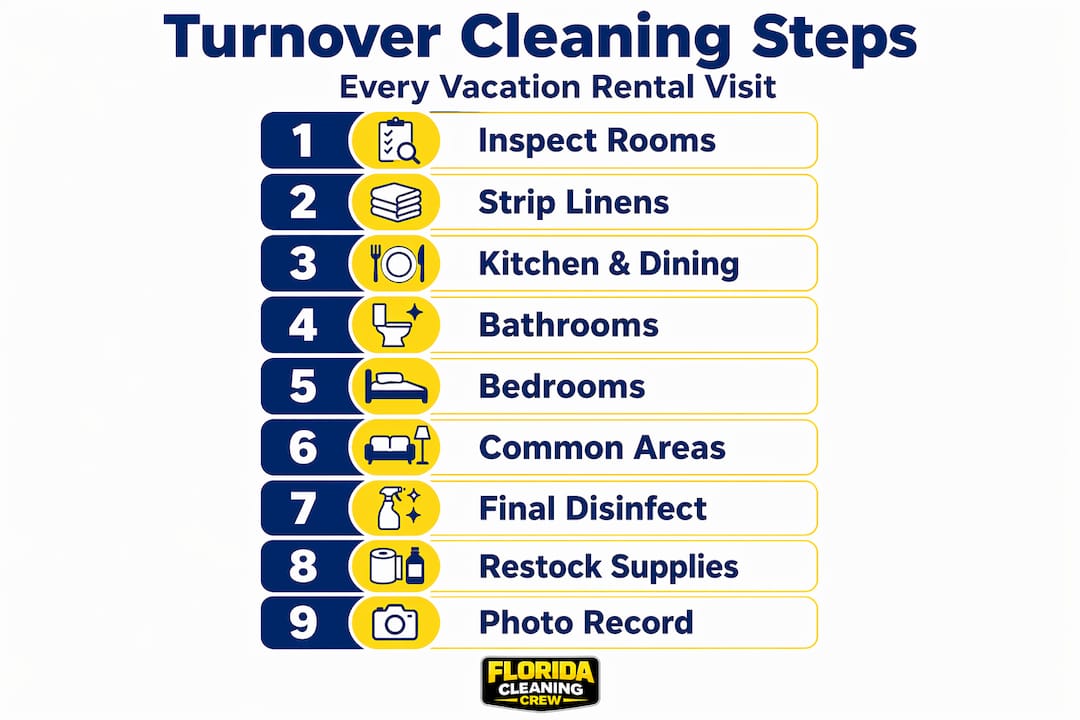
1. Check-out inspection first
Walk every room before cleaning begins. Look for damage, unusual stains, missing items, or anything that needs to be documented. Take timestamped photos immediately. Timestamped checkout photos are your strongest evidence if a guest disputes damage later on Airbnb or VRBO, creating a clear “before” record that platforms like Airbnb’s AirCover rely on to resolve claims.
2. Strip linens and start laundry
Pull all sheets, pillowcases, and towels and start the first load before doing anything else. This way, laundry runs while you clean, saving 30 to 45 minutes on every turnover.
3. Kitchen and dining area
Clear all dishes and run the dishwasher. Wipe down counters, backsplash, appliance exteriors, cabinet fronts, and the inside of the microwave. Check the refrigerator for left-behind food. Clean the stovetop and oven if needed. Sanitize the sink last.
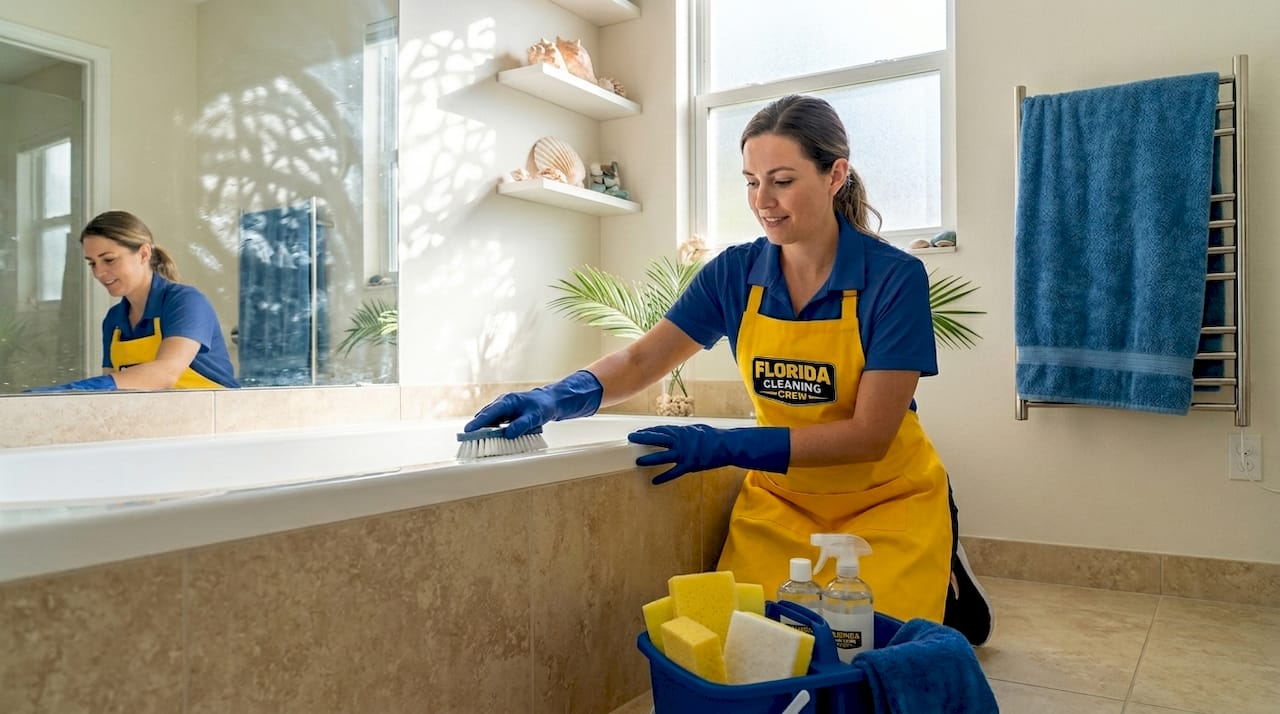
4. Bathrooms
Apply toilet bowl cleaner first and let it sit while you wipe counters, mirrors, and fixtures. Scrub the shower and tub, then finish the toilet. Replace towels, restock toiletries, and check that the trash bin is empty and clean.
5. Bedrooms
Remake beds with fresh linens. Check under the bed, inside nightstand drawers, and in closets for items guests may have left behind. Dust surfaces, wipe light switches, and vacuum thoroughly.
6. Living areas and common spaces
Wipe all high-touch surfaces including remote controls, door handles, and light switches. Straighten cushions and furniture. Vacuum rugs and upholstered pieces. Mop hard floors.
7. Patios and outdoor spaces
Wipe down furniture and check for trash. In Tampa Bay, salt air and humidity mean outdoor surfaces need more frequent attention than in drier climates. Check for mold on cushions or chair frames.
8. Final disinfection pass
This step is what separates a surface-clean property from a truly sanitized one. Apply disinfectant to all high-touch surfaces and let it work. Disinfectant dwell time is one of the most overlooked factors in vacation rental cleaning. The product must remain wet on the surface for the full manufacturer-specified contact time to actually kill pathogens, not just look clean.
9. Restock and reset
Consistent restocking of toiletries, towels, and consumables is critical for guest satisfaction. Missed restocking leads to complaints even more frequently than actual cleanliness issues in some cases. Restock coffee, paper products, soap, and shampoo according to your standard quantities.
10. Photo documentation
Before you leave, take 8 to 12 photos covering every key room and area. This is your proof of completion and your shield against any post-checkout claims.
Pro Tip: Use a printed or digital room-by-room checklist for every turnover. Signing off on each room physically, even as a solo host, prevents the “I thought I already did that” mistake that leads to re-cleans.
If you want a ready-to-use structure, the vacation rental cleaning checklist from Floridacc covers every room with specific task lists built for Tampa Bay hosts.
Common post-stay cleaning mistakes to avoid
Knowing the workflow is one thing. Knowing where hosts consistently go wrong is what protects your ratings when things get busy.
“Neglecting to close the loop on identified defects during a post-stay inspection results in repeated guest complaints and lower ratings. Failure to remediate before the next guest arrives is one of the most common and costly operational mistakes hosts make.”
Here are the mistakes worth tracking down and eliminating:
- Rushing disinfection. Spraying and immediately wiping defeats the purpose. If your disinfectant label says two minutes of contact time, it means two minutes of wet surface. This is where many well-intentioned cleaners fail.
- Missing high-touch surfaces. Guests touch remote controls, light switches, drawer pulls, and door handles constantly. These surfaces spread illness faster than countertops, yet they get skipped in casual cleanings.
- Skipping photo documentation. Without timestamped photos, a guest who disputes damage after checkout has more leverage than you do. No photos means no proof.
- Ignoring restocking tasks. Finding an empty toilet paper roll or no coffee pods on their first morning is a one-star complaint waiting to happen. Restocking is not optional, it is part of the clean.
- Not cross-referencing your booking calendar. Hosts who do not synchronize their cleaning schedule with check-in and check-out times regularly run out of cleaning time. Coordinate your turnover cleaning schedule with your calendar before the problem shows up in a guest review.
- Improvising instead of following a checklist. Memory is not a cleaning system. A guest complained that the previous host’s cleaner “clearly forgot” the shower door. The host had no checklist to verify otherwise.
The pattern across all of these mistakes is the same: speed without structure. Moving fast through a property without a repeatable process creates gaps that guests notice immediately.
Verifying cleaning quality without being there
One of the toughest parts of managing vacation rentals remotely is confirming that cleaning actually happened to your standard. Trusting that it was done right is not a strategy.
Here is how to build a verification system that works:
- Require photo-verified checklists. Whether your cleaner is a hired professional or a team member, require them to submit 8 to 12 photos of key areas upon completion. Photo verification reduces guest complaints and creates direct accountability for every turnover.
- Review the report in under two minutes. A well-structured photo checklist allows you to scan the entire property remotely. You should be looking at the beds, bathrooms, kitchen counters, floors, and outdoor spaces. If any photo is missing or unclear, ask for a reshoot before the guest arrives.
- Use timestamped photos for every turnover. The timestamp is what makes these photos legally and financially useful. Timestamped inspection photos document the exact condition of your property after checkout, which matters when a guest claims damage that happened before their stay.
- Set automated reminders with deadlines. Build cleaning completion deadlines into your workflow at least two hours before guest check-in. Automated notifications to your cleaner and a follow-up prompt to yourself reduce last-minute scrambles.
- Track feedback patterns. When a guest mentions something in a review, go back to the photo report from that turnover. You will usually find the gap. This feedback loop is how you improve your cleaning instructions over time.
Pro Tip: Shift from trust-based cleaning to photo-verified checklists and you will spend less time anxious about your property and more time focused on bookings. Concrete photo and checklist data is your operational foundation.
| Verification method | What it confirms | Time required |
|---|---|---|
| Photo report (8 to 12 images) | All key areas cleaned and reset | Under 2 minutes to review |
| Timestamped checkout photos | Pre-arrival property condition for disputes | Taken during turnover |
| Digital checklist sign-off | Each room task was completed | Instant review |
| Automated completion notification | Cleaner finished before check-in window | No time needed from host |
Post-stay inspections with standardized checklists also create formal records that help manage security deposit decisions and trigger maintenance requests before they become bigger problems.
Local considerations for Tampa Bay rental hosts
Tampa, Clearwater, and St. Petersburg hosts deal with a specific set of conditions that affect how you clean and how often.
Humidity and mold risk. Florida’s year-round humidity means bathrooms, shower curtains, and outdoor furniture are at constant risk for mold. After every checkout, check grout lines, shower curtains, and any outdoor cushions. Rotate or replace outdoor fabric furniture covers more frequently than you would in a drier climate.
Coastal salt and sand. Properties near Clearwater Beach or St. Pete Beach deal with sand tracked through every room and salt residue on windows and outdoor surfaces. Add a sand sweep to your entry cleaning routine, and refer to window cleaning tips for managing salt buildup on glass in coastal rentals.
Seasonal guest volume. Tampa Bay’s snowbird season runs from roughly November through April, bringing a surge in longer-stay bookings. Longer stays mean more wear on linens, appliances, and upholstery. After a two-week stay versus a three-night stay, your cleaning time and supply needs will be meaningfully different. Build that variability into your schedule.
Here are some best post-guest cleaning practices specific to the Tampa Bay market:
- Use mold-resistant cleaning products in bathrooms and on grout, not just standard bathroom spray
- Increase floor cleaning frequency in ground-floor or beach-access units due to constant sand traffic
- Inspect HVAC vents and replace filters more often than recommended in humid conditions
- Coordinate with a local Tampa Bay cleaning service familiar with the coastal conditions and guest expectations in this market
- Keep a dedicated outdoor cleaning kit with pressure-wash-compatible cleaners for patios and entryways
Pro Tip: When guests check out after a holiday weekend in the Tampa area, expect your turnover to take 20 to 30 percent longer than usual. Block that extra time on your calendar rather than discovering the problem mid-clean.
My honest take on post-stay cleaning after years in this business
I have seen hosts with gorgeous properties lose entire seasons of repeat bookings because their cleaning process had no structure. And I have seen modest, well-kept units build five-star reputations simply because every turnover was consistent.
The thing that genuinely changed my perspective was switching to photo-verified checklists. Before that, I was operating on trust, hoping the cleaner caught everything. After that change, I had a visual record of every turnover, and my anxious pre-guest check-ins became two-minute reviews instead of frantic property walkthroughs.
The hardest lesson I learned was about disinfectant dwell time. I thought spraying and wiping was cleaning. It is not. Real sanitization requires the product to stay wet on the surface. That detail took me embarrassingly long to internalize, and once I did, I stopped advertising my property as “100% disinfected” and started describing my protocols honestly instead. Guests trust that more, and it is the more defensible position anyway.
The other thing I will say plainly: trying to improvise your way through every turnover does not work when you have tight Tampa Bay check-in windows. Standardize the checklist, trust the process, and lean on local professional cleaners who understand what coastal and humid-climate cleaning actually demands. It is the difference between grinding through every turnover and running a property that guests recommend.
— Matt
Let Floridacc handle your Tampa Bay vacation rental turnovers
If the process above feels like a lot to manage on your own, that is exactly the problem Floridacc solves for Tampa Bay hosts and property managers.

Floridacc specializes in Airbnb and vacation rental cleaning across Tampa, Clearwater, and St. Petersburg, with photo-documented turnovers, consistent checklists, and reliable scheduling that fits tight booking calendars. Every clean is backed by a satisfaction guarantee, and you get the photo verification you need to stay protected against damage disputes. Whether you manage one unit or a full portfolio, Floridacc’s professional home cleaning team is built for the pace and standards vacation rental hosting demands. Request a free quote and find out how easy a consistent, verified turnover process can be.
FAQ
What does post-stay cleaning actually involve?
Post-stay cleaning covers stripping linens, sanitizing all surfaces, cleaning bathrooms and kitchens, vacuuming and mopping, restocking consumables, and photo-documenting the completed turnover before the next guest arrives.
How long should post-stay cleaning take?
Most vacation rental turnovers take between two and four hours depending on property size and the length of the previous stay. Build extra buffer time after longer stays or holiday weekends.
Why is disinfectant dwell time so important?
Dwell time is the period a disinfectant must remain wet on a surface to kill pathogens effectively. Skipping it means surfaces look clean but are not fully sanitized, which creates health risks for incoming guests.
How do I verify cleaning quality if I am not on-site?
Remote hosts verify cleaning quality using digital mission reports with 8 to 12 timestamped photos covering key areas, which can be reviewed in under two minutes.
What is the biggest restocking mistake vacation rental hosts make?
Running out of toilet paper, coffee, or hand soap on a guest’s first morning is one of the most common and preventable complaints. Consistent restocking according to a fixed supply list prevents this entirely.