
A cleaning contract for small business is a formal, legally binding document that defines the scope of cleaning services, pricing, schedule, and liability protections between a business owner and a cleaning provider. It is the industry-standard term for what many owners loosely call a “cleaning agreement” or “service agreement,” and the distinction matters. A simple verbal arrangement or a one-page invoice does not carry the legal weight of a properly structured contract. For small businesses in Tampa, Clearwater, and St. Petersburg, where foot traffic and professional presentation directly affect customer perception, having a written cleaning services contract is one of the most practical decisions you can make.
What is a cleaning contract for small business?
A cleaning contract is defined as a formal agreement that specifies exactly what cleaning tasks will be performed, how often, at what cost, and who bears responsibility if something goes wrong. This separates it from a bid or proposal, which is designed to win work, not govern an ongoing relationship. The contract takes over once the work begins, and it protects both parties throughout the life of the engagement.
The three most common pricing structures used in these agreements are flat monthly fees, hourly rates, and performance-based contracts with measurable KPIs and audit requirements. Each model carries different risk and flexibility profiles, which is why understanding the contract type before signing matters as much as reading the fine print.

Many small business owners treat a cleaning contract as simple paperwork. Legal experts caution that this misunderstanding exposes businesses to costly damage claims and security liabilities with no legal recourse. A contract is a risk management tool first, and a scheduling document second.
For Tampa Bay businesses specifically, the local climate adds another layer of relevance. High humidity, seasonal storms, and heavy foot traffic from tourism mean cleaning needs fluctuate. A well-written small business cleaning agreement accounts for those variations rather than locking you into a rigid, one-size-fits-all arrangement.
What are the essential elements of a cleaning contract?
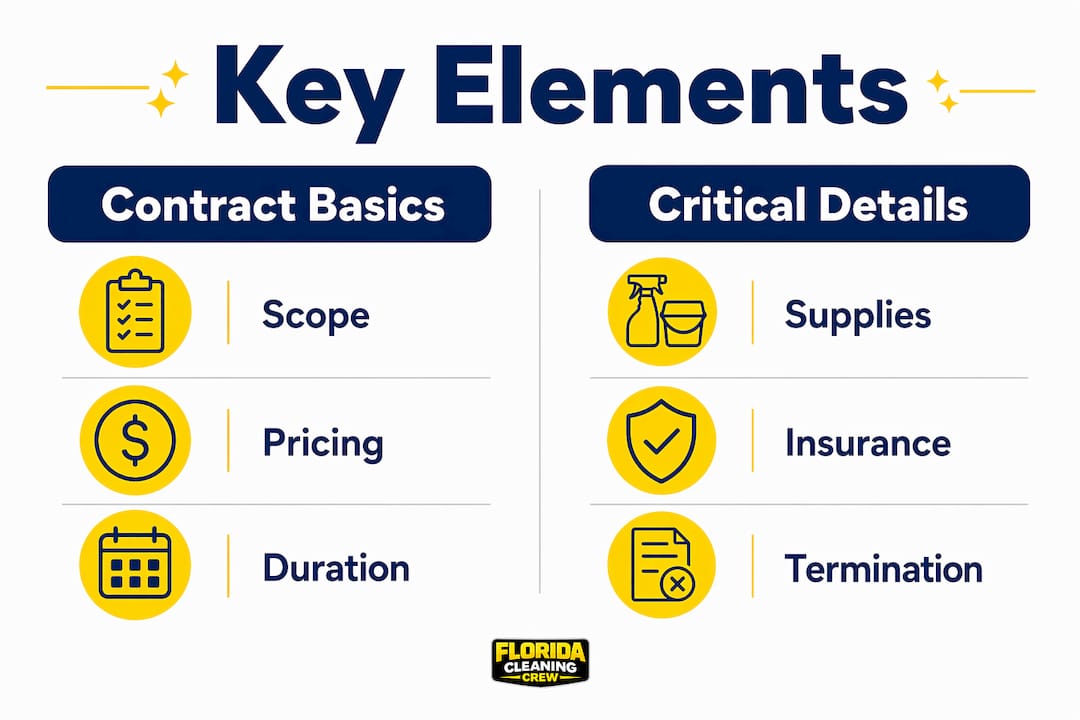
A robust cleaning contract must include business and client details, a detailed scope of work, visit schedule, payment terms, quality assurance protocols, access and security rules, liability insurance requirements, and termination clauses. Leaving out any one of these creates a gap that almost always becomes a dispute later.
Here is what each element should cover:
- Business and client details. Full legal names, addresses, and contact information for both parties. This establishes who is bound by the agreement.
- Scope of work. A task-level list of exactly what will be cleaned, how, and with what frequency. Vacuuming, mopping, restroom sanitization, trash removal, and surface wiping should each be listed separately.
- Out-of-scope exclusions. A dedicated section specifying what the provider will not do. An out-of-scope section prevents scope creep, which facility managers identify as the top cause of service disputes.
- Cleaning frequency and schedule. Days, times, and access windows. For retail businesses in St. Petersburg, this might mean after-hours cleaning to avoid disrupting customers.
- Pricing and payment terms. The agreed rate, invoice schedule, accepted payment methods, and late payment fees.
- Quality assurance standards. Measurable KPIs and audit processes. Performance contracts typically include rectification deadlines of 24 to 48 hours for quality issues before penalties apply.
- Access and security protocols. Key control procedures, alarm code handling, and liability for security breaches. Many providers require signed key receipts as standard practice.
- Insurance and liability. Proof of general liability insurance and workers’ compensation coverage from the provider.
- Termination clauses. Termination clauses typically require 30 days notice, with early cancellation fees protecting the provider’s investment in onboarding and supplies.
Pro Tip: Before signing, ask the provider to walk through the scope of work line by line. Any hesitation on specific tasks is a signal that those tasks may not actually be included, even if the contract language seems to cover them.
One often-overlooked element is supply and equipment responsibility. Contracts must clarify who provides cleaning supplies and equipment, since these costs directly affect pricing and liability. If the provider supplies everything, that cost is baked into the fee. If you supply consumables, the contract should define restocking timelines and what happens if supplies run out mid-visit.
How do different pricing models compare for your small business?
Choosing the right pricing model is one of the most consequential decisions in a cleaning services contract. The three main models each suit different business types and operational priorities.
| Pricing Model | How It Works | Best For | Key Risk |
|---|---|---|---|
| Flat monthly fee | Fixed cost for a defined task list, billed monthly | Predictable budgets, consistent cleaning needs | Scope creep if task list is vague |
| Hourly rate | Billed per hour of cleaning time | Ad-hoc or variable cleaning needs | Cost unpredictability over time |
| Performance-based | Payment tied to measurable outcomes and KPIs | High-standard environments, medical or food service | Requires detailed audit processes |
Commercial cleaning rates typically range from $0.07 to $0.20 per square foot or $30 to $50 per hour, depending on service complexity. This means a 2,000-square-foot Tampa office could cost anywhere from $140 to $400 per visit under a per-square-foot model. Understanding that range before negotiating gives you a realistic anchor point.
Flat fees work best for businesses with predictable, recurring needs, like a Clearwater retail shop cleaned three nights per week. The budget stays consistent, and the provider knows exactly what to deliver. The risk is that a vague task list turns a flat fee into a source of constant negotiation over what is and is not included.
Hourly rates give you flexibility for irregular spaces or seasonal surges, but they require trust. Without a cap or a clearly defined task list, an hourly contract can drift well beyond your initial estimate. Always negotiate a not-to-exceed clause if you go this route.
Performance-based contracts are the most sophisticated option. They tie payment to measurable outcomes, such as bacteria counts in restrooms or inspection scores on a standardized checklist. These contracts work well for food service businesses or medical offices in Tampa Bay where cleanliness directly affects compliance and customer safety.
Pro Tip: Ask for a 90-day trial period with any new provider before committing to a 12-month contract. This gives both parties time to calibrate expectations without the financial exposure of a long-term commitment.
What common pitfalls should small businesses avoid in cleaning contracts?
Most problems in cleaning partnerships trace back to decisions made before the first cleaning visit. These are the mistakes that create the most friction.
- Vague scope of work. Facility managers consistently report that high-level scope descriptions cause most partnership breakdowns. “Clean the office” is not a scope. “Vacuum all carpeted areas, mop hard floors with a pH-neutral cleaner, sanitize all door handles and light switches, and empty all trash bins” is a scope.
- Missing exclusions list. Without a clear out-of-scope section, providers and clients interpret the contract differently. One party assumes window cleaning is included. The other assumes it is not. The contract should resolve this before it becomes a conversation.
- Ignoring access and security details. Access protocols including key control, alarm codes, and security procedures must be explicitly defined to prevent breaches and establish liability. If a provider loses a key and you have no signed receipt on file, your legal position is weak.
- Skipping the supplies conversation. Contracts that do not address who provides supplies create hidden costs. If the provider runs out of disinfectant mid-visit and uses a substitute product that damages your flooring, the liability question becomes complicated without clear contract language.
- Confusing a bid with a service agreement. A bid is a sales document. A service agreement governs ongoing operations and is a fundamentally different instrument. Treating a bid as a binding contract leaves you without enforceable terms once the work begins.
- Overlooking dispute resolution. Contracts without a defined escalation process leave both parties with no structured path when something goes wrong. A simple clause specifying written notice, a response window, and a resolution timeline prevents most disputes from becoming legal matters.
Pro Tip: Request a copy of the provider’s certificate of insurance before signing anything. A licensed and insured provider carries general liability coverage that protects your business if property is damaged during a cleaning visit.
The supplies issue deserves extra attention. Many small business owners in Tampa assume the cleaning company brings everything. Many cleaning companies assume the client stocks consumables like paper towels and trash bags. Neither assumption belongs in a professional contract. Write it down.
How to create, negotiate, and manage a cleaning contract effectively
Creating a solid cleaning agreement does not require a lawyer, but it does require specificity and a clear process. Follow these steps to build a contract that holds up over time.
- Start with a template, then customize it. Generic templates from sources like PactDraft or LeadDuo provide a solid legal framework. Customize the scope of work section completely for your specific facility type, whether that is a Tampa Bay retail space, a Clearwater medical office, or a St. Petersburg restaurant.
- List every task explicitly. Walk through your space room by room and write down every cleaning action you expect. Then share that list with the provider and ask them to confirm or flag anything outside their standard service.
- Define all exclusions before signing. Ask the provider directly: “What is not included in this contract?” Their answer should match the exclusions section word for word.
- Negotiate flexibility clauses. Build in provisions for flexible scheduling adjustments during peak business periods or after events. Tampa Bay businesses dealing with seasonal tourism surges need this more than most.
- Use electronic signatures and store records digitally. Platforms like DocuSign or Adobe Acrobat Sign create a timestamped, legally valid record. Store the signed contract alongside all amendments and correspondence.
- Set a quality audit schedule. Agree on monthly or quarterly walkthroughs with the provider to review performance against the contract’s KPIs. This keeps both parties accountable and surfaces issues before they become disputes.
- Plan for annual price adjustments. Build a clause that allows for price increases tied to a specific index or a fixed percentage, typically 3 to 5 percent annually. This prevents awkward renegotiations and keeps the relationship stable.
- Define the dispute resolution process. Include a written notice requirement, a response window of 48 to 72 hours, and a clear escalation path before either party can invoke the termination clause.
“The most effective cleaning contracts are not the longest ones. They are the ones where both parties can point to any line and agree on exactly what it means.” This principle applies directly to Tampa Bay small businesses, where relationships with local service providers often span years. Clarity upfront protects that relationship over time.
When managing renewals, treat each renewal as a renegotiation opportunity. Review the scope of work against your current needs, confirm insurance coverage is still active, and adjust pricing to reflect any changes in facility size or service frequency. A contract that made sense two years ago may no longer fit your business.
Key takeaways
A cleaning contract for small business is a risk management tool that protects both parties by defining services, pricing, access protocols, and dispute resolution in writing.
| Point | Details |
|---|---|
| Define scope precisely | List every cleaning task by room and surface to prevent disputes and scope creep. |
| Choose the right pricing model | Match flat fee, hourly, or performance-based pricing to your business’s cleaning frequency and budget predictability. |
| Address access and supplies | Specify key control procedures and who provides consumables to avoid liability gaps and hidden costs. |
| Include termination and dispute clauses | Require written notice periods and a structured escalation process before either party can exit the agreement. |
| Audit performance regularly | Schedule monthly or quarterly walkthroughs against measurable KPIs to keep service quality on track. |
Why specificity in cleaning contracts saves Tampa Bay businesses real money
Most small business owners I have worked with sign cleaning contracts the same way they sign software terms of service: quickly, without reading closely, and with the assumption that problems will sort themselves out. They rarely do.
The contracts that cause the most headaches are not the ones with bad providers. They are the ones with good providers and bad paperwork. A reliable cleaning company that does not have a clear scope of work will still miss tasks, not out of negligence, but because no one defined what “clean” actually means for your specific space. I have seen a Tampa Bay restaurant owner spend three months arguing with a provider over whether hood cleaning was included in “kitchen cleaning.” It was not in the contract either way. That dispute cost both parties time, money, and a working relationship.
The contracts that work are specific to the point of feeling excessive. They name the products used in restrooms. They specify the order in which rooms are cleaned. They define what happens if a cleaner calls in sick on a scheduled day. That level of detail is not paranoia. It is professionalism.
For small businesses in Clearwater or St. Petersburg, where your reputation in the community is tied to how your space looks and feels, a well-managed cleaning agreement is one of the highest-return investments you can make. The time you spend getting the contract right is a fraction of the time you will spend managing a bad one.
— Matt
How Floridacc supports small businesses with tailored cleaning contracts
Floridacc works directly with small businesses across Tampa Bay to create commercial cleaning agreements that are clear, specific, and built around your actual facility needs.

Every contract Floridacc provides includes a detailed scope of work, transparent pricing with no hidden fees, and a defined quality audit process. The team is licensed and insured, and the onboarding process is designed to get your agreement in place quickly without the back-and-forth that slows most partnerships down. Whether you run a retail shop in Clearwater, a medical office in Tampa, or a restaurant in St. Petersburg, Floridacc builds the contract around your space, not a generic template. You can explore the full contract guide for businesses or request a free estimate directly through the site.
FAQ
What is a cleaning contract for a small business?
A cleaning contract for a small business is a legally binding agreement that defines the cleaning services to be performed, the schedule, pricing, and liability protections for both the business owner and the cleaning provider. It differs from a simple invoice or verbal agreement by establishing enforceable terms for the entire service relationship.
What should be included in a small business cleaning agreement?
A small business cleaning agreement should include a detailed scope of work with task-level specifics, an exclusions list, visit schedule, payment terms, quality assurance KPIs, access and security protocols, insurance requirements, and termination clauses with notice periods.
How much does commercial cleaning cost for a small business?
Commercial cleaning typically costs between $0.07 and $0.20 per square foot or $30 to $50 per hour, depending on service complexity and location. A 2,000-square-foot office in Tampa Bay could range from $140 to $400 per visit under a per-square-foot pricing model.
What is the difference between a cleaning bid and a cleaning contract?
A cleaning bid is a sales document used to propose services and win work, while a cleaning contract governs the ongoing service relationship once work begins. Treating a bid as a binding contract leaves a business without enforceable terms for quality, scheduling, or dispute resolution.
How do I handle disputes with a cleaning provider?
A well-written contract includes a dispute resolution clause that requires written notice, a defined response window of 48 to 72 hours, and a structured escalation process before either party can invoke the termination clause. This prevents most disagreements from becoming legal matters.