

Most homeowners assume “flexible cleaning” just means they can pick a different day if something comes up. That’s a reasonable assumption, but it barely scratches the surface of what true flexibility looks like in practice. For Tampa Bay homeowners juggling busy schedules, and especially for Airbnb and short-term rental hosts managing back-to-back guests, real cleaning flexibility is the difference between a smooth operation and a guest walking into an unready property. This guide breaks down exactly what flexible cleaning services mean, how they work, and how to choose the right provider in the Tampa Bay area.
Table of Contents
- What is a flexible cleaning service?
- Why flexibility matters: Benefits for homeowners and hosts
- Flexible cleaning models: How do they work?
- Choosing the right flexible cleaning service in Tampa Bay
- Our take: Why true flexibility is risk control, not just convenience
- Ready for flexible cleanings that fit your life?
- Frequently asked questions
Key Takeaways
| Point | Details |
|---|---|
| Flexible cleaning defined | Services adapt to changing schedules for homeowners or rental hosts for maximum convenience and reliability. |
| Real-time rescheduling | Flexible services use automation and time windows to avoid last-minute cleaning disasters. |
| Less stress, more control | Homeowners and STR hosts reduce risk by choosing providers who are ready for unexpected changes. |
| Choosing the right provider | Smart selection based on communication, tech, and proven flexibility ensures true peace of mind. |
What is a flexible cleaning service?
The phrase “flexible cleaning service” gets used a lot, but it means different things depending on who you ask and what property you manage. For a regular homeowner, flexible might mean the ability to shift a weekly cleaning from Tuesday to Thursday when work gets busy, or skipping a session and doubling up the next week. That kind of flexibility is genuinely useful, but it’s relatively simple to arrange with most cleaning companies.
For short-term rental hosts, the definition gets a lot more specific. As Guesty explains in their scheduling guide for STR hosts, “flexible” in the short-term rental context means coordinating cleaning tasks around changing guest dates and times, using a time window or flexible time frame between checkout and the next check-in. This isn’t about picking a convenient weekday. It’s about building a system that moves automatically when a guest changes their arrival time, extends their stay, or cancels entirely.
Here’s a quick breakdown of the three main types of flexibility you’ll encounter:
On-demand cleaning refers to booking a clean with short notice, sometimes within 24 hours, when an unexpected need arises. This is ideal for homeowners who don’t want a recurring schedule but need reliable help when life gets chaotic.
Recurring cleaning with changes is a scheduled service (weekly, biweekly, monthly) where you have the option to reschedule individual sessions without canceling the entire plan. Most Tampa Bay homeowners operate in this model.
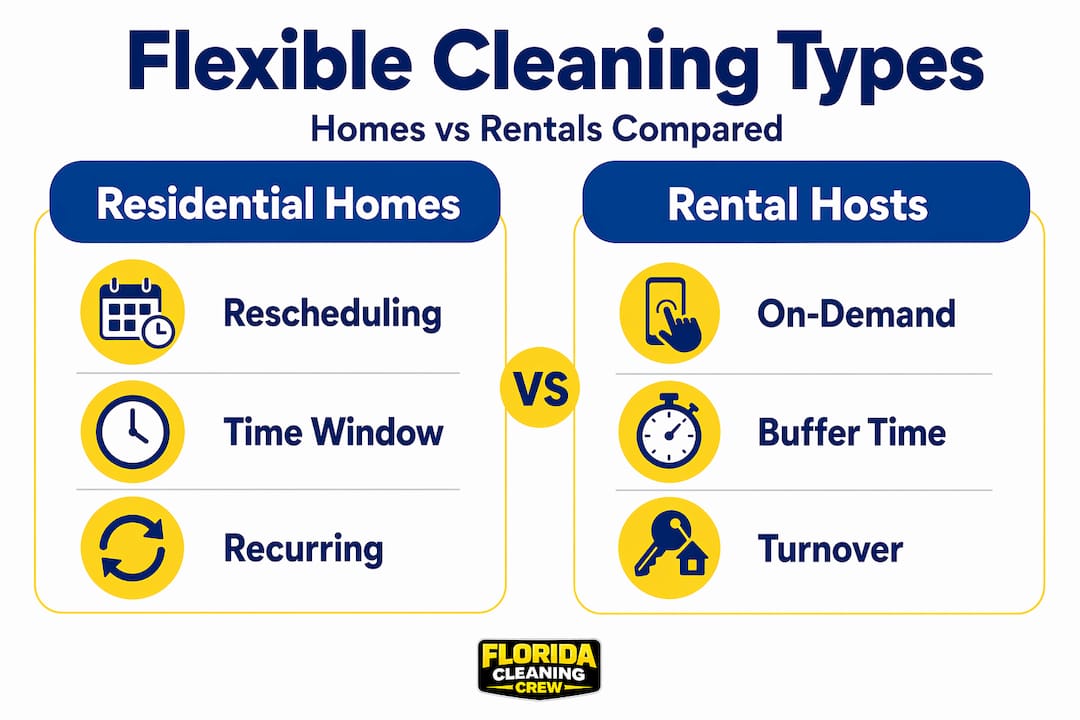
Buffered or window-based cleaning is the model used most often in short-term rental management. The cleaner has a time range to complete the job rather than a fixed hour. This model ties directly into our turnover cleaning guide and is where most of the operational complexity lives.
Here’s a simple comparison of how each model works in practice:
| Cleaning model | Best for | Schedule trigger | Rescheduling method |
|---|---|---|---|
| On-demand | Homeowners with irregular needs | Manual request | New booking |
| Recurring with changes | Busy households | Calendar-based | Direct communication |
| Buffered/window-based | Short-term rental hosts | Guest checkout/check-in | Automatic or manual update |
Key features that make a cleaning service truly flexible:
- Ability to reschedule with minimal or no fees for reasonable notice
- Communication channels that are fast and reliable (text, app, or email)
- Service windows instead of locked-in appointment times
- Support for last-minute changes without surcharges
- Consistent cleaners who know your property and preferences
“A cleaning service isn’t truly flexible unless the schedule bends with your life, not the other way around.”
The distinction matters because many services advertise flexibility but only mean they won’t charge you for one cancellation per month. That’s not the same as building a system that adapts in real time to changing reservation calendars.
Why flexibility matters: Benefits for homeowners and hosts
With a clearer definition in mind, it’s easy to see why true flexibility isn’t just a convenience. Let’s explore how it benefits you directly, whether you’re maintaining a primary home or running a rental property on Tampa Bay.
For homeowners, life in Tampa Bay rarely follows a tidy schedule. Hurricane warnings, work trips, family visits from out of state, and the general unpredictability of Florida weather all have a way of upending even the best-laid plans. A cleaning service that locks you into rigid appointments adds stress rather than relieving it. The practical value of flexibility for homeowners boils down to a few key scenarios:
- Schedule conflicts: When a work meeting runs late or a child’s school event lands on cleaning day, being able to call and shift the appointment without penalty is genuinely valuable.
- Travel: Tampa Bay residents who travel for work or leisure need to trust that their cleaning can pause, resume, or adjust without administrative headaches.
- Seasonal adjustments: Many homeowners want more frequent cleanings during the holiday season or after large gatherings, and less during quiet periods.
- Unexpected messes: A burst pipe, a pet accident, or a post-party cleanup can require an immediate booking. On-demand capability covers these situations.
For short-term rental hosts, the stakes are considerably higher. A missed or delayed turnover clean doesn’t just inconvenience you. It can result in a negative guest review, a refund request, or worse, a property listing suspension. According to Guesty’s STR automation research, flexibility for STR hosts is less about less work and more about managing timing risk. Systems that allow flexible time frames and automatic rescheduling can reduce manual coordination failures when reservations change.
This is a critical insight. Many hosts in Tampa Bay manage their rentals on platforms that allow guests to make same-day booking changes. A guest who extends their stay by one night shifts the entire next day’s cleaning window. Without a flexible cleaning system in place, the host has to manually contact their cleaner, negotiate a new time, and hope the cleaner is available. With a properly designed flexible system, that update happens automatically.
Our Airbnb turnover cleaning services are built specifically around this kind of scheduling reality. The rental cleaning specialists we work with understand that the window between checkout and check-in is often tight, unpredictable, and non-negotiable.
Real-world scenarios where flexibility saves Tampa Bay hosts:
- A guest checks out two hours late because of a delayed flight. A buffered cleaning window means the cleaner can start at 1:00 PM instead of 11:00 AM without a rebooking crisis.
- A reservation cancels 12 hours before arrival. A flexible system cancels or holds the cleaning automatically so you’re not paying for an unnecessary service.
- Back-to-back bookings leave only a four-hour turnover window. A flexible provider knows your property and can prioritize essential tasks when time is short.
Pro Tip: Ask your cleaning service what their policy is when a guest checks out two or more hours late. The answer tells you immediately whether they’re built for short-term rental work or not.
Statistic to keep in mind: Vacation rental management experts consistently report that failed or delayed turnovers are among the top five reasons for negative guest reviews. Protecting your review score is protecting your revenue.
Flexible cleaning models: How do they work?
Understanding the benefits is great, but let’s look at the nuts and bolts of how flexible cleaning services actually work in practice. Not all “flexible” arrangements are created equal, and knowing the differences helps you ask the right questions before signing any agreement.
The most important distinction is between a fixed time slot and a time window. A fixed time slot means the cleaner arrives at 10:00 AM, full stop. If checkout runs late, you have a conflict. A time window means the cleaner can arrive anytime between 10:00 AM and 2:00 PM. That four-hour window absorbs most real-world delays without requiring a single phone call.

As Guesty’s automation guide explains, using flexible time windows means cleaners may begin anytime between checkout and a specified buffer before the next check-in, and tasks reschedule or cancel automatically with reservation changes. That last part is the piece most homeowners and hosts overlook: automation.
Buffer time deserves its own explanation. In short-term rental management, buffer time is the protected window you build between a guest checkout and the next check-in. It exists for two reasons. First, it gives the cleaner enough time to complete the turnover even if checkout is slightly delayed. Second, it provides a cushion if the cleaner finishes early and the property needs airing out or final touches. For Tampa Bay rentals, where summer humidity can make a freshly cleaned home feel stuffy quickly, buffer time is especially important.
Here’s how the three main models compare across key operational factors:
| Factor | Fixed time slot | Time window | Automated rescheduling |
|---|---|---|---|
| Handles late checkouts | No | Yes | Yes |
| Handles reservation changes | No | Partially | Yes |
| Requires manual coordination | Always | Sometimes | Rarely |
| Best for | Consistent households | Small rental operations | Active STR hosts |
| Risk of missed clean | High (if schedule shifts) | Low | Very low |
When a reservation changes, here’s what should happen step by step in a well-designed flexible cleaning system:
- The reservation update is received by the host’s platform (Airbnb, VRBO, direct booking).
- The cleaning service is notified through a connected calendar, app integration, or direct message.
- The cleaning window is adjusted automatically or with a single confirmation from the host.
- The cleaner receives the updated schedule on their end with the new time window and any relevant notes.
- The host receives confirmation that the update is in place, usually via text or email.
Our streamlined cleaning solutions for Tampa Bay hosts are designed around this exact workflow. And if you want to make sure the cleaning itself covers every corner of your property, the vacation rental cleaning checklist is a practical resource for setting expectations with your cleaning team.
One common mistake rental hosts make is confusing automation with quality control. Automating the schedule is only valuable if the cleaning itself is thorough and consistent. A flexible schedule that delivers mediocre results still earns you a bad review. The goal is both: reliable flexibility and reliable quality.
Homeowners without rental properties benefit from a simpler version of these models. For most, the key flexibility needs are rescheduling with reasonable notice, the ability to add occasional deep cleanings, and seasonal adjustments. The complexity of automation and buffer times isn’t necessary for a single-family home, but understanding these concepts helps you evaluate whether a cleaning service is serious about adaptability.
Choosing the right flexible cleaning service in Tampa Bay
If you want maximum value, making the right choice is essential. Here’s how to confidently select a flexible service that truly works for you rather than just advertising flexibility as a buzzword.
Start with the scheduling conversation before you talk about anything else. Ask specifically: “What happens if I need to reschedule on short notice?” The answer should be clear, penalty-free within a reasonable window (most good providers allow changes up to 24 or 48 hours before the appointment), and easy to execute. Vague answers here are a red flag.
For rental hosts, the question gets more specific. Ask: “How do you handle a guest checkout that runs two hours late?” and “What’s your process when a reservation gets canceled the day before?” If the provider hasn’t thought through these scenarios, they’re not built for short-term rental work. As noted in Guesty’s STR management guide, scheduling tasks around changing guest dates and times with flexible time frames is crucial for professional rental management.
Key questions to ask any cleaning service before hiring:
- Do you offer time windows or only fixed appointment times?
- What is your rescheduling policy, and are there fees involved?
- How do you handle communication when a change needs to happen quickly?
- Can you integrate with booking platforms or shared calendars?
- Do you send the same cleaners each visit for consistency?
- Are you licensed and insured in Florida?
That last point is especially important in Tampa Bay. Licensed and insured cleaning services protect you from liability if a cleaner is injured on your property or if something is damaged during the clean. Never hire a provider who can’t verify both.
Common mistakes Tampa Bay homeowners make when hiring cleaning services:
- Choosing based on price alone without asking about flexibility policies
- Not setting clear expectations for what “flexible” means to them before booking
- Assuming all providers handle rental turnovers the same way
- Failing to test the communication process before a critical cleaning window
- Not reading reviews specifically about reliability and scheduling
Reviews are particularly revealing. Look for feedback that mentions how the company handled a scheduling problem, not just how clean the house was. A company that responds gracefully to a last-minute change is far more valuable than one that does a perfect job under ideal conditions.
Pro Tip: Before committing to a cleaning service, send a test inquiry at an odd hour (evening or weekend) and see how fast they respond. Fast, professional responses to inquiries predict fast, professional responses to scheduling changes later on.
A good cleaning frequency guide can also help you establish what kind of schedule actually fits your property and lifestyle before you start negotiations with a provider. Knowing whether you need weekly, biweekly, or monthly service with occasional on-demand options makes the conversation much more productive.
Tech-enabled scheduling is becoming less of a bonus and more of a baseline expectation for Tampa Bay rental hosts. If a cleaning service still relies entirely on phone calls and text messages to manage schedule changes, they may struggle to keep up with the pace of a busy rental calendar. Look for providers who use digital scheduling tools, shared calendar access, or at minimum a dedicated point of contact who responds within a few hours.
Our take: Why true flexibility is risk control, not just convenience
With all the practical details in mind, let’s rethink what flexibility means at its core. Most articles treat flexible cleaning as a nice perk, a quality-of-life upgrade for busy people. That framing undersells it considerably, especially for anyone managing a short-term rental.
Here’s our honest assessment after working with Tampa Bay homeowners and rental hosts: flexible cleaning is a form of risk management. It’s not fundamentally different from having insurance. You’re not hoping something goes wrong, but when something does go wrong (and in rental hosting, something always eventually goes wrong), you want a system that absorbs the shock rather than amplifies it.
Think about what happens when a cleaning service lacks flexibility. A guest extends their stay by a night. The host has to scramble to reach the cleaner. The cleaner may not be available at the new time. A different cleaner is sent, one who doesn’t know the property. The clean is rushed and incomplete. The next guests arrive to a poorly prepared space. They leave a one-star review. That review damages the listing’s ranking. Future bookings decline. The cost of one rigid scheduling policy compounds into hundreds or thousands of dollars in lost revenue.
Now reverse it. A flexible cleaning system receives the updated checkout time automatically. The cleaner’s window shifts. No calls are made. The same trusted cleaner arrives during the updated window. The property is guest-ready. The next guests check in, love the space, and leave a five-star review. That’s the actual business value of flexibility.
Guesty’s research frames it exactly right: for STR hosts, flexibility is less about less work and more about managing timing risk. That’s the mindset shift that separates hosts who grow their rental businesses from those who plateau or burn out.
For homeowners without rentals, the risk management angle is quieter but still real. A cleaning service that can’t adapt to your life will eventually get dropped when life gets complicated. And then you’re left with a home that doesn’t get the attention it needs during the most stressful periods, which are often the exact times a clean home would help most.
We’ve seen this play out in Tampa Bay repeatedly. Hosts who invest in truly flexible rental turnover insights don’t just reduce headaches. They build a more resilient operation that can scale. Homeowners who choose adaptable cleaning relationships don’t just get a cleaner house. They get one less thing to worry about when everything else demands their attention.
Flexibility is not a luxury. It’s infrastructure.
Ready for flexible cleanings that fit your life?
If this guide has made one thing clear, it’s that the right cleaning service should adapt to your schedule, not the other way around. Whether you’re a Tampa Bay homeowner who needs a cleaning partner that moves with your calendar, or a short-term rental host managing back-to-back guest turnovers, the difference between a rigid and a truly flexible provider has real consequences.

At Florida CC, our reliable home cleaning services are built around the reality of Tampa Bay life: unpredictable schedules, last-minute changes, and the need for consistent quality no matter when the clean happens. For rental hosts, we’re ready to work within your booking windows and keep your property guest-ready at every turnover. Start by reviewing our detailed rental cleaning checklist to see exactly what we cover, then reach out for a free estimate. Your schedule is the starting point, and we’ll build the rest around it.
Frequently asked questions
What does ‘flexible cleaning’ really mean for homeowners?
It means cleaners adapt to your changing schedule, offering rescheduling options or time windows rather than rigid appointments that penalize you for normal life changes.
How is ‘flexible’ cleaning different for Airbnb hosts?
For Airbnb hosts, flexible cleaning means cleaning times shift automatically or quickly according to guest stays, with built-in support for last-minute reservation changes and variable checkout times.
Do flexible cleaning services cost more than regular cleaning?
Flexible services may carry a modest premium, but they save homeowners and hosts considerably more money by preventing missed cleanings, last-minute emergency surcharges, and the revenue damage caused by a poorly prepared rental.
Is flexible cleaning available for both homes and rentals in Tampa Bay?
Yes, many Tampa Bay cleaning services offer flexible scheduling for both primary residences and short-term rental properties, though the models and coordination methods differ between the two.
What’s a ‘buffer time’ in cleaning service?
Buffer time is the protected window between a guest checking out and the next guest’s check-in, during which cleaners have room to complete their work even if checkout runs slightly late.