TL;DR:
- Consistent office cleaning improves employee health, enhances image, and reduces long-term costs.
- Recurring cleaning prevents surface contamination, illness spread, and asset deterioration more effectively than reactive cleaning.
- Proper scheduling tailored to office size and traffic maintains hygiene, compliance, and professional appearance.
Walking into a Tampa Bay office that smells stale, has dusty surfaces, and overflowing trash cans sends a message to every client and employee who walks through the door. Many small business owners and property managers operate under the assumption that cleaning when things “look dirty” is perfectly fine, but that mindset costs far more than a regular cleaning schedule ever would. Recurring office cleaning is not just about appearances. It protects your team’s health, preserves your professional reputation, satisfies compliance requirements, and saves real money over time. This guide breaks down the exact reasons a scheduled cleaning routine outperforms the wait-and-react approach in every meaningful category.
Table of Contents
- The hidden costs of inconsistent office cleaning
- What does ‘recurring office cleaning’ really mean?
- The tangible benefits: health, image, and long-term savings
- Setting up a smart, sustainable cleaning schedule
- Why most offices underestimate the power of routine cleaning
- Connect with Tampa Bay’s trusted office cleaning specialists
- Frequently asked questions
Key Takeaways
| Point | Details |
|---|---|
| Recurring cleaning prevents illness | Routine office cleaning significantly lowers the risk of spreading germs and sick days. |
| Builds lasting positive impression | Maintaining a spotless office enhances professionalism and client trust. |
| Saves money over time | Preventive cleanings reduce the need for costly emergency or deep cleans. |
| Eco-friendly options are available | Sustainable cleaning solutions can easily be built into a recurring schedule without sacrificing quality. |
The hidden costs of inconsistent office cleaning
Most business owners who skip a structured cleaning plan are not being careless. They are simply underestimating how quickly small problems compound into expensive ones. A missed week of cleaning is not neutral. It sets off a chain reaction that touches employee health, workplace culture, and the impression you leave on clients.
Consider what happens to high-touch surfaces like door handles, light switches, shared keyboards, and communal kitchens when they are not cleaned on a consistent schedule. Bacteria and viruses settle and multiply on these surfaces between cleanings. When someone in the office gets sick and no routine cleaning protocol exists to reduce surface contamination, illness spreads faster, and suddenly you are dealing with multiple employees calling in sick at once. The cost of lost productivity across two or three employees for even a few days exceeds the monthly cost of professional recurring cleaning many times over.
Here are the clearest signs that inconsistent cleaning is already costing your business:
- Employees taking more sick days than expected during peak seasons
- Clients or visitors commenting on or reacting to office odor, mess, or poor appearance
- Restrooms or break rooms that require emergency deep cleaning several times a year
- Carpets and upholstery that age and wear faster than they should
- Air quality complaints, allergy flare-ups, or persistent dust buildup
Illness outbreaks in offices are not random. They follow predictable patterns tied directly to surface hygiene and cleaning frequency. CDC recommends regular cleaning of shared surfaces as a proven strategy to reduce the spread of infection, and recurring schedules ensure compliance and lower illness risk across the entire team.
“A clean workspace is not a luxury. It’s a signal to your employees that you take their health and comfort seriously, and clients read that signal too.”
Beyond physical health, there is a psychological dimension that often goes unacknowledged. Studies on workplace environments consistently show that clutter and uncleanliness increase stress levels and reduce cognitive performance among employees. When your staff walks into a clean, fresh-smelling space every morning, they start the day with a baseline sense of order. When they walk into a space that feels neglected, that subtle friction adds up. Understanding the long-term health value of a clean commercial environment is the first step in making a genuinely informed decision about your cleaning budget.
The first impression problem is equally significant. Clients and vendors form opinions about your professionalism within seconds of walking through your door. A dusty reception desk, a fingerprint-covered glass door, or a stained break room table communicates disorganization and lack of attention to detail, regardless of how good your product or service actually is. You cannot control every element of the first impression you make, but a consistently clean office is one you absolutely can control.
What does ‘recurring office cleaning’ really mean?
Recurring office cleaning simply means scheduling professional cleaning at set intervals rather than calling for a one-off service when things get visibly bad. Those intervals could be daily, several times a week, weekly, or biweekly depending on your office size, staff count, foot traffic, and industry requirements.
The structure itself is what makes recurring cleaning valuable. Instead of scrambling to address visible problems, you maintain a baseline of cleanliness that prevents issues from developing in the first place. Think of it the same way you think about regular car maintenance. You do not wait for the engine to fail before changing the oil. You schedule maintenance on a predictable cadence because prevention is always cheaper than repair.
Different offices have genuinely different needs. A solo practitioner’s law office sees far less foot traffic than a 50-person open-plan marketing agency. Here is a practical framework for choosing your cleaning frequency:
| Office type | Recommended frequency | Reason |
|---|---|---|
| Medical or healthcare office | Daily | High germ exposure, regulatory requirements |
| High-traffic open plan office (20+ staff) | 3 to 5 times per week | Heavy use of communal surfaces |
| Small professional office (5 to 15 staff) | 2 to 3 times per week | Moderate traffic, visitor expectations |
| Solo or private practice (under 5 staff) | Weekly or biweekly | Lower volume, manageable hygiene risk |
| Property management office with client visits | 2 to 3 times per week | Client-facing image is critical |
Choosing the right office cleaning frequency depends on several overlapping factors. Here is how to think through them in order:
- Count your daily visitors. Include both employees and outside guests. More foot traffic means faster surface contamination and more visible wear.
- Identify your compliance requirements. Some industries, including healthcare, food-adjacent businesses, and childcare facilities, carry regulatory obligations that mandate minimum cleaning standards.
- Assess your break room and restroom use. These areas deteriorate fastest and create the strongest impressions, positive or negative.
- Consider your flooring types. Carpeted offices accumulate allergens and odors faster than hard floors, which may push your recommended frequency upward.
- Factor in Tampa Bay’s climate. High humidity encourages mold growth and can accelerate dust accumulation, especially during summer months. This is a real consideration unique to our region.
CDC recommends regular cleaning as a foundational strategy for maintaining hygiene and compliance, especially in shared workplaces. Recurring cleaning ensures those standards are met consistently rather than sporadically.
Pro Tip: Ask your cleaning provider for a written service checklist that specifies exactly which tasks are performed at each visit. This protects you, holds them accountable, and ensures nothing falls through the cracks over time. The best office cleaning services will have this documentation ready without you needing to request it.
The tangible benefits: health, image, and long-term savings
Let us get specific about what recurring office cleaning actually delivers in measurable terms, because “cleaner office” undersells the reality considerably.
Employee health and productivity. Absenteeism is expensive. When a staff member misses a day, the lost productivity does not simply pause. Work gets delayed, deadlines shift, and other team members absorb extra load. An office that maintains consistent cleaning of high-touch surfaces, restrooms, and communal areas sees measurably fewer sick days during cold and flu season. CDC recommends regular cleaning because recurring cleaning lowers illness risk, provides compliance, and saves money by preventing bigger cleanups.
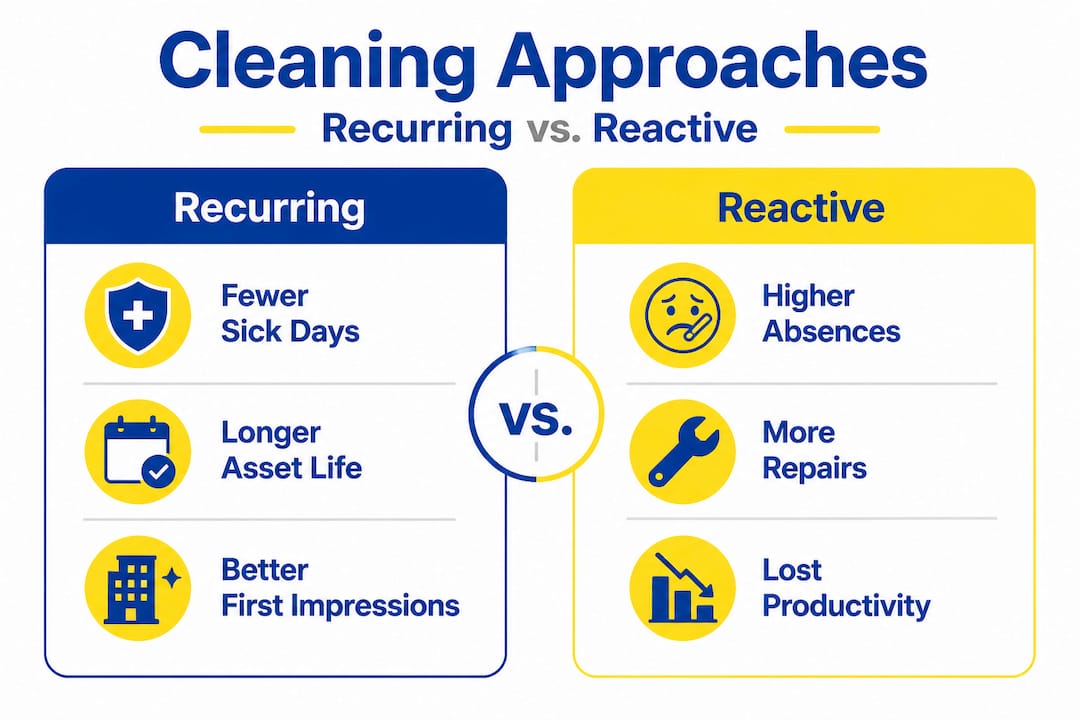
Here is a direct comparison of what recurring and reactive cleaning look like in practice:
| Category | Recurring cleaning | Reactive cleaning |
|---|---|---|
| Sick day frequency | Lower, surfaces cleaned regularly | Higher, contamination accumulates |
| First impression quality | Consistently professional | Unpredictable, often poor |
| Emergency cleaning costs | Rare | Frequent and expensive |
| Carpet and furniture lifespan | Extended by routine care | Shortened by neglect |
| Staff morale and satisfaction | Higher, visible organizational care | Lower, environment feels neglected |
| Compliance readiness | Always ready | Often scrambling |
Professional reputation. Tampa Bay is a competitive market for small businesses and property managers alike. Your office environment communicates your standards before you say a word. A recurring cleaning schedule means your space is always ready for an unannounced client visit, a surprise inspection, or a prospective employee walkthrough. You never have to apologize for the state of your conference room or quickly wipe down a surface before a meeting starts.
The benefits extend beyond just looking clean. Indoor air quality improves measurably when dust, mold spores, and allergens are removed on a scheduled basis rather than allowed to build up. Employees with allergies or asthma perform better in cleaner air environments. This is a concrete, measurable outcome that most office managers overlook entirely.
Here are the most direct benefits you will notice within the first 60 days of switching to a recurring schedule:
- Fewer team complaints about workspace cleanliness or odors
- Reduced frequency of restroom and break room emergencies
- A consistently presentable reception and conference area
- Longer intervals between costly deep cleans or carpet extractions
- Higher morale reflected in casual feedback and team communication
Pro Tip: Track sick day frequency for three months before and after implementing a recurring cleaning schedule. The data almost always makes the case for itself and gives you concrete numbers to bring to stakeholders when justifying the investment. This connects directly to the broader recurring cleaning benefits that extend well beyond surface appearances.
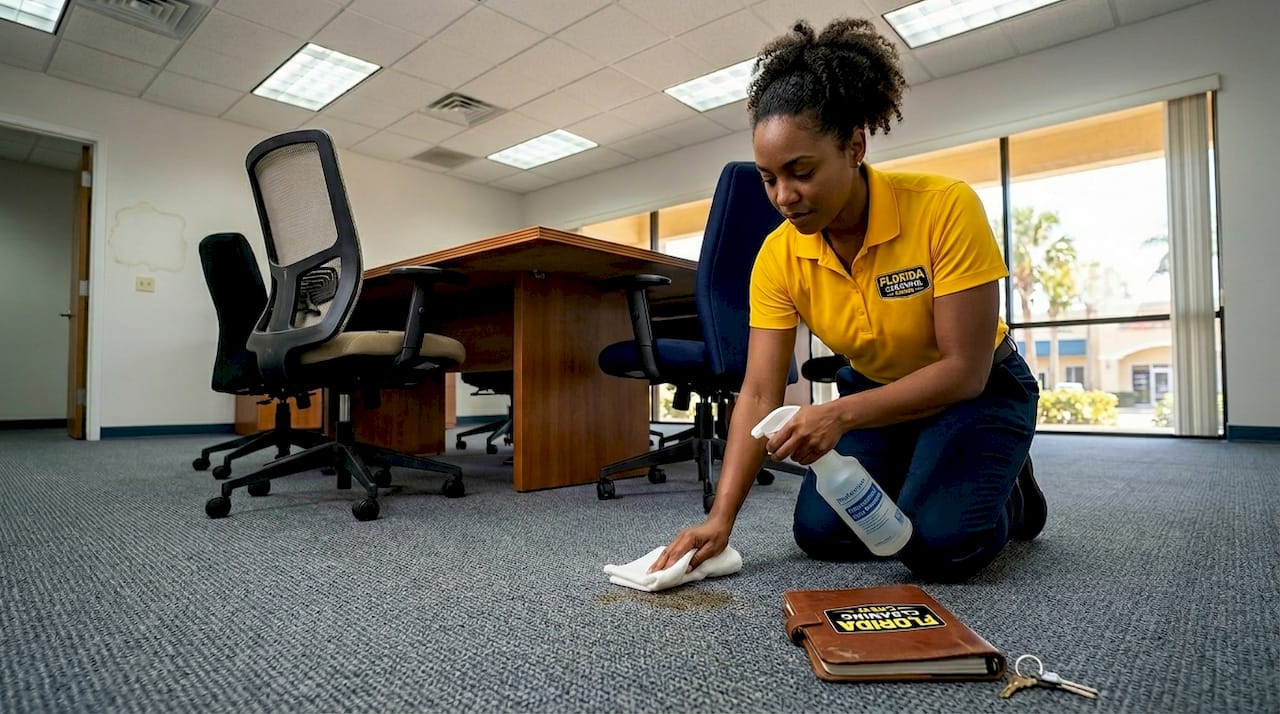
Cost control and asset preservation. Carpets that are vacuumed and spot-treated regularly last significantly longer than those that are only cleaned reactively when stains become obvious. The same applies to hard floors, upholstery, restroom fixtures, and kitchen appliances. The commercial cleaning benefits for Tampa Bay properties include measurable asset lifespan extension, which directly reduces capital expenditure over time.
Setting up a smart, sustainable cleaning schedule
Getting started with recurring office cleaning does not require an expensive overhaul or a complicated process. Here is a straightforward step-by-step approach that works for businesses of any size:
-
Assess your current space and pain points. Walk through your office with fresh eyes, or ask someone who does not work there daily to point out what they notice first. High-traffic areas, restrooms, and the kitchen are almost always the biggest concerns. Document everything.
-
Define your priorities and compliance requirements. If your business operates in a regulated industry, identify the minimum cleaning standards you need to meet. Even if you are not regulated, define what “consistently clean” means to you and your clients specifically.
-
Choose a cleaning frequency that matches real-world use. Use the table from the earlier section as a starting point, then customize based on your actual daily traffic and seasonal fluctuations. Tampa Bay’s summer humidity often demands more frequent attention to moisture-prone areas than the rest of the year.
-
Request a customized service checklist. Before signing any agreement, confirm exactly what each cleaning visit includes. A good provider will specify tasks by area and frequency, leaving no ambiguity about what you are paying for.
-
Build eco-friendly requirements into the brief. Specify that you want green-certified or plant-based cleaning products. Reduce single-use plastic waste by requesting reusable microfiber systems instead of disposable paper options. Local providers who already operate with sustainability in mind will have these practices baked in.
-
Monitor and adjust after the first 30 days. No schedule is perfect from day one. Check in with staff, walk through the space yourself, and communicate any gaps or priorities to your provider. A quality recurring cleaning relationship improves over time as your provider learns your specific space.
-
Review quarterly. Seasonal changes, staff growth, and shifts in office layout all affect cleaning needs. A quarterly check-in with your provider ensures your schedule stays aligned with reality.
CDC recommends regular cleaning because a recurring schedule makes it easier to maintain hygiene with less effort over time. Once the rhythm is established, it runs itself.
Pro Tip: Schedule cleaning outside of business hours whenever possible. Cleaning during the workday creates disruption, noise, and sometimes safety concerns. After hours cleaning means your team walks into a freshly cleaned office every morning without any interruption to their workflow, and the cleaning crew can work more thoroughly without navigating around staff.
Adding sustainability to your cleaning plan is easier than most office managers expect. Green cleaning products have improved dramatically in recent years and now match or exceed the performance of traditional chemical-heavy alternatives. Plant-based degreasers, low-VOC disinfectants, and HEPA-filtered vacuums are all widely available and used by responsible local providers. Eco-friendly cleaning also reduces the chemical load in your indoor air, which is directly relevant to staff health and comfort.
Why most offices underestimate the power of routine cleaning
Here is something we have observed repeatedly working in Tampa Bay commercial spaces: most office managers know their cleaning is inadequate, but they keep the same reactive system anyway. Not because they do not care. Because changing it feels like adding another item to an already full plate.
The reactive cleaning habit is comfortable precisely because it is invisible right until the moment it is not. You do not feel the cost of mild surface contamination accumulating every day. You do not see the slow decline in air quality or the gradual wear on your flooring. You definitely do not get a monthly invoice that says “morale cost from neglected environment.” But all of these costs are real and they compound quietly over months and years.
What we see most often is a slow erosion. An office that looked fine a year ago now has carpet that seems permanently dingy, restrooms that never quite smell right despite spot cleaning, and a break room that requires a full day of scrubbing every few months instead of a quick wipe-down twice a week. That is not a cleaning problem. That is a scheduling problem, and the fix is structural rather than reactive.
The mindset shift that matters most is moving from thinking of cleaning as a response to a visible problem and toward treating it as routine maintenance that protects an asset. Your office is not just a place your team works. It is a physical representation of your standards and values. The clients and employees who interact with that space every day are forming opinions based on what they experience there, whether they consciously realize it or not.
Routine commercial cleaning done consistently actually costs less than the cycle of neglect and emergency intervention. Once you make the switch and give the schedule three months to work, the results are usually obvious enough that going back to the old approach becomes genuinely unthinkable. We have yet to meet a small business owner who tried recurring professional cleaning for a quarter and then decided that ad-hoc spot cleaning was a better approach.
The key is finding a provider you can trust to show up on schedule, do thorough work, and communicate proactively. That relationship is what transforms cleaning from a frustrating expense into a quiet system that supports everything else you are trying to build.
Connect with Tampa Bay’s trusted office cleaning specialists
If this article has clarified what a well-structured cleaning schedule can do for your business, the next step is connecting with a provider who can actually deliver it without you needing to manage every detail.

Florida Cleaning Crew works specifically with small business owners and property managers across the Tampa Bay area who need reliable, consistent, and eco-conscious Tampa Bay office cleaning they can count on. We use green-certified products, operate on your schedule including after-hours service, and provide detailed service checklists so you always know exactly what you are getting. Whether you manage a single office suite or multiple commercial properties, our commercial cleaning services are designed to fit your needs and your budget. Request a free quote today and find out how straightforward it is to put a professional cleaning schedule in place that actually works.
Frequently asked questions
How often should an office be cleaned for best results?
Most offices benefit from daily or at least several times a week cleaning to control germs and maintain appearance. CDC recommends regular cleaning of high-touch surfaces as a key strategy for reducing illness spread in shared spaces.
What’s the difference between recurring cleaning and deep cleaning?
Recurring cleaning keeps spaces consistently tidy and sanitary through regular scheduled visits, while deep cleaning targets built-up grime, neglected areas, and more intensive sanitization that is typically needed only a few times per year. CDC recommends regular cleaning as distinct from more intensive disinfection, which is reserved for higher-risk situations.
How does a cleaning schedule support employee health?
Regular cleaning removes harmful germs from shared surfaces before they can spread through the office, directly reducing the risk of illness among your team. CDC recommends regular cleaning because recurring cleaning lowers illness risk in workplace environments.
Can recurring office cleaning be eco-friendly?
Absolutely. By choosing providers who use plant-based, low-VOC, or green-certified products and sustainable practices like microfiber systems and reduced single-use plastics, recurring office cleaning can align fully with your business’s environmental values without sacrificing results.