TL;DR:
- Regulatory standards require cleaning before disinfecting high-touch surfaces with EPA-registered products.
- Consistent documentation, staff training, and ATP testing validate effective, compliant cleaning processes.
- Working with professional cleaners ensures ongoing compliance, reduces risks, and builds client trust.
Failing a health inspection, losing a contract, or watching a client walk out because of a dirty facility can cost your business far more than a deep clean ever would. Tampa Bay business owners and property managers face a layered challenge: CDC guidelines require cleaning before disinfecting high-touch surfaces with EPA-registered products, ensuring proper dwell time and ventilation, while Florida-specific rules from OSHA and AHCA add another layer of complexity. This guide breaks every standard down into clear, actionable steps so you can protect your team, your clients, and your bottom line.
Table of Contents
- Understanding regulatory cleaning standards
- The essential checklist: Steps for top cleaning compliance
- Verification: Proving your cleaning is effective
- Industry specifics: Healthcare and high-risk environments
- Best practices for staff training and communication
- Why just checking boxes won’t keep your business safe
- Take cleaning standards to the next level with Tampa Bay experts
- Frequently asked questions
Key Takeaways
| Point | Details |
|---|---|
| Know your standards | CDC, OSHA, and Florida rules drive business cleaning requirements in Tampa Bay. |
| Follow a compliance checklist | A consistent cleaning process protects reputation and keeps you audit-ready. |
| Verify your results | ATP testing and thorough records prove your business meets standards. |
| Invest in staff training | Trained staff turn standards into everyday habits, reducing compliance risks. |
| Go beyond basic inspections | Cultivating a strong cleaning culture boosts safety and client trust for the long term. |
Understanding regulatory cleaning standards
If you’ve tried to decode the patchwork of cleaning regulations that apply to your Tampa Bay business, you’re not alone. The confusion is real, and the consequences of getting it wrong range from failed audits to serious liability. Let’s start by identifying exactly which agencies set the rules and what each one requires.
The three main regulatory bodies you need to know
Three organizations shape cleaning compliance for most businesses in this region:
- CDC (Centers for Disease Control and Prevention): Sets science-based guidelines on infection prevention, proper cleaning and disinfection sequences, product selection, and surface contact time. These apply broadly across most business types.
- OSHA (Occupational Safety and Health Administration): Focuses on employee safety during cleaning operations. This includes hazard communication standards, proper personal protective equipment (PPE) use, and safe handling of chemical disinfectants.
- AHCA (Agency for Health Care Administration): Florida’s own healthcare oversight body. AHCA enforces stricter protocols for medical offices, assisted living facilities, and any business providing clinical services. This includes documented infection control plans, mandatory staff training, and use of hospital-grade disinfectants.
As the cleaning standards in Tampa Bay landscape shows, local compliance requirements align with CDC and OSHA guidelines but add the AHCA layer for healthcare settings. That means infection control plans, hospital-grade disinfectants, staff training, and documentation are not optional for medical businesses operating here in Florida.
What does this mean for general businesses?
Even if you’re not running a medical office, OSHA and CDC requirements still govern how your facility handles cleaning. You need written procedures, trained staff, and records that prove consistent compliance. The difference between a general business and a healthcare facility is mostly the intensity of the documentation and the caliber of products used.
Here’s a quick comparison of what each body requires:
| Regulatory body | Primary focus | Key requirement | Who it applies to |
|---|---|---|---|
| CDC | Public health and infection control | Cleaning before disinfecting, EPA-registered products, dwell time | All businesses |
| OSHA | Worker safety | PPE protocols, chemical safety, hazard communication | All employers |
| AHCA | Florida healthcare oversight | Infection control plans, hospital-grade products, staff training records | Healthcare facilities in Florida |
“Businesses that understand the difference between regulatory cleaning requirements and basic janitorial work consistently outperform competitors in client trust, inspection outcomes, and staff safety metrics.”
High-touch surface focus
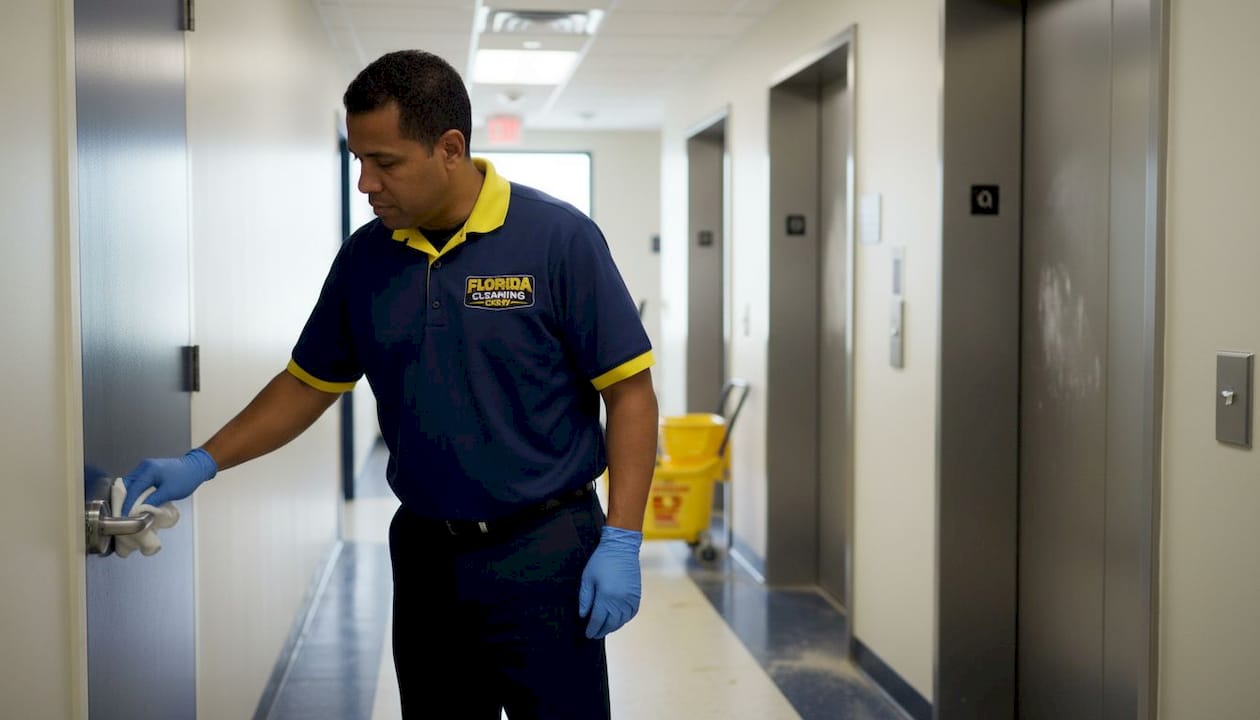
All three bodies zero in on high-touch surfaces: door handles, elevator buttons, light switches, restroom fixtures, shared equipment, and reception counters. These surfaces carry the highest cross-contamination risk and should be addressed in every cleaning cycle. Your written protocol must specifically name these areas, define the cleaning frequency, and log when they were last serviced.
The essential checklist: Steps for top cleaning compliance
Knowing the frameworks is one thing. Putting them to work in your facility is another. Here is a step-by-step process aligned with CDC guidelines and Florida-specific requirements that you can implement starting this week.
-
Assess your facility’s risk level. Not every space carries the same contamination risk. A healthcare waiting room and a private office suite need entirely different cleaning intensities. Start by mapping zones: high-traffic and high-touch areas (restrooms, lobbies, shared equipment) versus lower-risk spaces (private offices, storage rooms). This determines your cleaning frequency and product selection.
-
Gather your EPA-registered products and verify their labels. Only use disinfectants listed on the EPA’s List N, which confirms they are effective against the pathogens relevant to your business. The label will specify the required contact or “dwell time,” which is how long the product must remain wet on the surface to actually kill germs. Many businesses skip this step and wipe too early, making the disinfection ineffective. The CDC guidance on this is clear: always clean surfaces before disinfecting to remove physical debris, because disinfectants cannot penetrate dirt effectively.
-
Clean first, then disinfect. This sequence is non-negotiable. Cleaning with soap or detergent physically removes dirt, grease, and organic matter. Disinfecting kills the remaining microbial load. Skipping or reversing this order significantly reduces the effectiveness of your disinfectant. Your facility cleaning requirements should always list this as a mandatory two-step process.
-
Respect dwell time. After applying your disinfectant, let it sit for the full time listed on the product label, typically one to ten minutes depending on the product and the target pathogen. Staff who spray and immediately wipe are not disinfecting, they are just distributing residue. Train your team to apply, wait, then wipe.
-
Ventilate during and after cleaning. Good airflow reduces the concentration of airborne chemicals and accelerates drying time. Open windows where possible, use exhaust fans, and avoid cleaning in closed spaces with strong disinfectants without proper ventilation. This is especially important in Tampa Bay’s humid climate, where poor airflow can trap chemical vapors and slow drying times.
-
Document every cleaning cycle. Keep a log for each area that records the date, time, product used, staff member responsible, and any observations or issues. This documentation is your best defense in an inspection or liability situation.
-
Schedule and rotate products. Using the same disinfectant indefinitely can allow certain microbes to develop resistance over time. Rotating between two or three EPA-approved products with different active ingredients reduces this risk and keeps your protocol effective.
Pro Tip: Rotating disinfectant products on a monthly basis, using agents with different active ingredients (quaternary ammonium, hydrogen peroxide, sodium hypochlorite), prevents microbial resistance and keeps your cleaning protocol genuinely effective rather than just routine.
Verification: Proving your cleaning is effective
After you execute the cleaning checklist, how do you validate your efforts? Visual inspection is not enough. A surface can look clean and still harbor dangerous levels of biological contamination. That’s where objective verification tools come in.
ATP testing: The gold standard for verification
ATP (adenosine triphosphate) testing is a rapid method for measuring biological residue on surfaces. ATP is present in all living cells, so a high ATP reading signals that organic matter or microbes remain on a surface even after cleaning. The test uses a swab and a small device called a luminometer that delivers results in seconds as an RLU (relative light unit) score. ATP testing measures biological residue on surfaces via RLU scores to verify disinfection effectiveness beyond visual inspection, with benchmarks varying by facility type.
The general benchmarks for clean surfaces suggest RLU scores below 30 to 100, depending on the environment and the specific device being used. Healthcare environments target the lower end of that scale, while a general office may accept slightly higher readings. A result above your target threshold is a clear signal to re-clean and re-test before the area is used again.
CIMS certification and audit readiness
CIMS (Cleaning Industry Management Standard) is an independently audited certification that evaluates your cleaning organization’s quality systems, service delivery, and management practices. To meet CIMS requirements, a cleaning operation must satisfy 100% of mandatory elements and at least 60% of recommended elements, verified through a formal third-party audit. For Tampa Bay businesses that want to demonstrate credible compliance to tenants, clients, or inspectors, working with a CIMS-certified provider is a meaningful signal of quality.
Ways to document compliance for inspectors and clients
Inspection readiness doesn’t happen by accident. Build these documentation habits into your standard operations:
- Maintain a cleaning log for every zone in your facility, updated after each service
- Keep records of all products used, including Safety Data Sheets (SDS) for each chemical
- Document staff training sessions with dates, topics covered, and attendee signatures
- Store ATP test results alongside the logs for the corresponding area and date
- Keep copies of your infection control plan (required for healthcare) and any certifications
This documentation serves two purposes. First, it proves to inspectors that your cleaning program operates consistently, not just before a scheduled audit. Second, it builds confidence with clients and tenants who increasingly want proof that the spaces they occupy meet credible health and value standards.
| Verification method | Speed | Cost | What it measures | Business impact |
|---|---|---|---|---|
| Visual inspection | Immediate | None | Surface appearance only | Low: misses microbial residue |
| ATP testing | Seconds | Low to moderate | Biological contamination level | High: objective, auditable proof |
| CIMS audit | Days to weeks | Moderate to high | Full management system quality | Very high: third-party credibility |
Industry specifics: Healthcare and high-risk environments
For certain sectors, cleaning compliance becomes even more critical. A missed step in a medical office or commercial kitchen isn’t just an inspection failure. It’s a genuine public health risk.
Industries with advanced cleaning requirements
Several business categories in Tampa Bay operate under elevated cleaning standards:
- Healthcare facilities (clinics, dental offices, assisted living): Must maintain documented infection control plans, use hospital-grade EPA-registered disinfectants, conduct staff training on bloodborne pathogen protocols, and undergo periodic AHCA inspections.
- Food service businesses (restaurants, catering, commissary kitchens): Governed by the Florida Department of Business and Professional Regulation and local Hillsborough or Pinellas county health departments. Require food-safe sanitizers, temperature-controlled storage cleaning, and documented schedules for equipment and surfaces.
- Short-term rentals and hospitality (Airbnb, hotels, vacation properties): Must meet guest health expectations and increasingly face platform-specific cleaning protocols that align with CDC standards. Guest reviews now frequently mention cleanliness as the top factor in rebooking decisions.
- Gyms and fitness centers: High-touch equipment and shared locker rooms demand frequent disinfection cycles and visible cleaning logs that members can see in real time.
As Florida-specific standards make clear, AHCA-regulated facilities must maintain infection control plans, use hospital-grade disinfectants, provide staff training, and keep detailed documentation. These are not aspirational suggestions. They are enforceable requirements with penalties for non-compliance.
Unique cleaning requirements by sector
For businesses that need specialized cleaning protocols, the distinction between a general clean and a compliant clean often comes down to product specification, frequency, and documentation. A dental office, for example, must use an EPA-registered, hospital-level disinfectant on operatory surfaces between every patient, not just at the end of the day.
Pro Tip: If your business serves any vulnerable populations, including elderly clients, immunocompromised individuals, or young children, treat your cleaning protocol as a healthcare-level responsibility regardless of your industry classification.
“Public trust in a business, whether it’s a dental office, a hotel, or a shared workspace, is inseparable from cleanliness. When people can see that a facility takes hygiene seriously and can prove it with documented protocols, they return and they recommend. Visible compliance is a competitive advantage, not just an obligation.”
Best practices for staff training and communication
The strongest standards only work when your staff knows and lives them. You can have the best products, the most detailed checklist, and a certified cleaning program, and still fail an audit because a new hire didn’t follow the correct dwell time or skipped a zone during a busy shift.
Training is not a one-time event. It’s an ongoing system. Here’s how to build it properly:
-
Conduct formal onboarding training for every new cleaning staff member. Cover product handling, PPE requirements, cleaning and disinfection sequences, zone-specific protocols, and documentation procedures. Require staff to demonstrate competency, not just sit through a presentation. Per Florida compliance requirements, training documentation must be maintained and available for regulatory review.
-
Schedule quarterly refresher sessions. Cleaning standards evolve. EPA product lists are updated. New pathogens emerge. Refresher training keeps your team current and reinforces habits that can drift over time. These sessions also provide a forum for staff to flag issues they’ve noticed in the cleaning protocol.
-
Post visual protocols in cleaning supply areas. Laminated cards with step-by-step instructions, product dwell times, and zone maps reduce errors during busy shifts. When staff can reference the correct procedure quickly, compliance becomes the path of least resistance.
-
Designate a cleaning compliance lead. One person in your facility should own the cleaning program. They review logs, conduct spot checks, coordinate with your professional cleaning provider, and stay current on regulatory updates. This accountability structure prevents the “everyone assumes someone else is handling it” failure mode.
-
Review and update your protocols annually at minimum. Set a calendar reminder to revisit your infection control plan, product list, and staff training records every year. If your business category, facility size, or occupancy level changes, your cleaning protocol must change with it.
Clear internal communication about cleaning standards also signals your organizational values to both staff and clients. When your office cleaning services are visibly structured and documented, employees take cleanliness more seriously, clients notice, and the entire culture around hygiene shifts from reactive to proactive.
Why just checking boxes won’t keep your business safe
Here’s an uncomfortable truth that most compliance guides won’t tell you: businesses that focus primarily on passing inspections are playing a losing game. Inspections are snapshots. They capture a single moment in a facility’s cleanliness history, and they’re often scheduled or anticipated in advance. Real compliance is what happens on a random Tuesday when the inspector isn’t there and your senior cleaner called in sick.
We’ve seen this pattern repeatedly across Tampa Bay facilities. A business invests heavily in cleaning the week before a health inspection. They pass with flying colors. Then, over the following months, procedures drift, documentation gets skipped, and products are used past their expiration dates. By the next inspection cycle, they’re scrambling again. This cycle is expensive, stressful, and preventable.
The facilities that consistently maintain top-tier cleanliness treat their cleaning program as a system, not a scheduled event. Every zone has an owner. Every product has a log. Every staff member has documented training. And every week, someone is spot-checking results, not just assuming the work was done correctly. The difference between these facilities and the inspection-focused ones isn’t budget. It’s culture.
What professional cleaning expertise actually provides is this: a repeatable, documented system that runs the same way every single time, regardless of who’s on shift or what day of the week it is. That consistency is what builds genuine trust with clients, tenants, and regulators. It also means fewer surprises. Facilities with embedded cleaning cultures report far fewer compliance issues, fewer guest or client complaints about hygiene, and significantly better outcomes in unannounced inspections.
The mindset shift we’d encourage for every Tampa Bay business owner is this: stop treating cleaning as a cost to minimize and start treating it as a quality signal to invest in. Your clients, your staff, and your inspection record will reflect that decision clearly.
Take cleaning standards to the next level with Tampa Bay experts
Running a compliant, inspection-ready facility in Tampa Bay is genuinely complex. Between regulatory layers, product specifications, documentation requirements, and staff training cycles, it’s a full-time responsibility on top of running your actual business.
That’s exactly where a professional cleaning partner changes the equation. Working with an experienced team that understands Florida’s specific regulatory environment means your facility stays compliant between inspections, not just before them. Florida Cleaning Company provides reliable commercial cleaning for Tampa Bay businesses across a wide range of industries, with protocols aligned to CDC, OSHA, and AHCA requirements. Whether you need recurring facility cleaning solutions for an office, medical space, or retail property, our licensed, insured expert cleaning crew brings documented systems and trained staff to every job. Request a free estimate today and take compliance off your plate.
Frequently asked questions
What is the difference between cleaning, sanitizing, and disinfecting in business environments?
Cleaning removes visible dirt and debris using soap or detergent, sanitizing reduces the number of germs to a safe level, and disinfecting uses EPA-registered chemicals to actually kill pathogens on surfaces. Per CDC guidance, cleaning must always happen before disinfecting for the process to be effective.
How often should businesses in Tampa Bay clean and disinfect?
High-touch surfaces should be cleaned and disinfected daily at minimum, with frequency increasing based on foot traffic, occupancy levels, and the nature of the business. CDC guidelines recommend adjusting schedules to reflect actual risk levels rather than applying a one-size-fits-all approach.
What is ATP testing and why should my business use it?
ATP testing measures biological residue on surfaces in seconds, giving you an objective RLU score that confirms whether a surface is genuinely clean or just visually clean. ATP testing goes beyond what any visual check can confirm, making it the most reliable tool for verifying that your cleaning is actually working.
What documentation should I keep for cleaning compliance?
Maintain logs of cleaning schedules, EPA-registered products used, staff training records, and any ATP test results so you can demonstrate consistent compliance to inspectors. Per Florida regulatory requirements, these records must be available for review and are considered evidence of an active, managed cleaning program.