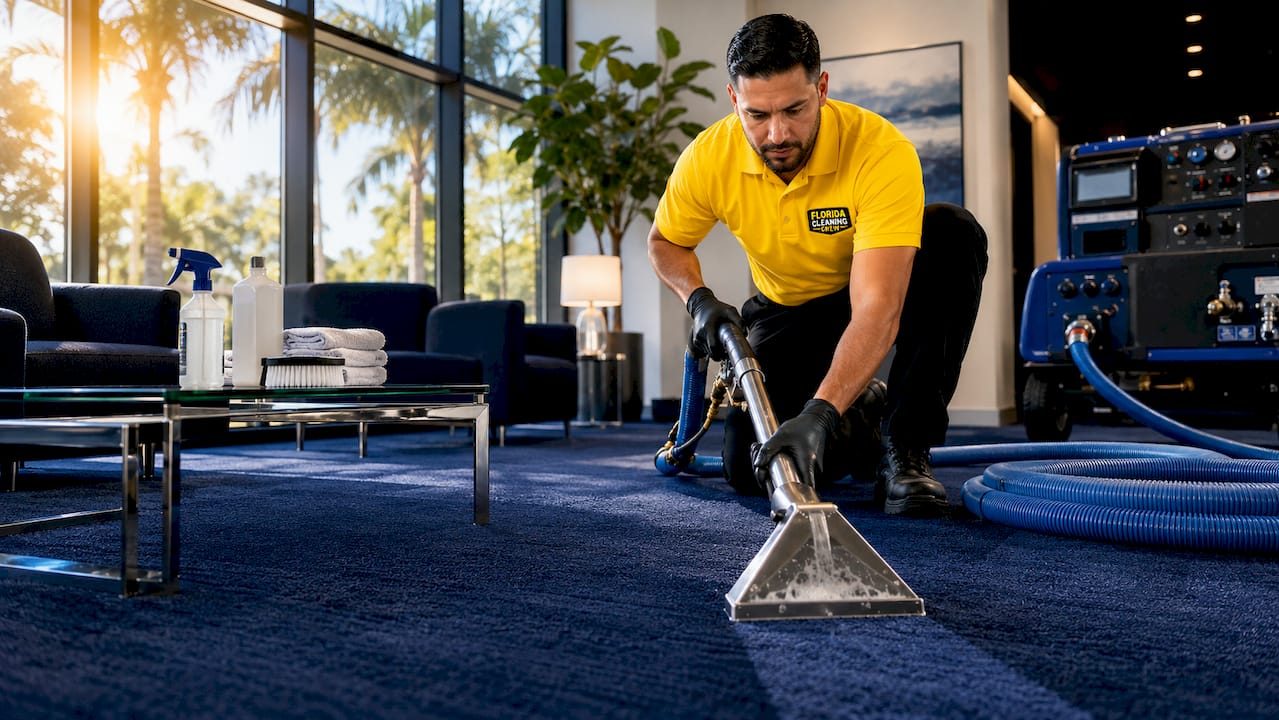
Professional commercial carpet cleaning is the process of using specialized equipment and techniques to extract embedded soil, allergens, and contaminants that routine vacuuming and janitorial work cannot reach. For businesses and property managers in Tampa, Clearwater, and St. Petersburg, this distinction matters more than most realize. The carpet in your office or retail space is not just a floor covering. It is a filter, a first impression, and a financial asset. Understanding why clean commercial carpets professionally is the right strategy means looking at health outcomes, warranty compliance, and the real cost of doing nothing. This guide covers all three.
Why clean commercial carpets professionally: the core case
Professional carpet cleaning in commercial settings relies on methods like hot water extraction, also called steam cleaning, along with CRI-certified equipment and trained technicians. These are the industry-standard terms you will hear from reputable providers. The phrase “professional cleaning” specifically refers to this category of deep-fiber sanitation, not the surface-level work a janitorial crew performs nightly.
The core case for professional cleaning rests on three pillars. First, commercial carpets trap far more contaminants than residential ones because foot traffic volume is exponentially higher. Second, standard janitorial cleaning is insufficient for deep-fiber sanitation, meaning the dirt you cannot see is doing the most damage. Third, most carpet manufacturers require documented professional cleaning to keep warranties valid.
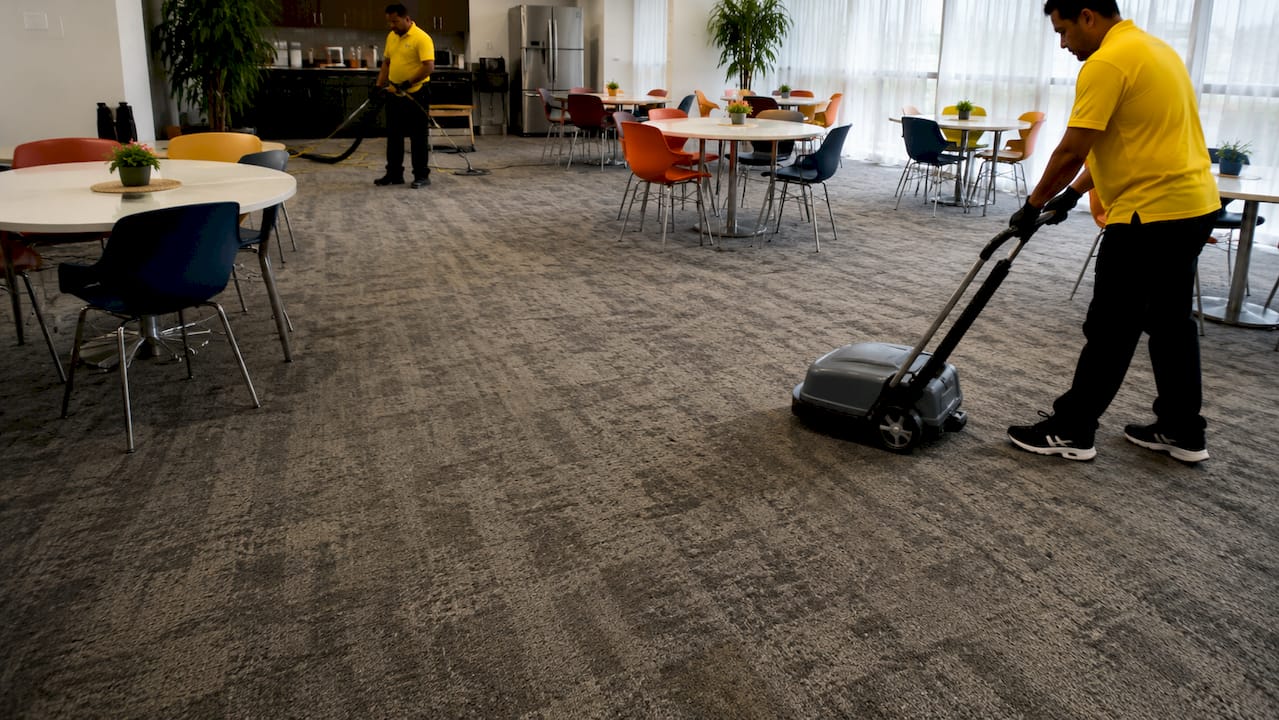
Businesses that treat carpet cleaning as optional are not saving money. They are deferring a larger expense.
How does professional carpet cleaning improve health and indoor air quality?
Commercial carpets act as a reservoir for everything that enters a building. Pollen, dust mites, bacteria, mold spores, and fine particulate matter all settle into carpet fibers within hours of entering through doors and HVAC systems. In a busy Tampa office or a Clearwater retail store, that accumulation happens fast.
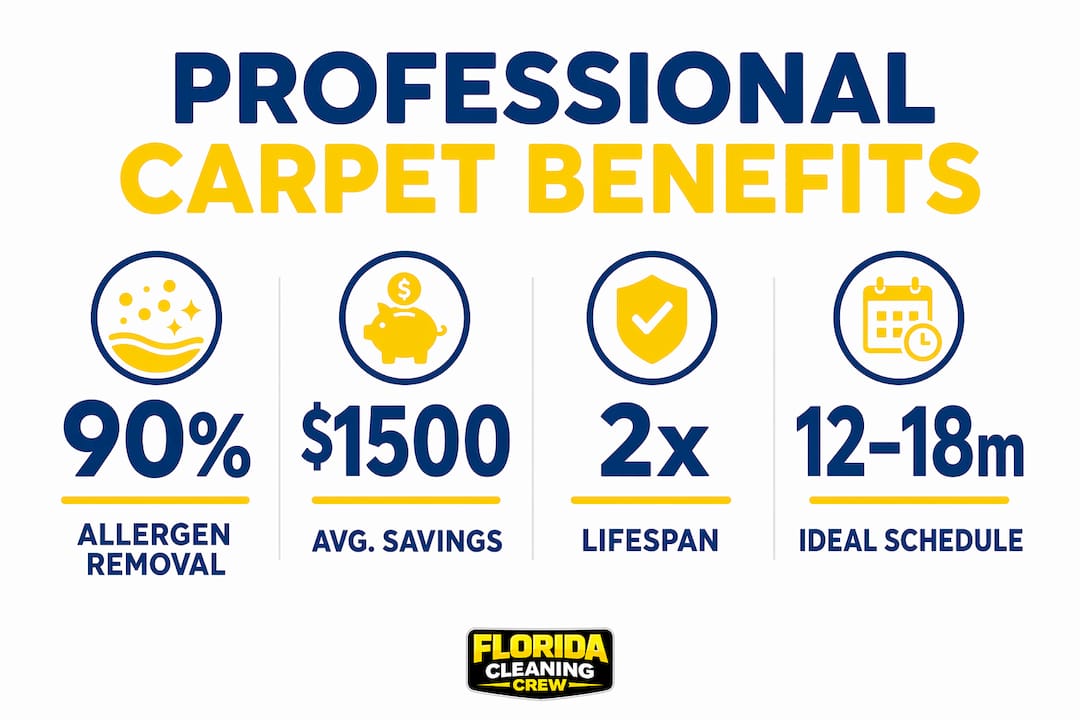
Hot water extraction removes 80–90% of soil and allergens that standard vacuuming leaves behind. That figure is significant because it means a vacuumed carpet still holds the majority of its embedded contaminants. For employees with asthma, seasonal allergies, or respiratory sensitivities, that residual load translates directly into sick days and reduced productivity.
The health benefits extend beyond offices. Consider these high-risk environments:
- Medical offices and clinics: Carpet in waiting rooms collects pathogens from patients. Professional extraction combined with antimicrobial treatments reduces cross-contamination risk.
- Hospitality and hotels: Guest rooms and corridors see constant turnover. Embedded odors and allergens affect guest reviews and repeat bookings.
- Retail spaces: High foot traffic from outdoors brings in pesticides, vehicle residue, and seasonal allergens that settle near entrances.
- Corporate offices: Open-plan layouts concentrate foot traffic in specific zones, creating hotspots of fiber degradation and allergen buildup.
Mold is a specific risk in Florida’s humid climate. Carpets that stay damp from spills or inadequate cleaning dry slowly, creating conditions where mold colonies establish within 24–48 hours. Professional truck-mounted systems extract moisture far more completely than consumer machines, reducing that window significantly.
Pro Tip: Ask your cleaning provider for a post-service moisture reading. In Tampa Bay’s humidity, carpets that retain moisture above 15% after cleaning are at real mold risk. A reputable provider will check this before leaving.
Allergen control through professional cleaning methods is not a luxury for health-sensitive spaces. It is a baseline operational requirement.
Why does professional cleaning protect your carpet investment and warranty?
Commercial carpet is expensive. A mid-grade broadloom installation for a 5,000-square-foot office in St. Petersburg can run $15,000 to $40,000 installed. That is a capital expenditure most property managers want to protect.
The threat most businesses overlook is abrasive grit. Grit in high-traffic areas acts like sandpaper, permanently cutting carpet fibers with every footstep. The damage is invisible until the carpet looks matted and worn, at which point it is irreversible. Cleaning frequency must match foot traffic volume, not just visible dirt. A carpet that looks clean may already be losing structural integrity at the fiber level.
Warranty compliance adds a financial layer that many property managers miss entirely. Failing to maintain documented professional cleaning can void manufacturer warranties, exposing businesses to full replacement costs with no recourse. Most commercial carpet warranties require professional cleaning at intervals specified by the manufacturer, often every 12–18 months, performed by certified technicians.
The table below shows how cleaning frequency affects carpet lifespan and financial outcomes:
| Traffic Level | Recommended Cleaning Frequency | Estimated Lifespan with Proper Care | Lifespan without Professional Cleaning |
|---|---|---|---|
| Low (private offices) | Every 18 months | 10–15 years | 6–8 years |
| Medium (general office) | Every 12 months | 8–12 years | 5–7 years |
| High (retail, lobbies) | Every 6 months | 7–10 years | 3–5 years |
| Very high (hospitality) | Every 3–6 months | 5–8 years | 2–4 years |
“Regular maintenance can double commercial carpet lifespan, making scheduled professional cleaning one of the highest-return maintenance investments a property manager can make.”
The financial rationale is straightforward. If professional cleaning twice a year costs $800 to $1,500 for a mid-size office, and it extends carpet life by five years, the savings on deferred replacement far exceed the cleaning cost. Treating carpet as a functional business asset rather than a consumable changes how you budget for it.
What are the best practices for commercial carpet maintenance?
The most effective commercial carpet maintenance programs combine professional deep cleaning with daily and weekly routines that slow dirt accumulation between service visits. Reactive cleaning after visible soiling appears is the wrong model. Preventative scheduled cleaning integrated with a facility health and safety plan is the standard that protects both carpet and occupants.
Here is a practical maintenance framework organized by frequency:
- Daily: Vacuum high-traffic zones, entrances, and corridors using CRI-certified vacuum cleaners. CRI certification means the machine has been tested to remove soil without damaging fibers or releasing captured particles back into the air.
- Weekly: Vacuum all carpeted areas, including low-traffic zones. Spot-treat stains immediately using pH-neutral solutions. Never scrub. Blot from the outside of the stain inward.
- Monthly: Inspect carpet for matting, odor, or visible soiling in transition zones. Check walk-off mats for saturation and replace or clean them as needed.
- Every 6–18 months: Schedule professional hot water extraction based on your traffic level. Use the table in the previous section as your baseline.
Walk-off mats and CRI-certified vacuuming together reduce dirt ingress significantly, which means professional cleaning sessions go deeper and last longer between visits. A quality walk-off mat captures up to 80% of soil before it reaches the carpet. Most businesses undersize their mats. The standard recommendation is at least six feet of mat coverage at every entrance.
Scheduling professional cleaning also requires operational planning. For retail spaces in Clearwater or Tampa, schedule during low-traffic periods, early mornings or after closing. Post wet-floor signage during drying. Coordinate with your cleaning provider on drying time so the space is ready for business the next day.
Pro Tip: Keep a cleaning log with dates, service provider, and method used. This documentation is your proof of warranty compliance and your record for insurance or liability purposes if a slip-and-fall claim ever involves your flooring.
Common mistakes to avoid include using rental machines for deep cleaning, allowing carpets to stay wet for more than four hours after cleaning, and applying over-the-counter carpet shampoos that leave sticky residues. Those residues attract more dirt and accelerate re-soiling. For more structured guidance, Floridacc’s carpet care tips for businesses covers scheduling and maintenance in detail.
How do professional methods differ from DIY or janitorial cleaning?
The gap between professional carpet cleaning and standard janitorial or DIY approaches is not a matter of effort. It is a matter of physics and equipment capability.
| Method | Equipment | Soil Removal Depth | Drying Time | Residue Risk | Warranty Compliant |
|---|---|---|---|---|---|
| Daily vacuuming | Consumer or commercial vacuum | Surface only | None | None | No |
| Janitorial bonnet cleaning | Rotary machine with pad | Top 20% of fiber | 1–2 hours | Moderate | No |
| DIY rental machine | Low-powered extractor | Top 40% of fiber | 6–24 hours | High | No |
| Professional hot water extraction | Truck-mounted system | Full fiber depth | 2–4 hours | Minimal | Yes |
Truck-mounted hot water extraction avoids over-saturation and the mold risk common with rental machines. The thermal energy generated by truck-mounted systems reaches temperatures that kill bacteria and dust mites at the fiber level. Consumer and rental machines simply cannot replicate that heat or suction capacity.
Rental machines are a specific problem. They inject water but lack the extraction power to remove it fully. Carpets cleaned with rental machines often stay damp for 12–24 hours, which in Florida’s climate is long enough for mold to begin establishing. The cleaning solutions included with rentals frequently leave residues that attract soil faster than before cleaning.
Bonnet cleaning, which many janitorial companies offer as a carpet service, only addresses the top layer of fiber. It makes carpet look cleaner temporarily but pushes contaminants deeper into the pile. Over time, bonnet-cleaned carpets accumulate a compacted layer of soil at the base of the fiber that becomes very difficult to extract.
Certified technicians bring knowledge of fiber types, cleaning chemistry, and drying protocols that protect your carpet rather than stress it. For a full breakdown of methods and what each one does, Floridacc’s carpet cleaning explained guide is a useful reference. You can also review the professional cleaning process used by certified providers to understand what a proper service visit should include.
Industry standards recommend professional cleaning at least every 12–18 months, with delayed cleaning accelerating irreversible fiber damage. That standard exists because the research on fiber degradation is clear: waiting until carpet looks dirty means the damage is already done.
Key takeaways
Professional commercial carpet cleaning protects health, preserves warranty compliance, and extends carpet lifespan in ways that routine vacuuming and janitorial cleaning cannot match.
| Point | Details |
|---|---|
| Health and air quality | Hot water extraction removes 80–90% of embedded allergens that vacuuming leaves behind. |
| Warranty compliance | Documented professional cleaning at regular intervals is required to keep most commercial carpet warranties valid. |
| Fiber protection | Abrasive grit damages fibers invisibly; cleaning frequency must match foot traffic, not visible dirt. |
| Lifespan and cost | Regular professional cleaning can double carpet lifespan, deferring expensive replacement costs. |
| Best practice schedule | High-traffic areas need professional cleaning every 3–6 months; low-traffic areas every 12–18 months. |
Carpets are infrastructure, not decoration
I have worked with enough property managers to know that carpet cleaning is almost always the last line item anyone wants to spend on. The logic seems reasonable: if it looks okay, leave it alone. But that thinking is exactly what leads to a $30,000 carpet replacement that could have been avoided with $4,000 in cleaning over five years.
What changed my perspective was seeing the fiber analysis on a carpet that looked presentable but had never been professionally cleaned in three years. Under magnification, the fibers were shredded at the base. The carpet had maybe 18 months of life left, and no amount of cleaning was going to reverse that structural damage. The property manager had saved money on cleaning and was about to spend it on full replacement.
The other thing I see consistently is businesses underestimating the health liability. A Tampa medical office with carpeted waiting rooms that has not been professionally cleaned in two years is not just an aesthetic problem. It is a potential liability if a patient with documented respiratory issues can connect their symptoms to the facility environment.
My honest recommendation: treat your commercial carpet the same way you treat your HVAC system. Schedule it, document it, and do not wait for a visible problem to act. The benefits of commercial cleaning go well beyond what shows up on the surface, and the cost of prevention is always lower than the cost of replacement.
— Matt
Floridacc serves Tampa Bay businesses with certified carpet cleaning

Floridacc provides professional commercial carpet cleaning for businesses across Tampa, Clearwater, and St. Petersburg. The team uses hot water extraction equipment and warranty-compliant methods designed to protect your carpet investment and meet manufacturer documentation requirements. Whether you manage a medical office, retail space, or multi-tenant commercial property, Floridacc builds a cleaning schedule around your traffic levels and operational hours. Every service is backed by licensed and insured professionals who understand Florida’s humidity challenges and what they mean for carpet care. Request a free estimate through Floridacc’s commercial cleaning for small business page, or explore the full range of Tampa Bay commercial cleaning services to find the right fit for your facility.
FAQ
How often should commercial carpets be professionally cleaned?
Industry standards recommend professional cleaning at least every 12–18 months for low-traffic areas and every 3–6 months for high-traffic zones like lobbies, retail floors, and hospitality spaces. Cleaning frequency should be based on foot traffic volume, not visible soiling.
Does professional carpet cleaning really extend carpet life?
Yes. Regular professional maintenance can double the lifespan of commercial-grade carpet by removing abrasive grit that cuts fibers with every footstep. Extending carpet life from five years to ten years on a $20,000 installation represents significant capital savings.
Can dirty carpets void a manufacturer warranty?
Failing to document professional cleaning at required intervals can void most commercial carpet warranties. Manufacturers typically require certified technicians and specific methods like hot water extraction to maintain warranty coverage.
Why can’t janitorial staff handle commercial carpet cleaning?
Standard janitorial cleaning addresses surface soil but does not reach the deep fiber layer where allergens, bacteria, and abrasive grit accumulate. Bonnet cleaning and consumer vacuums lack the extraction power and thermal energy of truck-mounted professional systems, and neither method satisfies manufacturer warranty requirements.
What is the risk of using rental machines for commercial carpet cleaning?
Rental machines have limited suction capacity and often leave carpets damp for 12–24 hours. In Florida’s humid climate, that moisture window is long enough for mold to begin growing. Rental cleaning solutions also leave residues that attract soil faster, accelerating re-soiling between cleanings.