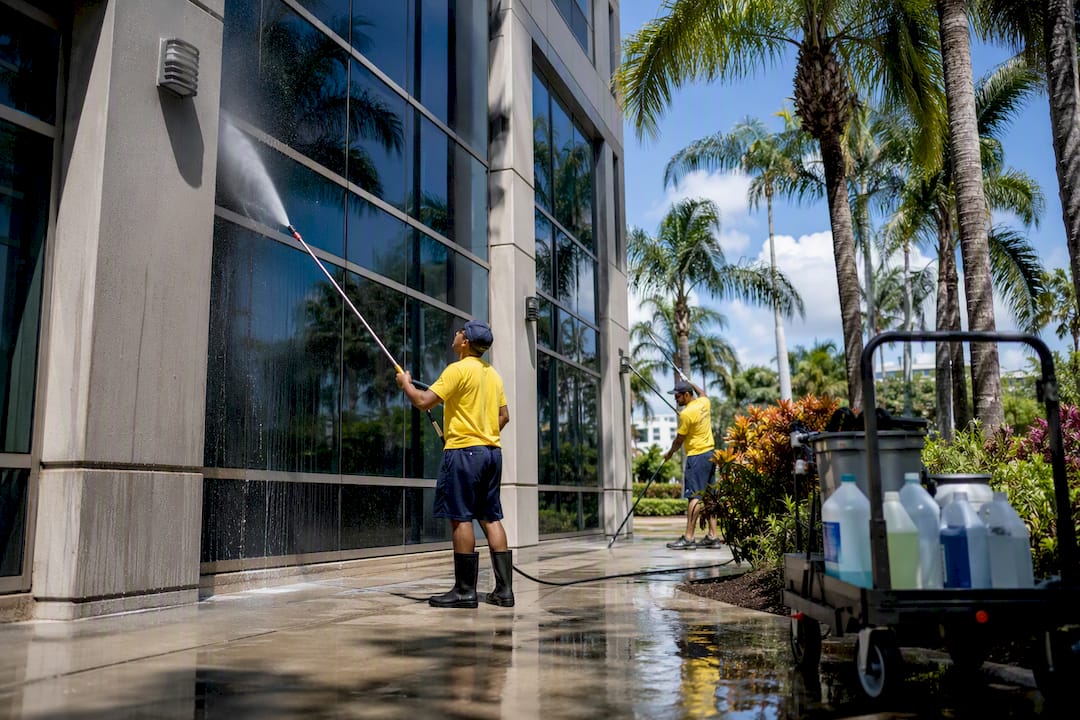
Most U.S. offices pay between $0.10 and $0.25 per square foot for routine commercial cleaning, according to Nilfisk’s pricing breakdown. Warehouses and light industrial space run lower, often $0.04 to $0.10, since there’s less fixture density and fewer restrooms per square foot. Medical clinics land higher, typically $0.25 to $0.35, because infection control and exam room turnover eat up labor hours. If a quote lands wildly outside these bands for your facility type, that’s your cue to ask why before you sign anything.
Statistic Callout: ISSA’s commercial cleaning pricing guidance puts the full national range at roughly $0.05 to $0.30 per square foot depending on facility type and service level. Anything below or above that spread deserves a second look at the scope.
TL;DR:
- Commercial cleaning rates mostly depend on facility type, with offices paying $0.10 to $0.25 per square foot and clinics often exceeding $0.30 due to disinfection needs.
- Labor production rates vary widely; a medical clinic may require nearly double the labor hours of an office of the same size, significantly impacting costs.
- Proper scope definition, including cleanable square footage and task frequency, is crucial before signing a contract to avoid unexpected charges.
- Most bids outside the typical $0.05 to $0.30 per square foot range should prompt questions about scope, labor assumptions, or scope scope scope.
- Accurate cost estimation relies on multiplying production rate by loaded labor cost, then adding overhead and profit, rather than guessing based solely on square footage.
Table of Contents
- What Does Commercial Cleaning Cost Per Square Foot by Facility Type?
- What Factors Push Commercial Cleaning Rates Up or Down?
- How Do You Calculate Cost Per Square Foot?
- Sample Cost Scenarios by Building Size and Visit Frequency
- What Should You Check in the Scope Before Signing?
- How Florida Cleaning Crew Builds Transparent Estimates
- Why the Cheapest Bid Rarely Wins Long Term
- Get a Transparent Commercial Cleaning Estimate for Your Tampa Bay Property
- Key Takeaways
- Sources
- FAQ
What Does Commercial Cleaning Cost Per Square Foot by Facility Type?
The rate you should expect depends heavily on what kind of building you’re running and how often crews show up. A rate quote that ignores facility type is basically a guess dressed up as a number.
| Facility Type | Per-Visit Range ($/sq ft) | Typical Frequency |
|---|---|---|
| Office | $0.10 – $0.25 | 2–5x/week |
| Medical/clinic | $0.25 – $0.35 | Daily |
| Retail | $0.08 – $0.18 | Daily to 3x/week |
| Restaurant | $0.12 – $0.25 | Daily |
| School | $0.07 – $0.12 | Daily (school year) |
| Warehouse/industrial | $0.04 – $0.10 | 1–3x/week |
Metro location shifts these numbers meaningfully. A building in New York or San Francisco pays a premium tied to local wage floors, while facilities in mid-sized Southeast markets, including much of Tampa Bay, tend to land toward the middle or lower end of each range. Frequency matters too. A daily-cleaned office generally pays a lower per-visit rate than a weekly account because crews are moving through familiar territory and covering less accumulated mess each trip.
A few things hold across almost every account:
- Restroom count and fixture density push per-sq-ft cost up faster than square footage alone.
- Higher-frequency contracts often negotiate a lower per-visit rate even though the monthly total rises.
- Facilities with 24/7 occupancy (some retail, healthcare) usually pay more for after-hours or overnight access.
Statistic Callout: Most healthy U.S. commercial accounts settle between $0.10 and $0.25 per square foot for standard office-grade service, per ISSA’s benchmarks. Rates outside that band for a standard office usually signal either a stripped-down scope or an inflated one.
What Factors Push Commercial Cleaning Rates Up or Down?
Square footage alone tells you almost nothing about what a cleaning contract should cost. Production rate, meaning how many square feet one cleaner can realistically finish in an hour, drives most of the variance you’ll see between bids. BSCAi’s production-rate research shows a standard office runs around 4,200 square feet per hour, while a medical clinic with exam rooms and disinfection protocols drops closer to 2,200. Same square footage, nearly double the labor.
Beyond production rate, a handful of variables move the price:
- Visit frequency: daily service costs less per visit than sporadic deep cleans, but more per month overall.
- Scope depth: restroom checks, breakroom detailing, and floor care cadence add hours the base rate doesn’t cover.
- Local labor costs: payroll burden and minimum wage differences between metros shift the loaded rate directly.
- Access and security: badge systems, after-hours entry, and background check requirements add administrative cost.
- Emergency response expectations: same-day callback service for spills or incidents typically carries a premium.
Pro Tip: If a proposal lists “daily cleaning” without specifying which tasks occur daily versus weekly, request a detailed task breakdown before comparing prices, as unclear scopes can hide additional costs.
How Do You Calculate Cost Per Square Foot?
The formula facility managers actually use looks like this:
- Estimate hours needed per visit using a production rate (square feet per hour for that facility type).
- Multiply hours by the loaded labor rate (base wage plus payroll burden, typically 25% to 40% on top).
- Add supplies, overhead, and a profit margin.
- Divide the total by cleanable square footage to get dollars per square foot per visit.
Loaded labor rates start with BLS wage data for janitors and cleaners, then add payroll burden including taxes, insurance, and benefits, which can increase vendor costs above the median hourly wage.
Worked example 1: Small office, 3,000 sq ft, weekly. At 4,200 sq ft/hour, that’s roughly 0.7 hours of labor. At a loaded rate of $22/hour plus supplies and margin, expect around $20 to $25 per visit, or $80 to $100 monthly.
Worked example 2: Warehouse, 30,000 sq ft, weekly. Lower fixture density means faster production, often around 6,000 sq ft/hour or more. Total labor typically runs approximately 5 hours, resulting in per-visit and monthly costs consistent with industry norms.
| Facility | Sq Ft | Frequency | Est. Monthly Cost |
|---|---|---|---|
| Small office | 3,000 | Weekly | $80 – $100 |
| Warehouse | 30,000 | Weekly | $600 – $700 |
Add-ons like carpet extraction or floor stripping bill separately and shift these totals upward.
Sample Cost Scenarios by Building Size and Visit Frequency
Use these as sanity checks, not gospel. Every building has quirks that move the number a little.
- 3,000 sq ft office, weekly: roughly $0.10/sq ft, about $300/month, assuming trash and restrooms are included but carpet care is billed separately.
- 10,000 sq ft office, 3x/week: around $0.12/sq ft per visit, roughly $1,200 to $1,500/month.
- 30,000 sq ft warehouse, nightly minimal service: near $0.06/sq ft, close to $1,800/month for basic trash and sweep service.
- 5,000 sq ft retail, daily high-traffic: about $0.18/sq ft, near $2,700/month, reflecting glass, floors, and frequent restroom service.
- 2,000 sq ft medical clinic, high-compliance: roughly $0.30/sq ft, near $1,800/month, driven by disinfection protocols and slower production rates.
Statistic Callout: These ranges track closely with national averages reported by commercial cleaning cost calculators, which is a useful cross-check when a bid feels off.
What Should You Check in the Scope Before Signing?
“Cleanable square footage” isn’t the same as your building’s total square footage. Mechanical rooms, storage closets, and unused space usually get excluded, and vendors who don’t ask about this upfront may be lowballing a bid they’ll later ask you to renegotiate.
Before comparing any two bids, confirm these items in writing:
- Exact cleanable square footage, with named exclusions.
- Task-level detail: trash cadence, restroom check frequency, breakroom service, high-touch surface disinfection, and floor care schedule.
- Change-order language defining how scope additions get priced.
- Inspection and cure periods for quality issues.
- Insurance, bonding, and substitution-of-personnel clauses.
Watch for these red flags:
- Hourly rates well below your local market average with no explanation.
- A scope of work that says “as needed” instead of naming a frequency.
- No defined change-order process, which means every scope tweak becomes a negotiation.
Our commercial cleaning contract guide walks through the clauses worth negotiating line by line, and the office cleaning scope checklist helps you compare bids task by task instead of just by the bottom-line number. For a broader look at evaluating any service proposal without anchoring purely on the lowest price, Ivan’s Landscaping’s guide to comparing commercial proposals covers similar negotiation ground.
Pro Tip: Ask for the contract term up front. Commercial cleaning agreements often run 2 to 3 years, and roughly 40% now include sustainability clauses. If a vendor won’t commit to a term or a clear renewal process, that’s worth asking about.
How Florida Cleaning Crew Builds Transparent Estimates
Florida Cleaning Crew is licensed and insured, and every commercial estimate starts with actual scope walkthroughs rather than a generic per-square-foot number pulled from a spreadsheet.
- Line-item quotes that separate base service from add-ons like floor care or disinfection.
- Local wage and operational adjustments for Tampa, Clearwater, and St. Petersburg accounts.
- Eco-friendly product options built into the standard scope, not sold as a premium add-on.
A scope-first estimate means you know exactly what you’re paying for before the first visit, not after a change order shows up in month two.
…
Why the Cheapest Bid Rarely Wins Long Term
Most facility managers I’d point this out to already suspect it: the lowest bid per square foot is usually the least sustainable one. A vendor quoting $0.06 per square foot for a 10,000-square-foot office with daily service either has an unrealistic production rate assumption or is planning to cut hours once the contract is signed. Math doesn’t lie. If the loaded labor rate and production rate don’t add up to the quoted price, something in the scope is getting skipped.
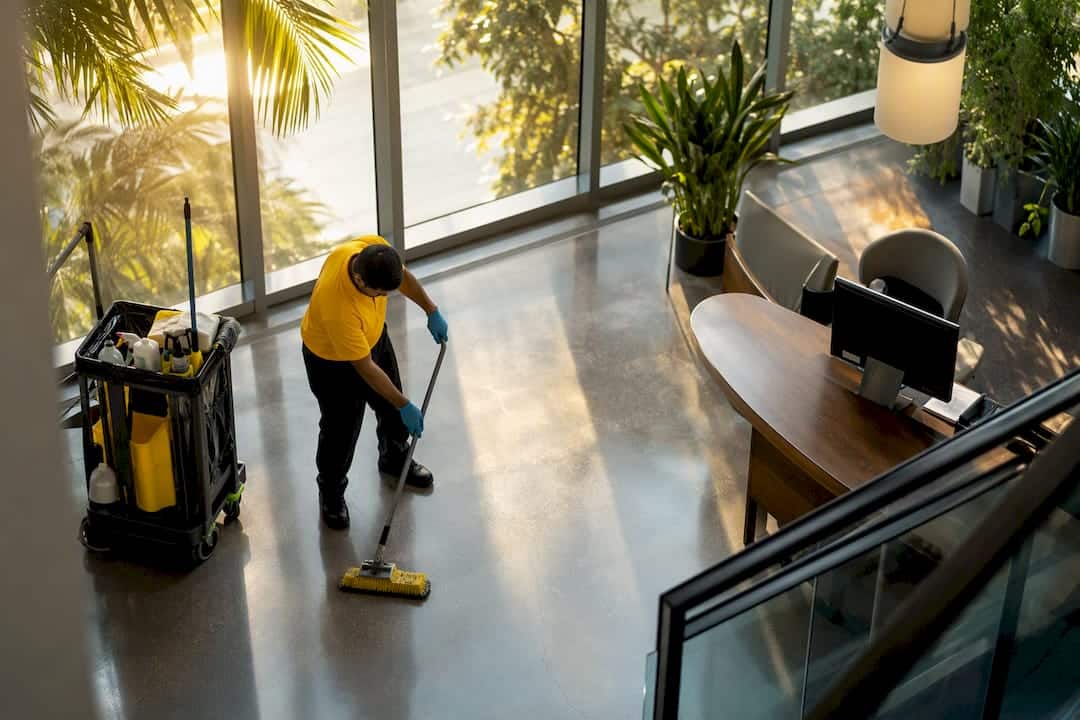
Where conventional advice falls short is treating square-foot pricing as the whole answer. It’s a useful baseline when scope is stable, but research on commercial cleaning contracts makes clear it breaks down fast once frequency, high-touch tasks, or seasonal swings enter the picture. A single number per square foot can’t capture a retail space that gets slammed during the holiday rush or an office that empties out in July.
What should you prioritize first? Not the rate. The production-rate math behind the rate. Once you can estimate expected labor hours for your own building, you can spot a bid that’s too good to be true before it costs you a mid-contract renegotiation.
— Matt
Get a Transparent Commercial Cleaning Estimate for Your Tampa Bay Property
Floridacc builds every commercial quote around the same scope-first math walked through above: real production rates, real loaded labor costs, and a line-item breakdown instead of a flat number pulled out of thin air. That means no surprise change orders three months into your contract and no guessing whether your rate reflects your actual building.

If you manage an office, retail space, or medical facility anywhere in Tampa, Clearwater, or St. Petersburg, Floridacc can walk your space and hand you a scoped quote built the same way the examples above were calculated. Bring your square footage and visit frequency, or just describe your current pain points with your existing vendor. Visit the commercial cleaning services page to see what’s included, or head straight to the free estimate request page to get a quote started this week.
Key Takeaways
Commercial cleaning cost per square foot depends far more on production rate and scope depth than on square footage alone, and vetting a quote means checking the math behind it, not just the number.
| Point | Details |
|---|---|
| Know your benchmark | Most U.S. offices pay $0.10 to $0.25 per sq ft; clinics run higher, warehouses run lower. |
| Production rate drives price | Medical clinics often require considerably more labor hours than an office of the same size due to specialized cleaning protocols. |
| Calculate, don’t guess | Use hours needed times loaded labor rate, plus overhead and margin, divided by cleanable square footage. |
| Lock down scope in writing | Define cleanable square footage, task frequency, and change-order terms before signing. |
| Get a scoped local quote | Floridacc builds line-item estimates for Tampa Bay facilities using the same production-rate math. |
Sources
- Commercial Cleaning Rates per Square Foot: Full Pricing Guide – ISSA
- How To Calculate Commercial Cleaning Rates – Nilfisk
- Bureau of Labor Statistics: Janitors and Cleaners wage data
- A Practical Commercial Cleaning Contract Template Guide – Facility Management Insights
- Commercial cleaning production rates — BSCai
FAQ
How much should I charge per square foot for commercial cleaning?
Standard office accounts typically price between $0.10 and $0.25 per square foot, based on Nilfisk’s industry guidance. Adjust up for higher-compliance facilities like medical clinics, and down for low-fixture spaces like warehouses.
How much does it cost to clean a 3,000 sq ft office?
At $0.10 per square foot with weekly service, expect roughly $300 per month, though daily service or added tasks like floor care will raise that figure. Floridacc’s commercial cleaning page breaks down what’s typically included at that scope.
How many hours does it take to clean a 1,500 sq ft space?
Using a standard office production rate of around 4,200 square feet per hour, a 1,500 square foot space takes roughly 20 to 25 minutes of labor per visit, though restroom count and layout can extend that.
How long does it take to clean a 10,000 sq ft building?
At office-level production rates, expect around 2 hours of labor per visit for a straightforward layout, longer for buildings with more restrooms or specialized areas like break rooms and conference spaces.