
Building trust with cleaning clients is the single most reliable driver of repeat business, referrals, and long-term revenue in the cleaning industry. Trust is not a soft concept here. It is the operational foundation that determines whether a client books again, recommends you to a neighbor in Tampa or St. Petersburg, or quietly switches to a competitor after one bad experience. The cleaning industry runs on access to private spaces, personal belongings, and daily routines. That access is only granted when clients feel genuinely confident in who they are letting through the door. This article breaks down the specific strategies that build that confidence, from your first message to your hundredth visit.
How transparent communication builds trust with cleaning clients
Clear, proactive communication is the fastest way to separate your cleaning business from the competition. 90% of cleaning companies fail to follow up with clients after service. That single gap is your biggest opportunity.

The follow-up text that changes everything
A same-day check-in text after every cleaning visit does more for client retention than any discount or promotion. The message does not need to be long. Something like: “Hi [Name], just checking in. We finished up at your home today. Let us know if everything looks great or if there is anything we can touch up.” That message signals accountability. It tells the client you care about the result, not just the paycheck.
The follow-up after the job matters more than the cleaning itself for client retention. That is a counterintuitive finding, but it makes sense. Clients remember how you made them feel after the service, not just during it.
Setting expectations before the first visit
Misunderstandings about scope, timing, or pricing are the leading cause of client dissatisfaction. Confirm appointment times 24 hours in advance. Send a brief summary of what the visit will cover. If a specific area will not be cleaned that day, say so before the team arrives, not after.
Here is a simple pre-visit communication sequence that works:
- Booking confirmation sent immediately after scheduling
- Reminder text or email 24 hours before the appointment
- A “we’re on our way” message 30 minutes before arrival
- A post-service check-in text within two hours of completion
This sequence takes less than five minutes of total staff time per client. The return in client confidence is significant.
Tone matters as much as timing
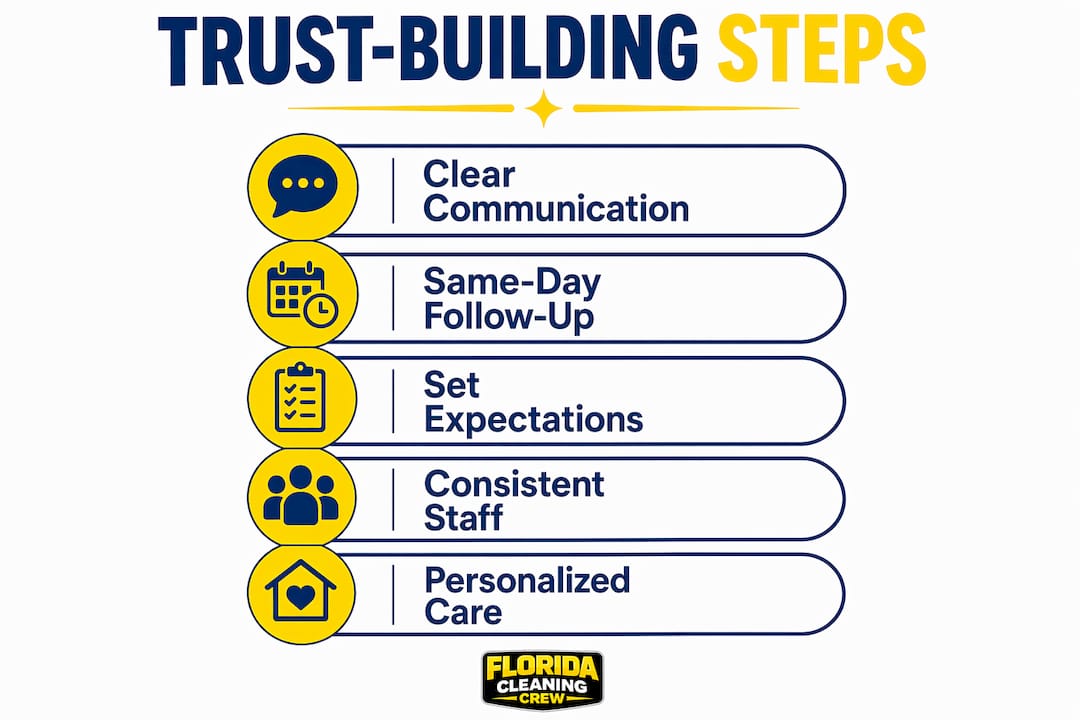
Warm, personal messaging builds more trust than corporate-sounding language. Write to clients the way a trusted friend would write, not the way a legal department would. Avoid phrases like “per our agreement” or “as per your request.” Use the client’s first name. Reference specific details about their home when you can.
Pro Tip: Create two or three message templates for your most common client interactions: booking confirmation, post-service follow-up, and complaint response. Personalize each one with the client’s name and a specific detail before sending. This takes 30 seconds and feels completely human.
Handling complaints is where most cleaning businesses lose clients permanently. When a client raises an issue, respond within the hour. Acknowledge the problem without deflecting. Offer a corrective visit within 24–48 hours. Clients who see a fast, graceful response to a complaint often become your most loyal referral sources.
- Use the client’s name in every message
- Avoid automated-sounding language
- Respond to complaints within one hour
- Offer corrective action before the client asks for it
- Follow up after the corrective visit to confirm satisfaction
Does professionalism really affect client retention?
Professionalism is not about wearing a uniform. It is about giving clients consistent, predictable experiences every single time. Consistent staffing and structured service systems directly link to long-term client loyalty by preventing fluctuating cleaning standards. Clients who see the same team member repeatedly develop comfort and familiarity. That familiarity is trust in its most practical form.
What clients actually look for
When a homeowner in Clearwater lets a cleaning team into their home, they are making a judgment call based on visible signals. Here is what those signals look like in practice:
- Background checks: Displayed prominently on your website and in your intake paperwork
- Insurance and bonding: Listed clearly so clients know they are protected if something breaks
- Team certifications: Any training from organizations like ISSA or ARCSI adds credibility
- Punctuality: Arriving within a 15-minute window of the scheduled time, every time
- Completion of specific requests: If a client asks for the baseboards in the hallway to be wiped, that task gets done and confirmed
Fast, reliable communication such as answering calls within three rings and responding to emails quickly creates client confidence and loyalty. Speed of response signals that you take the client seriously.
The power of team bios and photos
Displaying team member photos and bios with fun facts humanizes your staff and improves client connection before the first visit. A client who has seen a photo of Maria and knows she has been with your company for three years feels very differently about opening their front door than a client who has no idea who is coming.
Pro Tip: Add a short team bio page to your website with a photo, first name, years of experience, and one personal detail like a favorite local Tampa restaurant or a hobby. This costs nothing and converts skeptical visitors into confident clients.
Here is how two approaches to professionalism compare in practice:
| Approach | What Clients Experience | Retention Impact |
|---|---|---|
| No background check display | Uncertainty about who enters the home | Higher cancellation rate |
| Visible background check badge | Immediate sense of safety and accountability | Lower cancellation, higher rebooking |
| Rotating staff with no introductions | Unfamiliarity, reduced comfort | Clients shop around |
| Consistent team with bios and photos | Personal connection, trust built before arrival | Strong long-term loyalty |
Cleaning businesses that build loyalty through consistent staffing rather than one-off deep cleans see measurably better client retention. The role of cleaning in business reputation extends far beyond the physical result. It includes every interaction the client has with your brand.
What trust signals on your website actually do
Trust-building begins on your website before any booking is made. A client in St. Petersburg searching for a cleaning service will make a judgment about your company within seconds of landing on your homepage. The visual signals they see in those seconds determine whether they stay or leave.
Placing trust signals like background check and insurance badges visibly on your website can increase homepage conversion rates by 8–15% and booking page conversions by 22–30%. That is a measurable business result from a design decision that costs nothing to implement.
Where to place trust signals for maximum effect
The placement of trust badges matters as much as having them. Burying your insurance certificate in a footer link does almost nothing. Here is where trust signals perform best:
- Below the hero section on the homepage: Visible immediately after the headline without scrolling
- Adjacent to pricing information: Clients who see pricing with trust badges nearby feel the cost is justified and convert at higher rates
- On the booking form page: Reduces abandonment at the moment of commitment
- In email confirmations: Reinforces the decision the client just made
Social proof as a trust signal
Client reviews and ratings are the most persuasive trust signals available to a cleaning business. A Google review from a real Tampa homeowner carries more weight than any marketing copy you write. Display your five most recent reviews on the homepage. Link directly to your Google Business Profile so prospects can read the full history.
| Trust Signal Type | Best Placement | Effect on Client Behavior |
|---|---|---|
| Background check badge | Homepage, booking page | Reduces hesitation to book |
| Insurance and bonding certificate | About page, pricing page | Justifies premium pricing |
| Client reviews and star ratings | Homepage, service pages | Increases time on site and bookings |
| Team photos and bios | About page, confirmation emails | Builds personal connection pre-visit |
| Professional affiliations (ISSA, ARCSI) | Footer, about page | Signals industry credibility |
Professional affiliations from organizations like ISSA (the Worldwide Cleaning Industry Association) and ARCSI (the Association of Residential Cleaning Services International) signal that your business meets recognized industry standards. These logos take minutes to add to your site and carry real weight with discerning clients.
How do you adapt service to build lasting client relationships?
Long-term cleaning client relationships are built through personalization, not just performance. A client whose specific preferences are remembered and acted on without prompting feels valued. That feeling is what drives referrals and multi-year retention.
Regular, scheduled check-ins tailored to client preferences prevent issues from escalating and maintain relationships over time. The key word is “tailored.” Some clients want a monthly call. Others prefer a quick text after each visit. Ask clients directly how they prefer to be updated, then honor that preference consistently.
Customizing the cleaning plan
A generic cleaning checklist applied to every home is a missed opportunity. When a new client in Tampa signs up, ask three specific questions during onboarding:
- Are there any rooms or items that require special attention or should be avoided?
- Do you have pets, allergies, or preferences for specific cleaning products?
- What does a perfect cleaning visit look like to you?
The answers to those questions become the foundation of a personalized service plan. Document them. Share them with the team assigned to that client. Review them every six months to see if anything has changed. This level of attention is rare in the cleaning industry, and clients notice it immediately.
Pro Tip: Keep a simple client preference card in your scheduling software for each account. Include product preferences, access instructions, pet names, and any rooms that need extra care. Reviewing it before each visit takes 60 seconds and makes the client feel like your only customer.
Proactive notifications and scheduling flexibility
Life changes. Clients reschedule, travel, or need an extra visit before a dinner party. Flexible cleaning services that accommodate those changes without friction build enormous goodwill. When you need to reschedule on your end, notify the client as early as possible and offer two alternative times immediately.
Proactive notifications work in both directions. If your team notices a maintenance issue during a visit, such as a leaking pipe under the sink or a broken window latch, tell the client. You are not responsible for fixing it, but flagging it positions you as a partner who looks out for their home, not just a vendor who cleans it.
- Send schedule change notifications at least 48 hours in advance
- Offer two alternative time slots with every reschedule
- Flag non-cleaning issues observed during visits
- Conduct a brief quality review after every third visit
- Ask for feedback at the 30-day and 90-day marks of a new client relationship
Building rapport beyond the cleaning task itself is what separates a vendor from a trusted partner. Clients who see you as a partner do not shop around when a competitor sends them a discount mailer. They stay because the relationship has value that price alone cannot replace.
Key takeaways
Building trust with cleaning clients requires consistent action across communication, professionalism, digital presence, and personalized service, not a single impressive gesture.
| Point | Details |
|---|---|
| Follow up after every visit | A same-day check-in text increases retention and signals accountability to clients. |
| Display trust signals visibly | Background check and insurance badges on booking pages lift conversions by 22–30%. |
| Keep staffing consistent | Clients who see the same team repeatedly develop comfort that drives long-term loyalty. |
| Personalize every service plan | Documenting client preferences and acting on them makes clients feel genuinely valued. |
| Respond to complaints within one hour | Fast, graceful complaint resolution turns dissatisfied clients into loyal referral sources. |
What i’ve learned about trust that most cleaning guides won’t tell you
I have watched cleaning businesses in Tampa Bay do everything right on paper and still lose clients at a frustrating rate. The common thread is almost always the same. They treat trust as something that gets established once, at the start of the relationship, and then goes on autopilot. That is not how trust works.
Trust in a service relationship is more like a plant than a contract. It needs regular attention. The businesses that retain clients for five, seven, ten years are not necessarily the ones doing the most thorough cleaning. They are the ones who make clients feel seen and remembered at every touchpoint. The follow-up text. The remembered preference for fragrance-free products. The team member who says “I noticed your kitchen faucet was dripping last time, did you get that fixed?”
The uncomfortable truth is that most cleaning businesses compete on price because they have not figured out how to compete on trust. Price competition is a race to the bottom. Trust competition is a race to the top, and there is far less traffic up there.
One practical shift I recommend: stop thinking about client communication as a task and start thinking about it as a product. Your communication is part of what the client is paying for. When you frame it that way, the follow-up text stops feeling like extra work and starts feeling like a core deliverable.
The speed and reliability of communication deliver the best return on investment for client trust and loyalty. That is not a marketing opinion. That is an operational finding from BSCAI research. If you want to grow your cleaning business in Clearwater, St. Petersburg, or anywhere in the Tampa Bay area, invest in your communication systems before you invest in anything else.
— Matt
How Floridacc puts these trust principles into practice
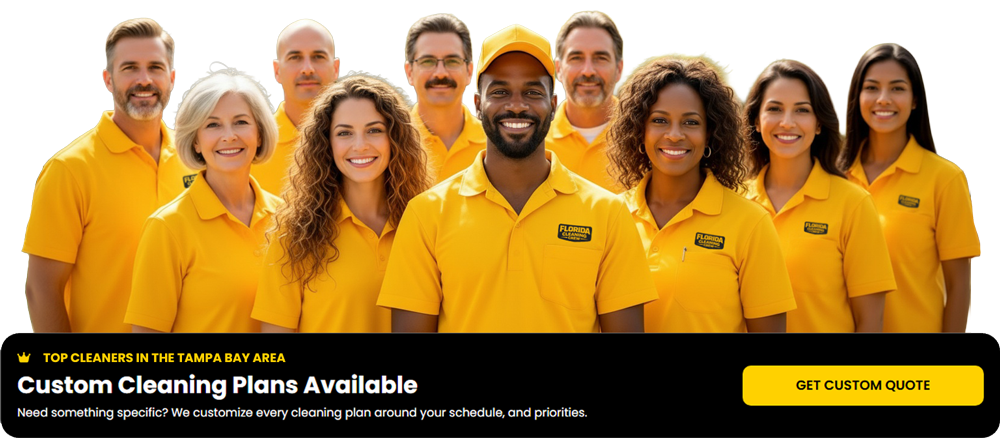
Floridacc has built its reputation in the Tampa Bay area by treating trust as a core service, not an afterthought. Every residential cleaning visit includes a post-service follow-up, a consistent team assignment where possible, and full transparency about insurance, bonding, and background checks.
If you are a homeowner in Tampa, Clearwater, or St. Petersburg looking for a cleaning service that operates this way, the residential cleaning service guide on the Floridacc website walks through exactly what to expect from a trustworthy provider. For those ready to experience reliable, professional home cleaning firsthand, Floridacc’s Tampa home cleaning services are available for a free estimate with no pressure and no obligation.
FAQ
What is the fastest way to build trust with a new cleaning client?
Send a same-day follow-up text after the first visit and confirm that every specific request was completed. 90% of cleaning companies skip this step, making it an immediate differentiator.
How do trust badges on a website affect bookings?
Placing background check and insurance badges near your pricing and booking form can increase booking page conversions by 22–30%, according to heat map studies and ISSA data.
Why does consistent staffing matter for client trust?
Clients who see the same team member repeatedly develop personal familiarity and comfort. Consistent staffing directly links to long-term loyalty by preventing fluctuating service standards.
How should a cleaning business handle client complaints?
Respond within one hour, acknowledge the issue without deflecting, and offer a corrective visit within 24–48 hours. Clients who receive a fast, graceful response often become your strongest referral sources.
How often should you check in with ongoing cleaning clients?
Scheduled check-ins should be tailored to each client’s preference, whether that is a monthly call or a quick text after each visit. Asking clients directly how they prefer to communicate is itself a trust-building act.