Professional storefront window cleaning for a typical small retail location usually costs less than what some listings suggest; restaurants and mid-size retail storefronts generally fall within a moderate price range; larger facades or office buildings can cost more depending on access, pane count, and scope. If you’re in Tampa, Clearwater, or St. Petersburg and want a fast local quote, Floridacc’s commercial window cleaning team is licensed, insured, and available for recurring contracts.
Quick pricing snapshot:
- Small storefront (4–8 windows): $75–$175 per visit
- Restaurant or mid-size retail (10–20 windows): $100–$300 per visit
- Larger facade or office building: $175–$600+
- Recurring contract discount: typically 10–20% off per-visit rates
- Final price depends on window count, access difficulty, interior vs. exterior scope, and scheduling
Key Takeaways
| Point | Details |
|---|---|
| Typical cost range | Small storefronts run $75–$175; restaurants and mid-size retail typically $100–$300 per visit. |
| Recurring contract savings | Locking in a schedule usually reduces per-visit cost by 10–20% compared to one-off rates. |
| Frequency by business type | Retail storefronts: weekly to bi-weekly; offices: monthly to quarterly; coastal locations need more frequent service. |
| Key hiring checks | Always request a certificate of insurance, an itemized written quote, and local references before signing. |
| Local option | Floridacc serves Tampa, Clearwater, and St. Petersburg with licensed, insured commercial window cleaning and flexible recurring contracts. |
Table of Contents
- What does storefront window cleaning actually include?
- How are storefront window cleaning prices calculated?
- How to estimate your storefront cleaning cost
- How often should you schedule storefront window cleaning?
- What safety standards and equipment should a pro use?
- How to pick the right storefront window cleaning contractor
- What to expect on the day of service
- What should a commercial window cleaning contract cover?
- How long does a storefront cleaning job take?
- Tampa Bay storefront cleaning: what’s different here
- A note from the Florida Cleaning Crew team
- Florida Cleaning Crew: local storefront window cleaning you can book today
- Sources
- FAQ
What does storefront window cleaning actually include?
The scope varies more than most business owners expect, and that gap between what you assume is included and what the contractor actually quotes is where surprise charges live.
Standard inclusions on most commercial quotes:
- Exterior glass cleaning (all ground-floor panes)
- Entry door glass (interior and exterior faces)
- Window frames and sills wiped down
- Interior glass if specified in the quote
- Track cleaning on sliding or storefront-style doors
Common add-ons that raise the price:
- Screen removal and cleaning
- Hard-water stain or mineral deposit removal
- Construction residue or adhesive removal
- High-reach work requiring water-fed poles or extension ladders
- Lift or aerial work platform for second-story or higher facades
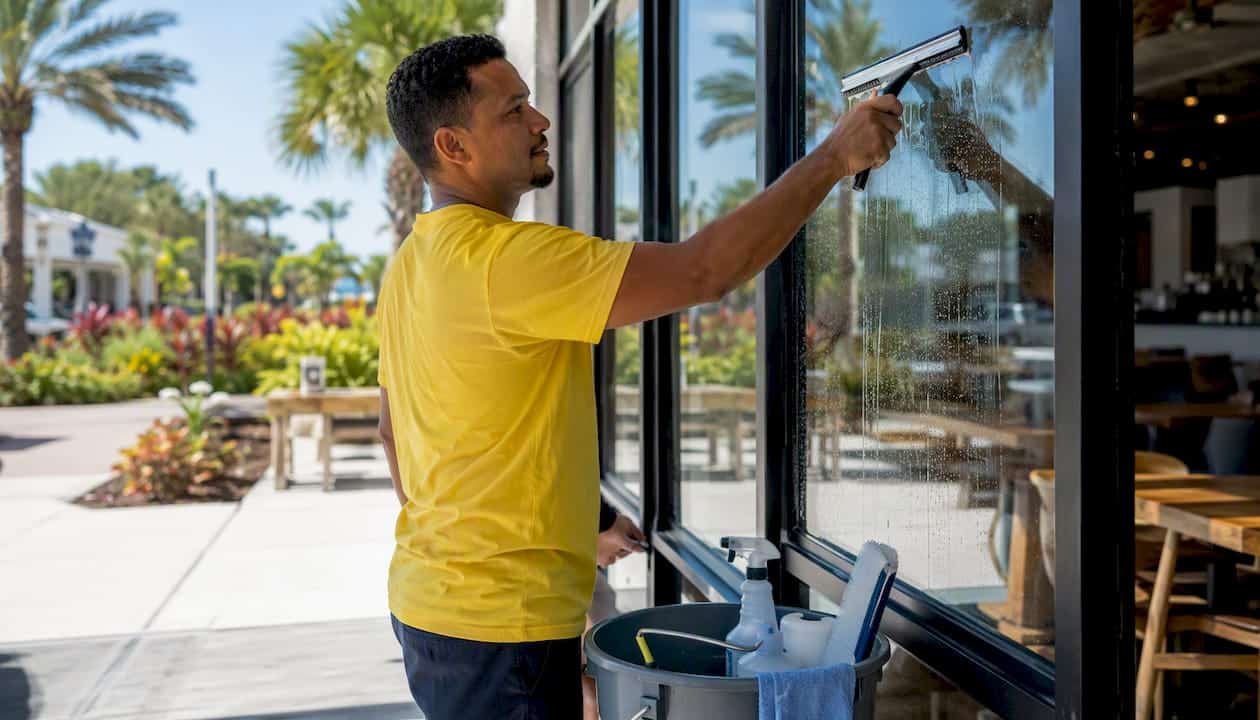
The distinction between a ground-floor storefront and a multi-story facade matters a lot for pricing. Ground-floor jobs use squeegees, scrubbing rigs, and water-fed poles from the sidewalk. Anything above the second floor typically requires a lift, rope-access crew, or building rigging, all of which are quoted separately and carry additional safety and permitting requirements.
How are storefront window cleaning prices calculated?
There are five pricing models in common use, and knowing which one a contractor uses helps you compare bids fairly. According to industry pricing guidance, typical U.S. rate bands break down like this:
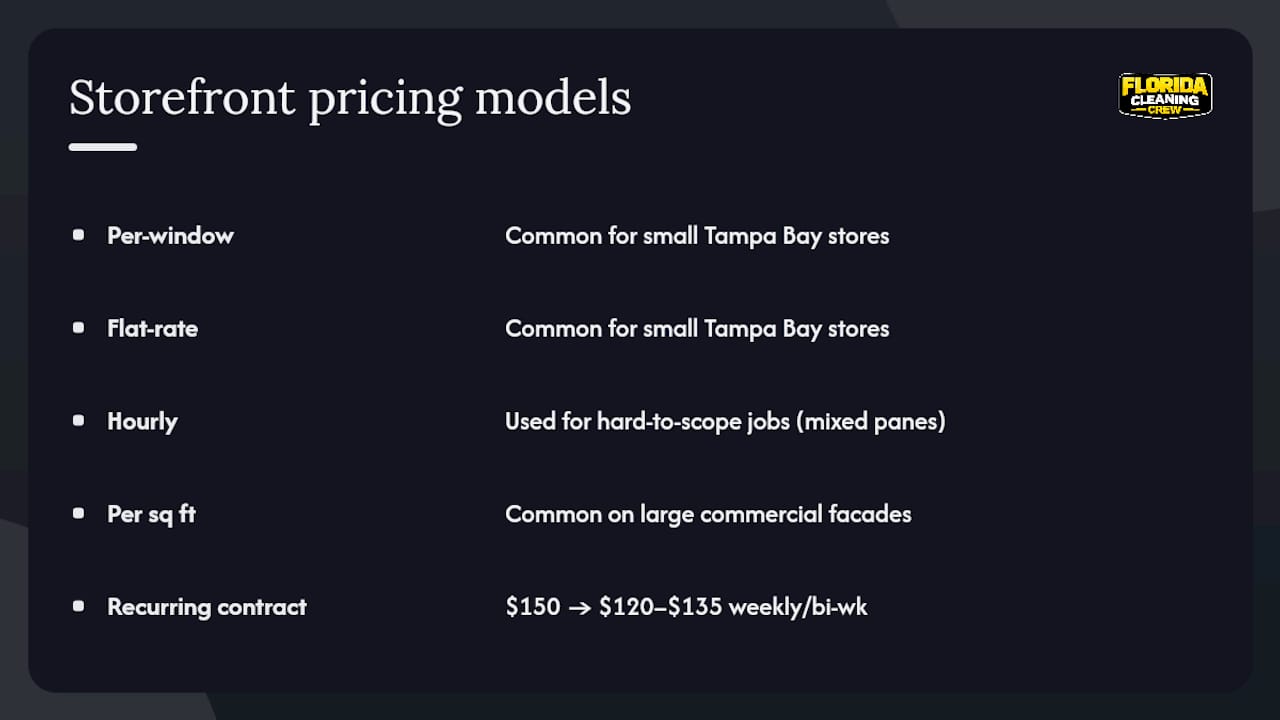
Most small storefronts in Tampa Bay are quoted on a per-window or flat-rate basis. Hourly pricing tends to appear when the job is harder to scope in advance, like a restaurant with a mix of fixed panes, sliding doors, and a transom row. Per-square-foot pricing is more common on large commercial facades.
Regional rates vary. Tampa Bay’s climate means more frequent cleaning is often necessary, which pushes some contractors to offer lower per-visit rates in exchange for a locked-in recurring schedule.
A storefront that costs $150 per single visit might run $120–$135 on a weekly or bi-weekly contract.
How to estimate your storefront cleaning cost
The practical pricing formula most contractors use looks like this:
Total = (Windows × per-window rate) + (Doors × per-door rate) + (Screens × per-screen rate) + Add-ons − Recurring Discount
Worked example: small cafe with 8 windows, 2 glass doors, 4 screens
- 8 windows × $15 = $120
- 2 doors × $10 = $20
- 4 screens × $5 = $20
- Subtotal: $160
- Recurring contract discount (15%): −$24
- Total per visit: $136
A few things that push the number up:
- After-hours or early-morning scheduling (before 7 AM or after close) often adds $25–$50
- Event prep or same-day requests may carry a rush premium
- Hard-water removal or sticker residue is typically billed at an hourly add-on rate
Most contractors set a minimum charge of $75–$100 for any commercial visit, regardless of how few windows are involved. If you have a very small storefront with two or three panes, you’re likely paying the minimum, not a per-window rate.
How often should you schedule storefront window cleaning?
Frequency guidance from commercial cleaning specialists points to business type and environment as the two biggest drivers:
- High-traffic retail storefronts: weekly to bi-weekly
- Restaurants: weekly to monthly (grease and cooking exhaust accumulate fast)
- Professional offices: monthly to quarterly
- Medical or dental facilities: bi-weekly to monthly
- Industrial or warehouse storefronts: monthly or as needed
Location matters as much as business type. A storefront on a busy St. Petersburg street with heavy foot traffic and salt air from the bay will need cleaning far more often than an office park in a quieter suburb. Coastal salt is particularly aggressive: it leaves a hazy film that, if left long enough, can etch into the glass permanently.
“Environmental exposure, particularly coastal salt and urban exhaust, usually dictates frequency more than building type alone. Coastal storefronts risk permanent glass etching if cleaned infrequently.”
Commercial Window Cleaning: How Often Should You Schedule?
Recurring contracts address this directly. Locking in a weekly or bi-weekly schedule with a local crew means you pay less per visit and never have to remember to call. For Tampa Bay storefronts near the water, that consistency is worth more than the discount. Learn more about how often windows should be cleaned for different property types.
What safety standards and equipment should a pro use?
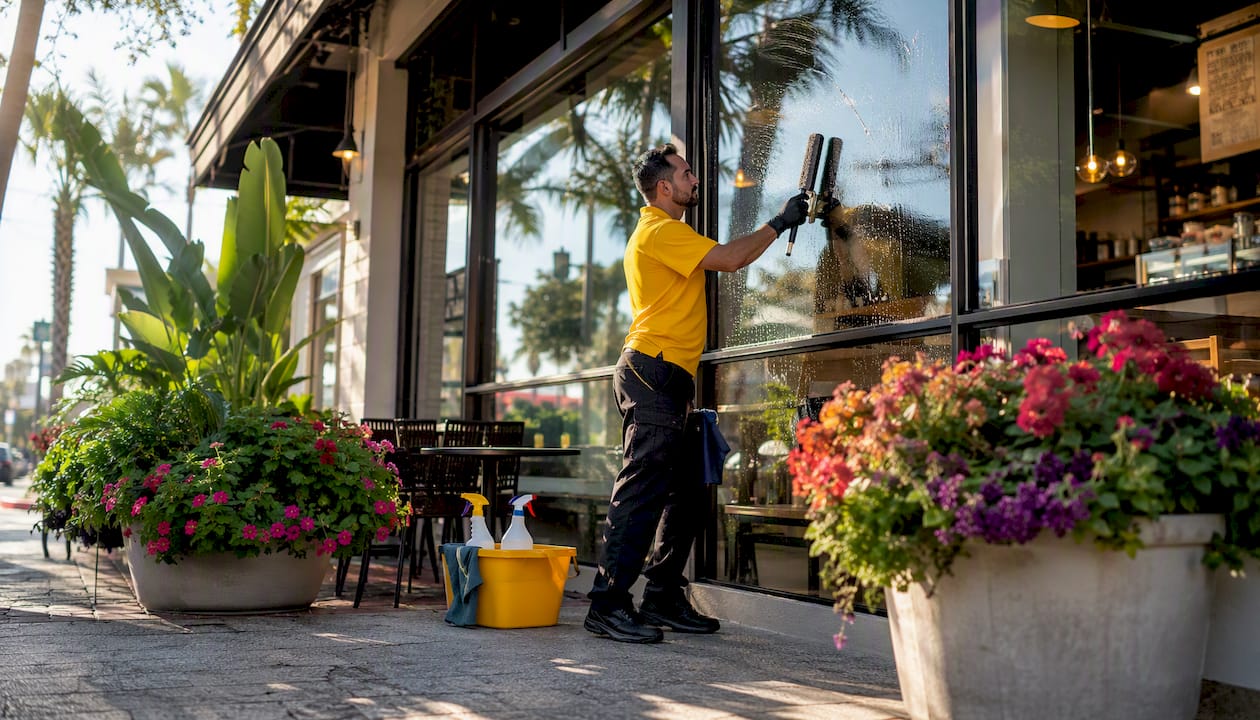
For ground-floor storefronts, the equipment list is straightforward: professional squeegees, scrubbing sleeves, a bucket or backpack sprayer, and a water-fed pole for anything above arm’s reach. The real safety questions arise when a job goes above the first floor.
Standard equipment for commercial storefront work:
- Squeegees (various blade lengths)
- Scrubbing pads and applicator sleeves
- Water-fed pole systems for second-story reach
- Extension ladders (properly footed and secured)
- Aerial work platforms or scissor lifts for higher facades
For elevated or high-rise work, ask about:
- Rope-access certification (SPRAT or IRATA standards)
- Aerial lift operator training
- Traffic control plan if the lift blocks a sidewalk or lane
OSHA regulations govern fall protection and safe work practices for elevated work. Any contractor working above six feet on a commercial property should be able to show documentation of fall protection training and compliant equipment. ANSI publishes voluntary consensus standards for equipment specs and safe-use procedures that reputable contractors reference for lift and ladder work.
Insurance checklist to request before signing:
- General liability insurance (minimum $1 million per occurrence is standard)
- Workers’ compensation coverage for all crew members
- Certificate of insurance naming your business as additionally insured
A contractor who hesitates to provide a certificate of insurance is a red flag, not a negotiating point.
How to pick the right storefront window cleaning contractor
Getting three quotes is the floor, not the ceiling. The real work is knowing what to ask when those quotes come in.
Questions to ask every contractor:
- Are you licensed and insured? Can you provide a certificate of insurance?
- What exactly is included in this quote? What is excluded?
- Do you have experience with storefronts similar to mine in size and access?
- What equipment do you use for ground-floor vs. elevated work?
- What is your scheduling flexibility? Can you work before or after business hours?
- Do you offer a satisfaction guarantee or re-clean policy?
- What are your contract terms and cancellation policy?
Red flags to watch for:
- Vague scope with no itemized breakdown
- No proof of insurance or reluctance to provide it
- Pricing significantly below the typical ranges above (often signals unlicensed work or cut corners)
- No local references or verifiable reviews
- Verbal-only quotes with nothing in writing
Trust signals that matter:
- Written, itemized quote with clear scope
- Local references from similar businesses in Tampa, Clearwater, or St. Petersburg
- Transparent minimum charges stated upfront
- Flexible scheduling options including after-hours
- Clear contract terms with a reasonable cancellation window
Clean commercial windows have a measurable effect on customer perception. The business case for regular maintenance is straightforward: a dirty storefront signals neglect before a customer ever walks in.
What to expect on the day of service
A little preparation on your end prevents delays and avoids extra charges.
Before the crew arrives:
- Clear window displays and merchandise from the interior sill area
- Notify staff that cleaners will be working near entry doors
- Confirm alarm codes or door access arrangements in advance
- Move any A-frame signs or outdoor furniture away from the glass
- Let the crew know about any known issues: hard-water spots, stickers, or recent construction nearby
Typical timeline:
- Small storefront (6–10 windows): 30–60 minutes
- Mid-size retail or restaurant (10–20 windows): 1–2 hours
- Larger facade with add-ons: 2–4 hours or more
What extends the job: hard-water mineral deposits, paint overspray, adhesive residue from old signage, or screens that haven’t been cleaned in months. These are not always visible in advance, so a good contractor will flag them on-site and confirm the add-on cost before proceeding.
After-hours scheduling, typically before 7 AM or after close, is common for restaurants and retail storefronts that can’t have crew working near customers. Expect a modest premium for those slots, usually $25–$50 added to the base quote.
Pro Tip: Ask your contractor to do a walkthrough with you before the first visit. Five minutes of shared expectations prevents most of the “that wasn’t included” conversations later.
What should a commercial window cleaning contract cover?
A written contract protects both sides and prevents the most common disputes. For recurring storefront work, the contract should spell out:
- Scope of work: exactly which surfaces, how many windows, interior vs. exterior, screens, frames
- Visit frequency and scheduling: weekly, bi-weekly, monthly, and how schedule changes are handled
- Pricing and minimums: per-visit rate, any minimum charge, and how add-ons are billed
- Recurring discount terms: the agreed percentage and whether it applies from visit one or after a trial period
- Cancellation policy: how much notice is required and whether there is a fee for early termination
- Guarantee or re-clean policy: what happens if you’re not satisfied with a visit
Most reputable contractors require 30 days’ written notice to cancel a recurring contract without penalty. Some offer a shorter window for month-to-month arrangements. A commercial cleaning contract guide can help you understand what standard terms look like before you sign.
Avoid any contract that locks you in for more than 12 months without a clear exit clause. The industry norm for small storefronts is month-to-month or quarterly, with a 30-day cancellation notice.
How long does a storefront cleaning job take?
For most small storefronts, a professional crew finishes in under an hour. Here’s a realistic breakdown:
- 2–4 windows (very small storefront): 20–30 minutes; minimum charge applies
- 6–10 windows (typical cafe or boutique): 30–60 minutes
- 10–20 windows (restaurant or mid-size retail): 1–2 hours
- 20+ windows or multi-story facade: 2–4+ hours; may require a second visit or lift equipment
Minimum charges are standard across the industry. Most commercial window cleaning companies set a floor of $75–$100 per visit. If your storefront has only two or three panes, you’re paying the minimum regardless of time on-site. Factor that into your frequency decision: a very small storefront might be better served by a bi-weekly visit at the minimum charge than a weekly one.
Tampa Bay storefront cleaning: what’s different here
Tampa Bay’s climate creates specific challenges that don’t apply in drier markets. Salt air from Tampa Bay and the Gulf coasts affects Clearwater and St. Petersburg storefronts with a fine mineral film that builds up fast, especially in summer when humidity is high and afternoon storms leave water spots on glass. Pollen season in spring adds another layer, and construction activity across the region means silica dust and overspray are common complaints.
For storefronts on or near the water in St. Petersburg or Clearwater Beach, weekly cleaning is often the practical minimum, not a luxury. The salt film that looks minor after one week becomes a stubborn haze after three. Left long enough, it etches into the glass and requires professional restoration rather than routine cleaning.
Floridacc serves Tampa, Clearwater, and St. Petersburg with streak-free commercial window service and recurring contracts designed for the local climate. The crew uses eco-friendly cleaning products and flexible scheduling, including early-morning slots before business hours, which is common for busy retail corridors in Ybor City, downtown St. Pete, and Clearwater’s beach district.
A note from the Florida Cleaning Crew team
Storefronts in Tampa Bay face a combination of salt air, humidity, and heavy foot traffic that most window cleaning guides written for drier climates don’t account for. We see it regularly: a business owner calls because their windows look permanently hazy, and the culprit is mineral etching from months of salt buildup that routine cleaning could have prevented.
Florida Cleaning Crew is licensed and insured, uses eco-friendly products, and covers Tampa, Clearwater, and St. Petersburg. Our pro-level window cleaning procedures are built for commercial storefronts, not just residential work. If you want a free estimate or want to talk through a recurring schedule, reach out directly and we’ll walk through your storefront’s specific needs.
Florida Cleaning Crew: local storefront window cleaning you can book today
Dirty windows cost you customers before they ever open the door. Florida Cleaning Crew gives Tampa Bay business owners a licensed, insured crew that shows up on schedule, uses eco-friendly products, and handles everything from frames and sills to high-reach panes with water-fed poles.

Services include storefront window cleaning, recurring commercial contracts, pressure washing add-ons for facades and sidewalks, and full commercial cleaning packages for small businesses. Coverage spans Tampa, Clearwater, and St. Petersburg, with flexible scheduling including early-morning and after-hours slots.
Ready to get a quote? Visit the commercial window cleaning service page or request a free estimate directly. No long-term lock-in required for most recurring programs.
Sources
- Window Cleaning Prices: How to Price Jobs for Profit 2026 Guide
- How Much to Charge for Window Cleaning: 2026 Price Guide
- Commercial Window Cleaning: How Often Should You Schedule?
- OSHA — Laws & Regulations
FAQ
How much does storefront window cleaning cost per visit?
Most small storefronts pay $75–$175 per visit; restaurants and mid-size retail typically run $100–$300. Larger facades or buildings with elevated access can reach $175–$600 or more depending on scope.
How often should a retail storefront get its windows cleaned?
Retail storefronts generally benefit from weekly to bi-weekly cleaning. Coastal locations in Tampa Bay near salt air may need weekly service to prevent mineral etching on the glass.
What should I ask a window cleaning contractor before hiring?
Ask for a certificate of insurance, an itemized written quote, references from similar storefronts, and a clear cancellation policy. Any contractor who won’t provide proof of insurance upfront is not worth hiring.
How do you properly clean storefront windows without streaks?
Professionals use a scrubbing applicator to loosen grime, then pull a squeegee across the glass in overlapping strokes, wiping the blade between passes. Water-fed pole systems with purified water are common for higher panes and leave no mineral residue.
Do window cleaners still clean high-rise or multi-story storefronts?
Yes. Multi-story facades are typically handled with water-fed poles, aerial work platforms, or rope-access crews depending on height. These jobs require additional safety documentation and are quoted separately from standard ground-floor storefront work.