
For Tampa Bay commercial properties, Florida Cleaning Crew is the recommended local provider for recurring janitorial cleaning services. The fastest next step: request an on-site walkthrough and a written scope of work before signing anything. Three things to confirm before you move forward:
- The provider carries verifiable liability insurance and a current certificate of insurance (COI)
- Their program references ISSA Clean Standards or CIMS for quality benchmarks
- You get a named account manager, not just a general service line
These three signals separate professional operations from fly-by-night outfits, and they matter more than price.
Table of Contents
- What do janitorial cleaning services actually include?
- Which property types need specialized janitorial protocols?
- How are janitorial programs structured and what goes in the contract?
- How much do janitorial services cost?
- How do you evaluate and hire the right janitorial service?
- How do you measure whether your janitorial program is working?
- Key Takeaways
- Why local knowledge matters for Tampa Bay commercial properties
- Florida Cleaning Crew serves Tampa Bay commercial properties
- Useful resources for property managers
- FAQ
What do janitorial cleaning services actually include?
The term “janitorial cleaning services” covers recurring, scheduled maintenance of a commercial facility. It is distinct from periodic deep cleaning or specialty work, which are typically quoted separately. ISSA recommends drawing a clear line between daily tasks and specialized services so managers can compare bids accurately.
Core daily and recurring tasks
- Restroom sanitation, disinfection, and consumable restocking (paper towels, soap, liners)
- Vacuuming carpeted areas and entryways
- Mopping hard-surface floors
- Trash and recycling removal
- Surface wiping: desks, counters, door handles, light switches
- Dusting horizontal surfaces and low ledges
- Breakroom and kitchen cleaning (sinks, counters, appliance exteriors, microwave)
- Entryway upkeep: mats, glass doors, lobby surfaces
Periodic and specialty services (usually quoted separately)
- Carpet extraction and hot-water cleaning
- Floor stripping, refinishing, and waxing
- High dusting: ceiling fans, vents, tops of shelving
- Window cleaning (interior and exterior)
- Post-construction cleanup
- HVAC vent cleaning
- Deep grout and tile restoration
Understanding the difference between routine and deep cleaning helps you avoid scope creep and surprise invoices.
Pro Tip: Insist that your written scope of work (SOW) specifies each task, its frequency, who supplies consumables, and the provider’s response time for a missed service. A vague SOW is the single most common source of disputes.
| SOW Element | What to Require |
|---|---|
| Task list | Every task named, not “general cleaning” |
| Frequency | Daily, weekly, monthly — per task |
| Consumables | Who supplies and restocks (paper, liners, soap) |
| Missed service | Response time and make-good policy in writing |
Which property types need specialized janitorial protocols?
Most commercial janitorial firms handle standard office and retail environments. The question is whether they have documented experience with your specific facility type, because some buildings require protocols that go well beyond vacuuming and mopping.
Common property types served:
- Office buildings and professional suites
- Retail stores and shopping centers
- Multi-family residential (common areas, lobbies, laundry rooms)
- Medical offices and clinics
- K–12 schools and higher education
- Industrial facilities and warehouses
- Hotels and hospitality properties
- Government and municipal buildings
When specialty protocols apply:
Healthcare and medical clinics require hospital-grade disinfectants, ATP testing for surface validation, and staff trained in infection-control procedures. Food production facilities follow SQF or GMP standards, which dictate chemical selection and documentation. Senior living communities need infection-control protocols similar to healthcare settings. Industrial sites may involve hazardous-material handling, which requires specific training and compliance documentation.
Quick vetting checklist for your property type:
- Ask for at least two references from facilities similar to yours
- Request documentation of any specialty training or certifications
- Confirm which disinfectants and chemicals they use and whether those are appropriate for your setting
- Ask how they handle protocol changes if your facility’s requirements shift
How are janitorial programs structured and what goes in the contract?
Most commercial cleaning programs run on one of three delivery models: nightly recurring service, a day porter who works on-site during business hours, or a hybrid that combines nightly maintenance with scheduled periodic deep cleaning. Pricing typically follows a per-square-foot monthly rate, a per-visit flat fee, or an hourly rate depending on facility size and scope.
The CIMS standard requires a site-specific scope of work and a written quality plan. That is the floor, not the ceiling. Your contract should also include:
- Exact task list and frequencies (daily, weekly, monthly)
- Who supplies consumables and how restocking is handled
- Named account manager with direct contact information
- Inspection cadence and how results are documented
- Make-good policy: what happens if a task is missed
- Termination clause: notice period and conditions
- Insurance requirements: minimum coverage amounts and COI delivery schedule
Pro Tip: Ask whether staff are W-2 employees or subcontractors. W-2 employees are vetted, trained, and covered by the provider’s workers’ compensation policy. Heavy reliance on subcontractors can mean inconsistent quality and gaps in liability coverage.
The first 30–90 days are a proving period. Build a trial clause into the contract that lets you exit with short notice if performance does not meet the agreed KPIs. A provider confident in their work will not resist this.
| Contract Type | How It Works | Best For |
|---|---|---|
| Monthly retainer | Fixed monthly fee for defined recurring scope | Predictable budgets, stable facilities |
| Per-visit | Flat fee per service visit | Variable schedules, smaller properties |
| Time-and-materials | Hourly rate plus supply costs | Irregular or project-based needs |
For a deeper look at what belongs in a commercial cleaning agreement, the commercial cleaning contract guide covers key clauses in plain language.
How much do janitorial services cost?
Pricing varies by facility size, frequency, and scope, but there are reliable benchmarks. According to RBM Building Services, standard full-service commercial janitorial programs typically run $0.10–$0.35 per square foot per month. A 10,000-square-foot office building cleaned five nights a week would fall somewhere in that range depending on local labor costs and the depth of the scope.
Main cost drivers:
- Facility size and floor plan complexity
- Cleaning frequency (nightly vs. three times per week)
- Foot traffic and soil load
- Specialty tasks: floor waxing, carpet extraction, disinfection protocols
- Green or eco-certified products (modest premium)
- Local labor market rates (Tampa Bay rates differ from rural markets)
- Contract length: longer commitments often carry lower per-visit rates
Pricing models at a glance:
| Model | Typical Use Case | Predictability |
|---|---|---|
| Per-square-foot monthly | Standard office or retail | High |
| Per-visit flat fee | Smaller or variable-schedule properties | Medium |
| Hourly | Project work, post-construction, irregular needs | Low |
As Ramclean notes, pricing models vary by provider and contract length, with longer agreements generally offering more favorable rates.
A bid that comes in significantly below the $0.10–$0.35 range deserves scrutiny. It usually means reduced frequency, fewer tasks, or staff paid below market rates. All three create quality problems within months. Ask for a line-item breakdown on any bid, not just a monthly total. An all-inclusive quote with no task list is not a quote; it is a placeholder.
How do you evaluate and hire the right janitorial service?
The walkthrough is where you learn the most. A provider who shows up prepared, asks about your facility’s specific needs, and takes notes is demonstrating how they will manage your account. One who quotes from a price sheet without seeing the building is telling you something important.
Essential questions to ask during vetting:
- Can you provide a current certificate of insurance and name our property as additionally insured?
- Are your cleaning staff W-2 employees or subcontractors?
- What background screening do you run on employees?
- How do you train new staff, and who supervises the crew at our facility?
- Can you provide two or three references from properties similar to ours?
- What equipment do you use, and do you bring your own supplies?
- Do you offer green or EPA-registered disinfectants?
- How do you track completed tasks and report to us?
These questions come directly from 4M Building Solutions’ vetting framework and reflect what experienced property managers consistently ask.
Red flags to watch for:
- Slow or evasive responses during the sales process (this predicts post-contract responsiveness)
- Refusal to provide a COI or named account manager
- A scope of work that uses vague language like “general cleaning” without task specifics
- No make-good policy for missed services
- Heavy subcontractor reliance with no direct oversight
Onboarding checklist once you select a provider:
- Confirm start date and align with any outgoing provider’s exit
- Schedule an initial deep clean before regular service begins
- Get a supervisor introduction and direct contact number
- Set the inspection schedule and agree on KPIs in writing
- Establish a reporting cadence: weekly summary, monthly review
Pro Tip: Run a reference check by calling, not emailing. Ask the reference specifically about responsiveness when something went wrong, not just whether they are satisfied overall. That answer tells you far more.
According to Pure Productive Services, a professional provider always conducts an on-site walkthrough before quoting and delivers a written SOW with task-by-task frequencies. If a provider skips the walkthrough, skip the provider.
How do you measure whether your janitorial program is working?
A signed contract does not guarantee clean floors. Quality assurance requires a system, not just occasional walkthroughs.
QA methods that actually work:
- Visual inspection checklists completed by a supervisor after each service
- Photo logs submitted through a mobile task-tracking platform
- ATP (adenosine triphosphate) testing for surface disinfection validation in restrooms, breakrooms, and high-touch areas
- Periodic third-party audits for healthcare or food-adjacent facilities
ISSA Clean Standards recommend objective measurement methods like ATP testing rather than relying solely on visual checks. Visual inspection catches obvious misses; ATP testing catches what the eye cannot see.
“A quality assurance program should include defined KPIs, a documented inspection schedule, and a clear process for addressing deficiencies. Without measurable standards, ‘clean’ is just an opinion.” — CIMS Cleaning Industry Management Standard
Sample inspection checklist items (per visit):
- Restrooms: surfaces disinfected, consumables stocked, floors mopped, odor-free
- Common areas: trash removed, floors vacuumed or mopped, surfaces wiped
- Entryways: mats clean, glass doors streak-free, debris removed
- Breakroom: sink clean, counters wiped, appliance exteriors cleaned
KPIs to track monthly:
- Task completion rate (percentage of SOW tasks completed per visit)
- Missed service incidents and resolution time
- Rework requests (tasks that had to be redone)
- Response time to complaints or special requests
Pro Tip: Top providers now use mobile reporting apps that let you see completed tasks and open issues in real time, without requiring a nightly walkthrough. Ask whether your prospective provider offers this before signing.
Key Takeaways
Hiring the right janitorial service comes down to a written scope, verified credentials, and a QA system you can actually enforce.
| Point | Details |
|---|---|
| Get a written SOW first | Every task, frequency, and consumable responsibility must be named before you sign. |
| Verify insurance before contracting | Require a current COI and confirm coverage amounts meet your property’s requirements. |
| Use pricing benchmarks | Standard programs typically run $0.10–$0.35 per square foot per month; bids well below that range warrant scrutiny. |
| Build in a trial period | A 30–90 day exit clause protects you if performance does not meet agreed KPIs. |
| Florida Cleaning Crew for Tampa Bay | Licensed, insured, and serving Tampa, Clearwater, and St. Petersburg with a named account manager and written scope. |
Why local knowledge matters for Tampa Bay commercial properties
Tampa Bay’s commercial property mix is genuinely varied. A Clearwater medical office has different cleaning requirements than a St. Petersburg retail strip center or a Tampa warehouse. Florida Cleaning Crew works across all three cities and understands the specific demands of each property type in this market, from humidity-driven floor maintenance to the disinfection standards that healthcare-adjacent facilities require.
The licensing, insurance, and background-check protocols Florida Cleaning Crew follows are not marketing language. They are the baseline that BBB-verified providers maintain, and they protect property owners from liability when something goes wrong. A named account manager means you are not starting over every time you have a question or a concern.
Property managers who work with IREM guidelines for vendor procurement will recognize the framework Florida Cleaning Crew operates within: documented scope, measurable performance, and a clear escalation path when issues arise.
Florida Cleaning Crew serves Tampa Bay commercial properties
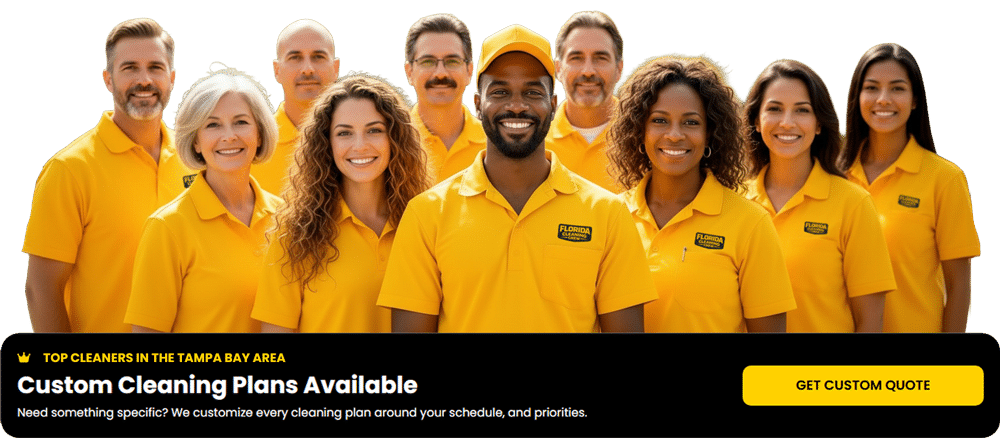
Florida Cleaning Crew is a licensed and insured commercial cleaning provider serving Tampa, Clearwater, and St. Petersburg. For property managers who need a reliable recurring program, the concrete difference is this: you get a named account manager, a written scope of work before the first visit, and a satisfaction guarantee that puts the obligation on the provider, not on you to chase down a resolution.
The team uses eco-friendly, EPA-registered products and handles everything from nightly office maintenance to periodic deep cleaning and commercial carpet care. No subcontractor shuffling. No vague monthly invoices.
To get started, request a free on-site walkthrough through the commercial cleaning services page. The walkthrough is how Florida Cleaning Crew builds the scope of work, so the quote you receive reflects your actual facility, not a generic square-footage estimate.
Useful resources for property managers
These organizations and resources provide standards, certification frameworks, and reputation data that support smarter vendor decisions.
| Resource | Why It Matters |
|---|---|
| ISSA Clean Standards | Industry benchmark for janitorial performance measurement, including ATP testing protocols |
| CIMS (2023) | Management standard requiring site-specific SOW, quality plans, and green-cleaning criteria |
| BBB | Reputation and complaint history lookup for cleaning providers before contracting |
| IREM | Property management resources covering vendor procurement and facility operations |
Additional resources:
- ISSA Clean Standards
- CIMS Cleaning Industry Management Standard (2023)
- How to Choose a Commercial Cleaning Company: A Property Manager’s Checklist — RBM Building Services
- How to Choose a Janitorial Service Provider: 8 Questions to Ask – 4M Building Solutions
- How to Hire a Commercial Cleaning Company: Complete Guide
- What to Expect from Janitorial Services in Philadelphia
- bbb.org
- IREM
FAQ
What is the difference between janitorial and cleaning services?
Janitorial services refer to recurring, scheduled commercial facility maintenance: daily tasks like restroom sanitation, vacuuming, and trash removal. “Cleaning services” is a broader term that includes one-time, residential, and specialty work such as carpet extraction or post-construction cleanup.
How much does commercial janitorial cleaning cost?
Standard full-service programs typically run $0.10–$0.35 per square foot per month, according to RBM Building Services. Actual cost depends on facility size, cleaning frequency, scope of tasks, and local labor rates.
Is an hourly rate a good way to price janitorial services?
Hourly pricing works for irregular or project-based work but creates unpredictable costs for recurring programs. Per-square-foot monthly rates give property managers better budget control for ongoing janitorial contracts.
What should a janitorial contract always include?
At minimum: a task-by-task scope of work with frequencies, named account manager, insurance requirements, a make-good policy for missed services, and a termination clause with a defined notice period.
How do I verify a janitorial provider’s reputation?
Check their BBB listing for complaint history and accreditation status, ask for references from similar facilities, and confirm their COI before signing. A provider who resists any of these steps is a red flag.