One bad review about dirty sheets or a grimy bathroom can cost you three future bookings. In Tampa Bay’s short-term rental market, where competition for five-star ratings is intense and guests have dozens of comparable options a quick search away, inconsistent cleaning is one of the fastest ways to watch your occupancy rate drop. Property managers who treat cleaning as a checkbox item rather than a repeatable system pay for it in chargebacks, owner complaints, and declining platform rankings. This guide walks you through every stage of a reliable cleaning process, from pre-turnover prep to final inspection, so you can stop putting out fires and start running properties guests rave about.
Table of Contents
- Before you start: Cleaning requirements and materials checklist
- Step-by-step turnover cleaning process for short-term rentals
- Cleaning, sanitizing, and focusing on high-touch surfaces
- Quality control: Inspection, restock, and the check-and-reset phase
- Our perspective: What most guides miss about property cleaning consistency
- Get expert help for flawless property cleaning in Tampa Bay
- Frequently asked questions
Key Takeaways
| Point | Details |
|---|---|
| Turnover vs. deep clean | Turnover cleans are guest-focused with repeatable steps, while deep cleans are periodic and more thorough. |
| Prioritize high-touch areas | Cleaning and then sanitizing high-touch surfaces is key to guest safety and satisfaction. |
| Verify with checklists | Use written or digital check-and-reset steps to ensure accountability with every cleaning. |
| Consistent systems win | Documented tools, checklists, and inspections are essential to property management success. |
| Professional help available | Expert cleaning teams and proven workflows can elevate property ratings and reduce manager headaches. |
Before you start: Cleaning requirements and materials checklist
Now that you know the pitfalls of inconsistent cleaning, let’s set you up with the right materials and a foolproof checklist before a single surface gets wiped.
Turnover clean vs. periodic deep clean
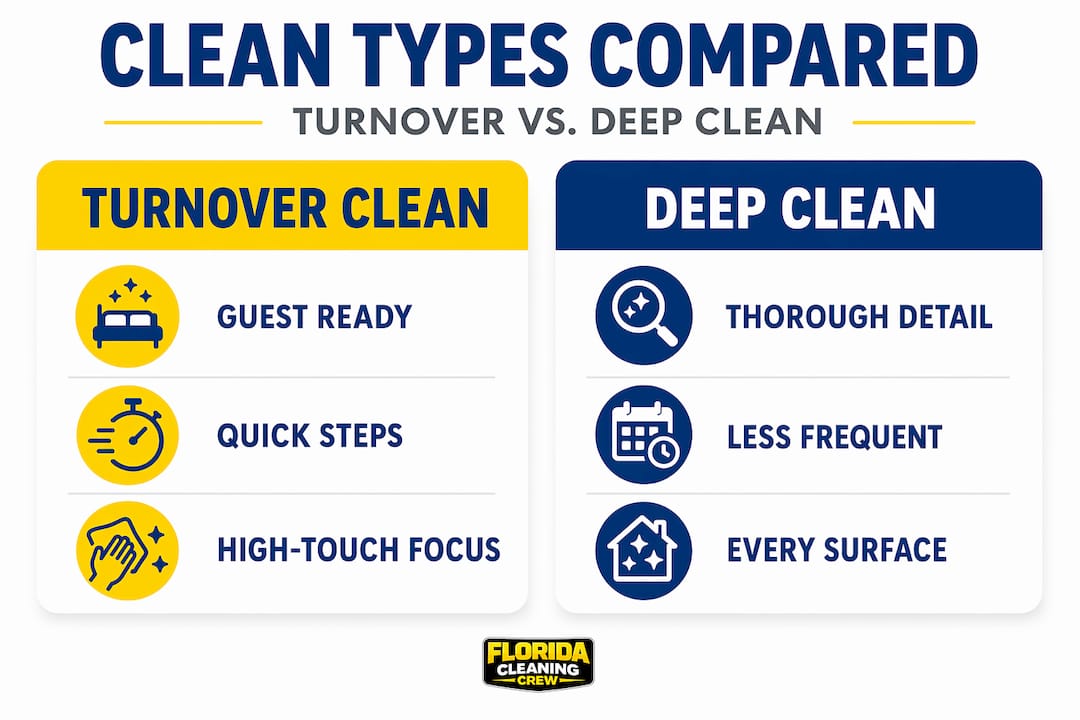
Not every clean is the same, and confusing these two types is one of the most common mistakes property managers make. A turnover clean happens between every guest stay or tenant transition. It covers visible surfaces, restocking essentials, laundry, trash removal, and a full wipe-down of bathrooms and kitchens. The goal is a guest-ready property in the shortest time possible.
A periodic deep clean, on the other hand, happens every one to three months depending on booking volume. It covers areas that guests rarely notice during a short stay but that accumulate grime over time: inside oven racks, behind appliances, baseboards, window tracks, ceiling fan blades, and grout lines. Skipping deep cleans leads to a slow buildup that eventually gets noticed in reviews with phrases like “looked clean at first, but…”
Vacation rental checklists should reflect both types separately, and your cleaners should never be left guessing which one applies to today’s job. As industry guidance makes clear, using a written room-by-room checklist for turnovers that is separate from deep cleaning gives cleaners consistent, auditable steps between guest stays.
Standard supplies checklist for Tampa Bay properties
Tampa Bay’s climate creates some specific cleaning demands that don’t apply in drier markets. High humidity accelerates mold growth in bathrooms and A/C vents. Patio furniture collects more pollen and moisture. Pool areas need routine wipe-downs even between guests. Your supply kit should account for all of this.
Essential materials for every property:
- Microfiber cloths in at least three colors (one per zone: bathroom, kitchen, general)
- Disinfectant spray rated for hard surfaces (EPA-registered)
- Glass cleaner for mirrors, sliding doors, and windows
- Toilet bowl cleaner and dedicated toilet brush
- Mop system with disposable or washable heads
- Vacuum with HEPA filter (critical for allergen control in rental units)
- Trash bags in multiple sizes
- Laundry detergent, stain remover, and fabric softener
- Rubber gloves and disposable gloves
- A/C vent brush or duster
- Grout brush for bathroom tile and tub surrounds
- Baking soda and white vinegar for mineral deposit buildup (common with Tampa’s hard water)
| Supply category | Turnover clean | Periodic deep clean |
|---|---|---|
| Surface disinfectant | Required every time | Required every time |
| Oven interior cleaning | Spot-check only | Full scrub required |
| A/C vent dusting | Light wipe | Full removal and clean |
| Grout scrubbing | Spot as needed | Full tile and grout |
| Laundry (linens, towels) | Every turnover | Every turnover plus mattress pads |
| Patio/pool furniture wipe | Every turnover | Deep scrub with degreaser |
| Inside cabinets and drawers | Spot-check | Full wipe and restock |
Pro Tip: Create a grab-and-go kit stored at each property, stocked with that unit’s specific needs. A beachside condo near Clearwater might need more mold-fighting products, while an inland property might need more dust control supplies. Tailoring the kit saves time and reduces the chance a cleaner arrives unprepared.
Refer to the turnover cleaning guide for property-specific variations across different rental types in the region.
Step-by-step turnover cleaning process for short-term rentals
With your supplies prepped and expectations set, it’s time to execute the turnover cleaning that keeps reviews five-star and owners confident in your management.
The proven room-by-room sequence
Order matters more than most people realize. Starting in the wrong room creates cross-contamination and wastes time backtracking. Here is the sequence that works consistently:
-
Strip and launch laundry first. Pull all used linens, towels, and bath mats immediately. Start the washer before doing anything else. This maximizes time efficiency and ensures clean linens are ready before the cleaner finishes the rest of the unit.
-
Remove all trash and clutter. Walk every room with a trash bag. Remove dishes, garbage, and any items left by the previous guest. Note any damage or missing items before cleaning begins so it doesn’t get confused with cleaning results.
-
Clean bedrooms top to bottom. Dust ceiling fans, light fixtures, and shelves before wiping lower surfaces. Vacuum under beds and furniture. Wipe down nightstands, lamps, and headboards. Remake beds with fresh linens once laundry is done.
-
Clean living and dining areas. Wipe remote controls, light switches, and armrests. Clean glass surfaces, TV screens (with appropriate cloth), and any decor items. Vacuum upholstered furniture and rugs. Mop hard floors last in this zone.
-
Clean the kitchen thoroughly. Wipe down all appliance exteriors (microwave, refrigerator, dishwasher). Clean stovetop burners and interior of microwave. Check refrigerator for leftover food. Wipe cabinet fronts, countertops, and backsplash. Run a quick dishwasher cycle if needed, then restock supplies.
-
Clean bathrooms last. Bathrooms get the most scrutiny from guests. Scrub toilets inside and out, wipe all fixtures, clean mirrors, and re-caulk any visible mildew as needed. Replace toiletries and paper products.
-
Final sweep and floor cleaning. Vacuum all carpeted areas, then mop hard floors moving toward the exit. This is your last pass before inspection.
Following a streamlined turnover process prevents the all-too-common scenario where a cleaner finishes quickly but misses an entire bathroom or forgets to replace toilet paper.
Turnover vs. deep clean: A quick comparison
| Task | Turnover clean | Deep clean |
|---|---|---|
| Strip and replace all linens | Yes | Yes |
| Wipe all high-touch surfaces | Yes | Yes |
| Clean inside oven and fridge | No (spot only) | Yes |
| Scrub grout | No | Yes |
| Dust blinds and window tracks | No | Yes |
| Clean behind furniture | No | Yes |
| Restock amenities | Yes | Yes |
| Inspect and flag maintenance | Yes (basic) | Yes (detailed) |
| Estimated time per unit | 1.5 to 3 hours | 4 to 6+ hours |
As noted in the cleaning checklist for Tampa hosts, matching the right clean type to the situation is what keeps both timelines and quality consistent. Industry guidance confirms that room-by-room turnover steps should be distinct, auditable, and repeatable so managers can verify compliance without being present at every clean.
Pro Tip: Keep a digital or paper log for each turnover. Include the cleaner’s name, start and end time, and any issues flagged. Add before-and-after photos of the bathroom, kitchen, and living areas. This creates accountability without micromanagement and gives you solid documentation if a guest disputes a cleaning quality claim.
Cleaning, sanitizing, and focusing on high-touch surfaces
Even well-done turnovers can miss a crucial step if you confuse cleaning with sanitizing. These are not interchangeable, and understanding the difference protects your guests and your reputation.
Cleaning vs. sanitizing: What each actually does
Cleaning physically removes dirt, debris, grease, and organic matter from a surface. It does not kill pathogens. Sanitizing reduces the number of microorganisms to a safe level. Disinfecting goes further and kills a broader range of bacteria and viruses on contact, but only after a surface has been cleaned first.
This sequence matters enormously. Applying disinfectant to a dirty surface is largely ineffective because the organic matter blocks the chemical’s contact with pathogens. Cleaning should always come before sanitizing or disinfecting, and cleaners should prioritize high-touch surfaces including light switches and doorknobs during every guest turnover. When disinfecting, follow surface-specific instructions on the product label, which includes proper dwell time (how long the product must remain wet on the surface to be effective) and whether rinsing is required.
Many cleaners spray and immediately wipe, which neutralizes the disinfectant entirely. Train your team on dwell times. Most EPA-registered disinfectants require 30 seconds to 4 minutes of wet contact time to be effective.
High-touch surfaces that must be cleaned and disinfected every turnover
Priority surfaces for every clean:
- Door handles (entry, interior, bathroom, patio)
- Light switches throughout the unit
- TV remotes and game controllers
- Thermostat controls
- Faucet handles (kitchen and all bathrooms)
- Toilet flush handles and toilet seat
- Refrigerator and microwave handles
- Cabinet knobs and drawer pulls
- Stair railings and balcony railings
- Alarm clocks, bedside lamps, and phone charging stations
- Window locks and sliding door handles
“Cleaning removes germs, dirt, and impurities from surfaces. Sanitizing lowers the number of germs on surfaces or objects to a safe level. Disinfecting kills germs on surfaces.” — CDC
These zones are where past guests leave the most biological trace. Skipping them is not just a hygiene issue; it’s a guest trust issue. A guest who notices fingerprints on the TV remote or residue on a faucet immediately assumes nothing else was cleaned properly either.
Review the Airbnb cleaning best practices guide for additional platform-specific guidance on high-touch protocols that align with current host expectations.
A note on eco-friendly disinfectants
Many Tampa Bay property managers are switching to EPA-registered, plant-based disinfectants that are effective against bacteria and viruses without leaving harsh chemical residues. This matters especially in properties with children’s rooms or guests with sensitivities. Always verify the EPA registration number on any product you use and confirm it covers the pathogens you’re targeting. Effectiveness, not just “natural” labeling, is what counts.
Quality control: Inspection, restock, and the check-and-reset phase
With the cleaning and sanitizing process covered, don’t overlook the final review and reset. This is where most cleaning operations fall short, and where the difference between a four-star and five-star property becomes visible.
The check-and-reset method
The concept of “check and reset” comes directly from quality control practices used by the best-performing short-term rental operators. The idea is simple: the clean is not finished when the last surface gets wiped. It’s finished when someone has verified, restocked, and documented the result.
A strong quality control process incorporates a “check and reset” phase that includes inspection, restocking counts, and photo proof for critical items, rather than treating the clean as complete when the last surface is wiped. Aligning your turnover workflow with a prepare, clean, sanitize, then check-and-reset sequence is the standard used by top-performing hosts across major booking platforms.
Step-by-step check-and-reset process
-
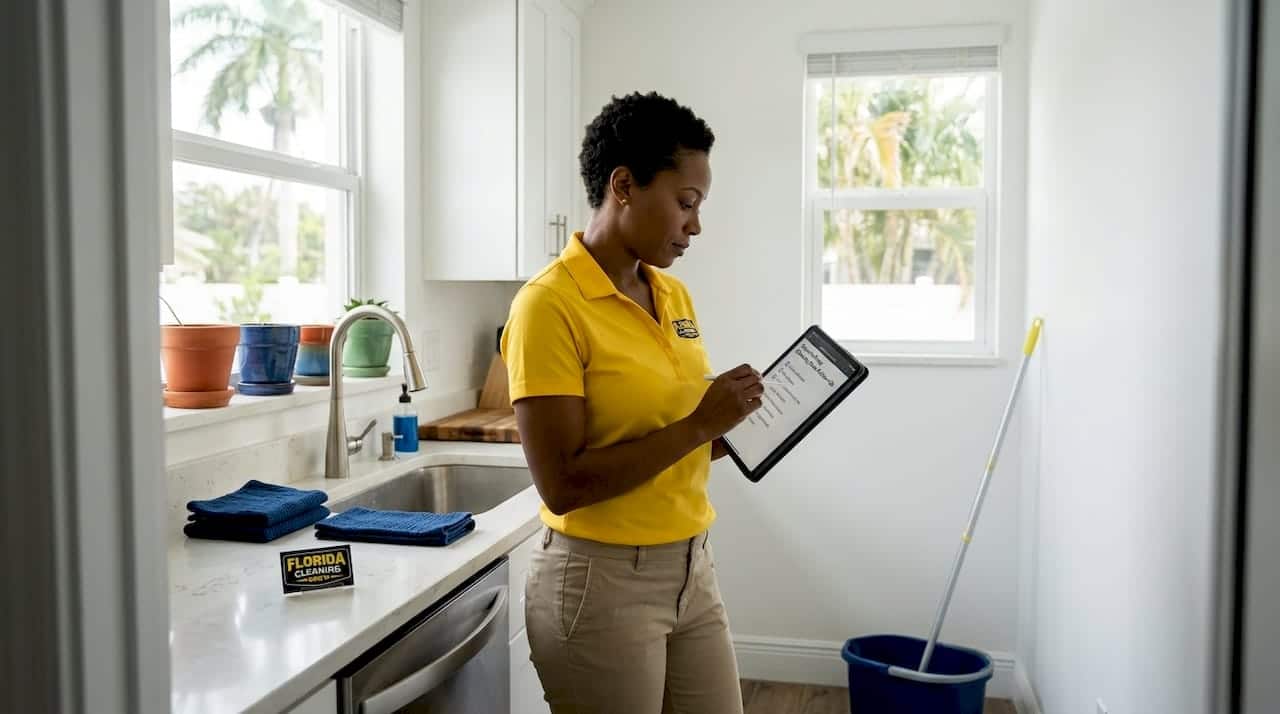
Walk every room from the guest’s perspective. Enter through the front door and look at the property the way an arriving guest would. Note anything that looks out of place: crooked artwork, scuff marks on doors, streaky mirrors, or a lingering odor.
-
Verify restocking levels. Confirm that toilet paper, paper towels, hand soap, dish soap, trash bags, and any property-specific amenities (shampoo, conditioner, coffee pods) are at the correct count. Many property managers use a laminated restock card in each room that lists exactly what should be present.
-
Take documentation photos. Photograph the kitchen counters, bathroom vanity, toilet area, made beds, and living room seating. These photos serve as evidence of condition at checkout for both guest and owner disputes. Timestamp them through your property management app or use a service like your phone’s camera roll with location data enabled.
-
Log and report any maintenance issues. If a cleaner notices a leaking faucet, a broken screen door, a burned-out bulb, or staining that requires professional treatment, this gets flagged in the inspection log immediately. Waiting until the next guest reports it costs you a review.
-
Reset the property to its welcome state. Adjust thermostat to the preset arrival temperature (important in Tampa’s summers), lock all windows and doors, ensure patio furniture is arranged correctly, and confirm all lights are off except any welcome lighting you use.
Pro Tip: Set up a quick post-inspection checklist using a free tool like Google Forms or a property management app. Your cleaner submits it with photos before they leave the property. You receive a notification and can approve remotely. This eliminates the need for you to be physically present at every turnover while still maintaining visibility.
For a consistent, accountable process, the Airbnb turnover services model used by professional teams in Tampa Bay integrates this check-and-reset approach into every booking cycle.
Training your team on what to flag
Not every cleaner naturally knows what rises to the level of “report this.” Build a brief training reference that covers: what damage looks like versus normal wear, how to handle a missing item (document but do not assume theft), when to flag a biohazard situation, and how to communicate a delayed turnover if the previous guest checked out late. Staff who know what to look for become your eyes on the ground, not just your hands on the mop.
Our perspective: What most guides miss about property cleaning consistency
You’ve now covered the technical steps. But what separates a property manager who maintains steady five-star ratings from one who’s constantly reacting to complaints?
Most failures in rental cleaning come from skipping verification, not from lack of effort. A cleaner can work hard for three hours and still miss a moldy shower curtain liner or an unstocked towel rack simply because no structured inspection happened at the end. Effort without a system produces inconsistent results. This is the uncomfortable truth that most cleaning guides skip over because it implies the problem isn’t always the cleaner. Sometimes it’s the manager’s process.
We’ve seen property managers in Tampa Bay implement punitive measures after bad reviews, docking cleaner pay or threatening termination over single incidents. This rarely improves outcomes long-term. What works better is immediate, specific feedback paired with a corrected process. If a property consistently gets missed in the same spot, the fix is a better checklist for that spot, not a punishment. Fear creates cleaners who hide problems rather than report them.
Photo documentation changes the accountability dynamic completely. When cleaners know each turnover ends with photos that go to the manager, quality improves without anyone playing watchdog. It’s not surveillance; it’s a shared standard. The photo log also protects cleaners from unfair blame when a guest makes a questionable damage claim. This creates a team dynamic instead of an adversarial one.
Here’s the insight most guides won’t say directly: consistency beats perfection. A property that delivers a reliably clean, well-stocked, odor-free experience every single time will outperform a property that occasionally wows guests but unpredictably disappoints. Guests calibrate expectations after their first stay. Reliable sameness builds trust faster than occasional greatness followed by a letdown.
For teams managing multiple units, centralizing Airbnb turnover insights around a documented system rather than individual cleaner judgment is what scales. One great cleaner is not a system. A process that any trained person can follow is.
Get expert help for flawless property cleaning in Tampa Bay
Managing turnovers across multiple properties in Tampa Bay is a real operational challenge, especially during peak season when back-to-back bookings leave almost no margin for error.

Florida Cleaning Company offers both residential cleaning services for long-term rental properties and purpose-built short-term rental packages designed specifically around the turnover workflow covered in this guide. Every service includes a structured checklist, trained staff familiar with Tampa Bay’s specific property types and climate demands, and the kind of documentation and photo verification that protects you and your owners. Whether you need ongoing rental cleaning support or a one-time professional deep clean to reset a property that’s fallen behind, the team is available, insured, and ready to fit into your existing management workflow without disruption.
Frequently asked questions
What is the difference between turnover cleaning and deep cleaning?
Turnover cleaning addresses guest-ready tasks between stays, while deep cleaning is a less frequent, thorough effort covering less-accessed areas. A turnover checklist should be kept entirely separate from deep cleaning instructions to avoid skipped steps.
Which surfaces are most important to disinfect during turnovers?
High-touch surfaces like doorknobs, remotes, faucets, and light switches must be cleaned and then disinfected each turnover. The CDC recommends always cleaning before disinfecting to ensure the disinfectant can work effectively.
How do I document my property’s cleaning for guest or owner assurance?
Use digital or written checklists, before-and-after photos, and inspection reports to show a verified process. Implementing a formal “check and reset” phase with photo proof for critical areas protects you from disputes and builds owner confidence.
Is it necessary to follow Airbnb’s Enhanced Clean process if using other platforms?
While not mandatory on every platform, following a rigorous protocol like Airbnb’s Enhanced Clean concept increases positive reviews and protects your reputation regardless of where your property is listed.