Deep cleaning a commercial kitchen means thoroughly restoring hygiene by removing hidden grease, bacteria, and carbon deposits that daily cleaning never reaches. Restaurant owners and food service managers who understand why deep clean commercial kitchens is a non-negotiable practice protect their staff, their customers, and their operating licenses. This guide covers the real reasons behind the requirement, the areas that matter most, how often to schedule cleans, and why your kitchen crew cannot handle this work alone. Tampa Bay restaurants face the same fire and contamination risks as any high-volume operation, and the consequences of skipping a proper deep clean show up fast.
Why deep cleaning commercial kitchens matters more than you think
Deep cleaning is not an intensive version of your nightly wipe-down. It is a methodical restoration of the entire kitchen environment, targeting zones that accumulate grease, carbon, and bacteria over weeks of service. The distinction matters because daily cleaning differs fundamentally from the technical risk management that a professional deep clean provides.
The most serious risk is fire. Grease buildup in ductwork is a leading cause of commercial kitchen fires, and simply cleaning the surface filters does nothing to address what has accumulated inside the extraction system. The National Fire Protection Association (NFPA) sets standards for kitchen exhaust cleaning precisely because this risk is well documented and preventable.
Bacterial contamination is the second major concern. Grease and food residue trapped behind appliances, inside floor drains, and along wall junctions create ideal conditions for pathogens to grow. No amount of daily mopping addresses those zones. The importance of deep cleaning kitchens becomes clear the moment a health inspector looks beyond the prep surfaces.
Regulatory compliance is the third driver. In the United States, local health departments and fire marshals conduct inspections that go beyond surface cleanliness. Failing an inspection in Tampa, St. Petersburg, or Clearwater can mean fines, temporary closure, or loss of operating permits. A documented professional deep clean is often the difference between passing and failing.
What are the key benefits of deep cleaning a commercial kitchen?
The benefits of kitchen sanitation at a deep-clean level extend well beyond passing an inspection. They affect your costs, your staff, and your reputation.
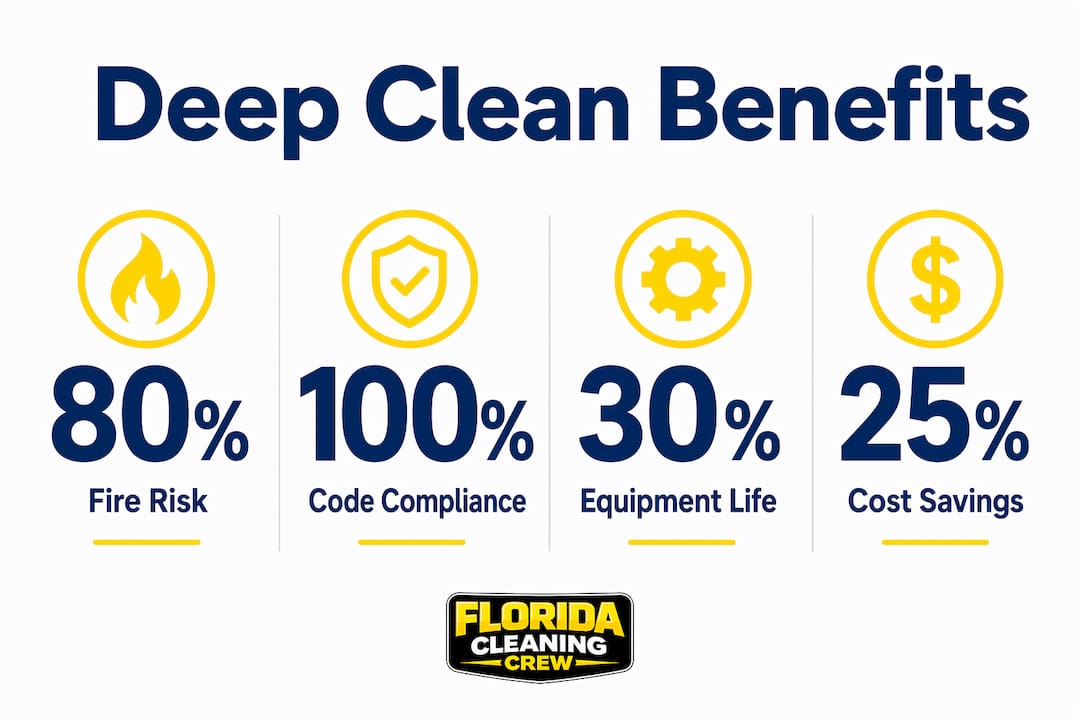
Fire risk reduction is the most urgent benefit. Extraction hoods, ducts, and fans collect grease with every service. That grease is highly flammable. NFPA guidelines require periodic professional cleaning of kitchen exhaust systems because surface-level filter cleaning leaves the ductwork interior untouched. A fire safety checklist for commercial properties consistently lists grease removal in extraction systems as a top priority.
Health code compliance follows directly. A professionally cleaned kitchen produces documentation that satisfies health inspectors and insurance auditors. In-house cleaning logs rarely meet the standard required under ventilation and hygiene regulations. Required documentation for compliance is one of the clearest reasons to use a professional service rather than relying on staff records.
Equipment longevity is a financial benefit that restaurant owners often underestimate. Grease and carbon buildup inside ovens, fryers, and grills forces equipment to work harder, raising energy costs and accelerating wear. Regular deep cleans extend the service life of expensive commercial appliances.
Pest and odor control are connected. Specialist cleaning removes grease and grime that attract cockroaches, rodents, and flies. Persistent kitchen odors are almost always a sign of hidden grease that daily cleaning has not reached.
Staff morale improves in a clean environment. A professionally cleaned kitchen reduces background stress for kitchen teams, allowing them to focus on food production rather than working around safety concerns. A cleaner workspace also reduces the risk of slip-and-fall accidents from grease on floors.
- Fire risk reduction through extraction system degreasing
- Health code compliance with documented professional records
- Extended equipment life and lower energy costs
- Pest prevention by eliminating hidden grease and food residue
- Improved staff morale and a safer working environment
Pro Tip: Schedule your deep clean immediately after a busy season or catering event. That is when grease accumulation peaks and the risk of a failed inspection is highest.
How often should commercial kitchens be deep cleaned?
Commercial kitchens require professional deep cleaning quarterly as a standard baseline, with monthly cleans recommended for high-volume operations. That frequency is not arbitrary. It reflects how quickly grease, carbon, and bacteria reach dangerous levels in a working kitchen.
The right schedule depends on your kitchen’s output. A small café serving 50 covers a day accumulates grease far more slowly than a full-service Tampa restaurant running 300 covers across lunch and dinner. Volume drives accumulation rate, and accumulation rate drives risk.
| Kitchen type | Recommended deep clean frequency | Primary risk if skipped |
|---|---|---|
| Low-volume café or deli | Every 3–4 months | Gradual grease buildup, odor issues |
| Mid-volume restaurant | Every 2–3 months | Bacterial growth, pest attraction |
| High-volume restaurant or hotel kitchen | Monthly | Fire hazard, failed inspections |
| Catering or event kitchen | After each major event | Carbon deposits, cross-contamination |
Legal and insurance implications make scheduling non-negotiable. Many commercial property insurance policies require documented evidence of regular kitchen cleaning. A fire caused by grease buildup in an uncleaned extraction system can void a claim if the insurer finds no cleaning records. The Tampa Bay compliance guide for businesses outlines exactly what documentation local inspectors expect to see.
Integrating deep cleans into a busy restaurant workflow takes planning. Schedule them during the slowest trading period, typically a Sunday night or a Monday when the kitchen is closed. Give your team advance notice so prep schedules adjust accordingly. Keep a cleaning log with dates, the scope of work completed, and the name of the service provider. That log is your first line of defense in any inspection.
What areas does a professional deep clean target?
A professional deep clean covers every zone where grease, bacteria, and carbon accumulate beyond the reach of daily cleaning. Understanding the scope helps restaurant managers set realistic expectations and verify that the job was done properly.
-
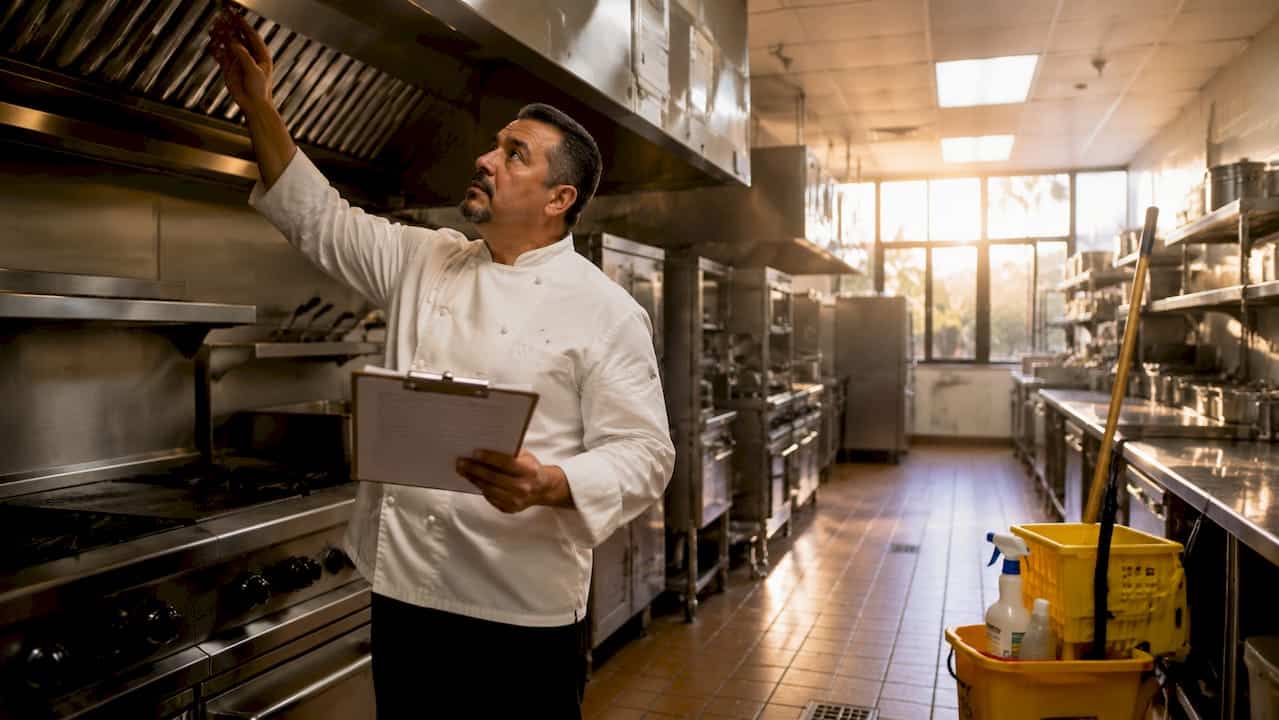
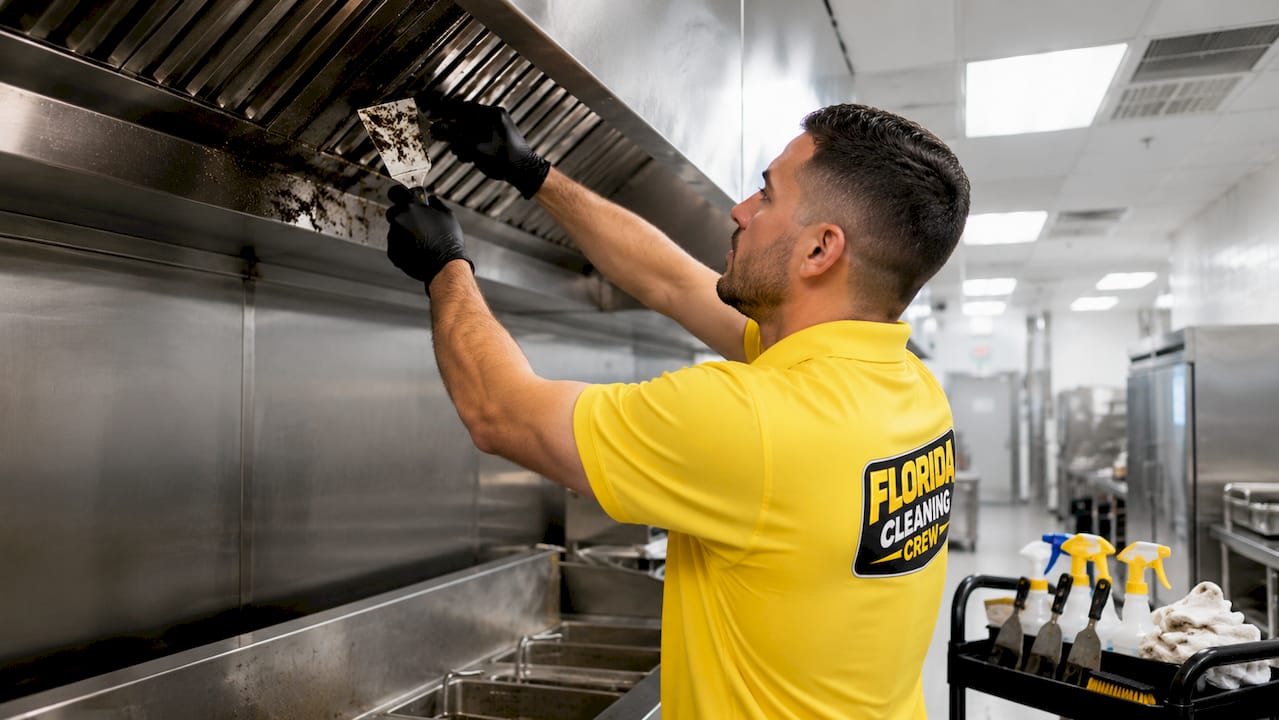
Exhaust hoods, ducts, and fans. These are the highest-priority zones. Extraction hood grease inside ductwork is a critical fire hazard. Professionals access the ductwork through cleaning panels, apply industrial degreasers, and use mechanical tools to remove hardened carbon deposits. This work requires safety training and equipment that kitchen staff do not have.
-
Behind and beneath cooking equipment. Ovens, fryers, grills, and ranges trap grease on their undersides and in the gaps between units. That grease hardens into carbon over time. Professionals move or tilt equipment to reach these zones and apply degreasers with the correct dwell time.
-
Floor drains and grease traps. Floor drains collect everything that washes off surfaces during service. Without periodic deep cleaning, they become breeding grounds for bacteria and a source of persistent odors. Grease traps require separate attention and may need to be pumped by a licensed contractor.
-
Walls, ceilings, and tile grout. Grease vapor settles on every surface in a commercial kitchen. Walls behind cooking lines and ceiling tiles above fryers accumulate a sticky film that daily wiping does not remove. Professionals use alkaline degreasers and steam equipment to restore these surfaces.
-
Walk-in coolers and freezers. Cold storage units develop mold, yeast, and bacterial growth on door seals, shelving, and floor drains. A deep clean includes sanitizing all interior surfaces with food-safe agents.
-
Food prep surfaces, sinks, and dishwashing zones. These areas see the highest cross-contamination risk. A deep clean goes beyond daily sanitizing to address scale buildup, mineral deposits, and grease in joints and seams.
-
Storage areas and dry goods shelving. Pests enter through storage zones. A deep clean includes clearing shelves, inspecting for pest activity, and sanitizing all surfaces before restocking.
Pro Tip: Ask your cleaning provider to confirm the dwell time used for each degreaser. Insufficient chemical dwell time is the most common reason an in-house deep clean fails to break down heavy grease and carbon deposits.
For a detailed breakdown of what a professional service covers, the deep cleaning scope guide from Floridacc explains the full process in plain terms.
Why can’t kitchen staff handle deep cleaning alone?
Kitchen staff are trained to cook and maintain service-level hygiene. They are not trained to dismantle extraction systems, apply industrial degreasers safely, or access ductwork. Expecting them to perform a professional deep clean creates real risks.
The most common problem is grease displacement. Frequent wiping by staff can push grease into cracks behind equipment, where it hardens into carbon deposits that only industrial-strength degreasers can remove. Staff cleaning can actually make the problem worse in hidden areas while the visible surfaces look clean.
Chemical safety is a second concern. Industrial degreasers used in commercial kitchen deep cleans are classified as hazardous substances. Using them without proper training, ventilation, and personal protective equipment puts staff at risk of chemical burns and respiratory injury. COSHH regulations in the UK and equivalent OSHA standards in the United States set clear requirements for the safe handling of these products.
The consequences of relying on staff alone are concrete:
- Failed health inspections due to grease buildup in extraction systems
- Voided insurance claims following a kitchen fire
- Equipment damage from carbon buildup that reduces efficiency and lifespan
- Pest infestations traced to hidden grease in inaccessible areas
- Staff injury from improper use of industrial cleaning chemicals
Professional cleaners bring the right equipment, the right chemicals, and the training to use both safely. They also provide the documentation that inspectors and insurers require. Understanding what sets professional cleaners apart from in-house efforts comes down to access, technique, and accountability.
The difference between daily cleaning and a professional deep clean is not a matter of effort. It is a matter of capability. Daily cleaning maintains service-level hygiene but cannot prevent the long-term fire and bacterial risks that only a methodical professional restoration addresses.
Key Takeaways
Deep cleaning commercial kitchens prevents fires, passes inspections, and extends equipment life in ways that daily cleaning cannot achieve.
| Point | Details |
|---|---|
| Deep clean vs. daily clean | Daily cleaning maintains surfaces; deep cleaning removes hidden grease, carbon, and bacteria in inaccessible zones. |
| Fire prevention is the top priority | Grease buildup inside extraction ductwork is a leading cause of commercial kitchen fires and requires professional removal. |
| Schedule by kitchen volume | High-volume restaurants need monthly deep cleans; standard operations require at least quarterly professional service. |
| Documentation protects your license | Professional cleaning records satisfy health inspectors and insurance auditors in ways that staff logs cannot. |
| Staff cleaning has real limits | Kitchen crews lack the training, equipment, and chemicals to safely deep clean extraction systems and hidden grease zones. |
What I’ve learned from watching kitchens skip this step
Restaurant owners tend to treat deep cleaning as a cost rather than a safeguard. I’ve seen that thinking play out in predictable ways. A kitchen that looks clean at the surface can be one grease fire away from a closure. The extraction system is the part nobody sees, and it is exactly where the risk lives.
The misconception I run into most often is that a thorough end-of-week clean by the kitchen team counts as a deep clean. It does not. The crew does a good job on what they can see and reach. But the ductwork, the underside of the fryers, the grease trap, and the floor drain channels are a different category entirely. Those areas need professional access and industrial-grade chemistry.
What I find genuinely underappreciated is the morale effect. A kitchen that has been properly deep cleaned feels different to work in. The air is cleaner, the surfaces are brighter, and the team moves with less friction. That is not a soft benefit. It shows up in service speed and staff retention.
The documentation piece is where I see the most avoidable stress. A Tampa Bay restaurant that cannot produce a cleaning log during an inspection is already on the back foot. A professional service gives you a dated, signed record of exactly what was done and when. That record is worth more than the clean itself when an inspector walks through the door.
My honest advice: treat deep cleaning as part of your operating budget, not as an emergency expense. The cost of a professional quarterly clean is a fraction of the cost of a failed inspection, a pest infestation, or a grease fire claim.
— Matt
Floridacc serves Tampa Bay restaurants with professional kitchen cleaning
Tampa Bay restaurant owners and food service managers who need reliable, documented deep cleaning have a local option they can trust.

Floridacc provides commercial cleaning for small businesses across Tampa, St. Petersburg, and Clearwater, including kitchen deep cleaning services built around compliance and inspection readiness. The team arrives with professional-grade equipment, uses the correct chemical protocols, and delivers the documentation your operation needs. Scheduling is flexible to fit around your service hours, so your kitchen is back in operation with minimal disruption. Request a free estimate and find out what a properly documented deep clean looks like for your kitchen.
FAQ
What is the difference between daily cleaning and a deep clean?
Daily cleaning maintains surface hygiene during and after service. A deep clean removes grease, carbon, and bacteria from extraction systems, behind appliances, and inside drains that daily routines never reach.
How often should a commercial kitchen be professionally deep cleaned?
Quarterly is the standard minimum, but high-volume restaurants should schedule monthly deep cleans to manage grease accumulation and stay compliant with health and fire safety requirements.
Does a deep clean cover the exhaust hood and ductwork?
A professional deep clean targets the full extraction system, including the hood, ducts, and fans, because grease buildup inside ductwork is a primary cause of commercial kitchen fires.
Can a failed inspection be avoided with regular deep cleaning?
Regular professional deep cleaning with documented records is one of the strongest defenses against a failed health or fire inspection. Inspectors look specifically at extraction systems and hidden grease zones.
Why does chemical dwell time matter during a deep clean?
Cleaning chemicals need adequate contact time to break down heavy grease and carbon deposits at a molecular level. Insufficient dwell time is the most common reason in-house cleaning attempts fail to produce a true deep clean result.