TL;DR:
- Florida does not require a statewide license; local permits confirm legal business operation.
- Insurance, background checks, and specialty credentials are vital for safe, reliable cleaning services.
- Eco-friendly products and transparency in licensing verification enhance safety and environmental health.
Most Tampa Bay homeowners assume that a “licensed cleaner” holds some kind of statewide Florida credential. That assumption is understandable, but it’s wrong in ways that can cost you real money. Florida does not require a general state license for residential or commercial cleaning companies. What actually matters is a mix of local business permits, specialty certifications for certain types of work, and verifiable insurance coverage. Add Tampa Bay’s year-round humidity and growing demand for healthier indoor environments, and you quickly realize that choosing a cleaning company requires a sharper checklist than most people use.
Table of Contents
- What does ‘licensed cleaner’ mean in Tampa Bay?
- Why hiring a licensed cleaner matters for safety and liability
- Eco-friendly cleaning practices and licensing: What to look for
- How to verify licensing and eco-friendly claims when hiring
- The uncomfortable truth: Why ‘licensed’ isn’t the only thing that matters
- Discover reliable licensed cleaning for Tampa Bay homes and businesses
- Frequently asked questions
Key Takeaways
| Point | Details |
|---|---|
| Local licensing essential | Tampa Bay cleaning companies must hold city and county Business Tax Receipts for legitimacy. |
| Verify specialty credentials | Hire only certified professionals for mold, biohazard, or post-construction cleaning jobs. |
| Insurance reduces risk | Licensed cleaning companies with insurance and workers’ comp minimize liability for property owners. |
| Eco-friendly equals healthy | Certified green products help prevent mold and reduce respiratory risks linked to traditional cleaners. |
| Always double-check claims | Request proof of BTRs, insurance, and eco-certifications before hiring any cleaning provider. |
What does ‘licensed cleaner’ mean in Tampa Bay?
The phrase “licensed cleaner” gets thrown around constantly in marketing, and it creates genuine confusion. Let’s clear it up so you can make smarter decisions when comparing companies.
In Florida, no statewide license is required for general residential or commercial cleaning. Instead, cleaning companies operating in Tampa, St. Petersburg, Clearwater, and surrounding municipalities must obtain a Local Business Tax Receipt (BTR), sometimes called an occupational license, from their city or county government. This is essentially a business registration that confirms the company is legally operating in that jurisdiction. It is not a skills test or a safety certification.
That distinction matters. A BTR tells you the business exists legally. It does not tell you whether the crew is trained, insured, or using safe products. When you see licensed cleaning services advertised locally, you’re mostly seeing companies that hold these local permits, which is a baseline requirement, not a mark of excellence.
Specialty cleaning work is a different story. Jobs involving mold remediation, biohazard cleanup, or post-construction debris require additional credentials from Florida’s Department of Business and Professional Regulation (DBPR). Specialty licensing requirements for mold assessors and remediators are strictly enforced because improper handling creates serious health risks. If a company claims to handle mold without DBPR credentials, that is a red flag.
Comparison: General cleaning vs. specialty cleaning requirements
| Requirement | General cleaning | Specialty cleaning (mold, biohazard) |
|---|---|---|
| Statewide license | Not required | DBPR license required |
| Local BTR | Required | Required |
| Insurance | Strongly recommended | Mandatory |
| Workers’ compensation | Required for 4+ employees | Required for 4+ employees |
| Certification/training | No formal requirement | Industry-specific certification |
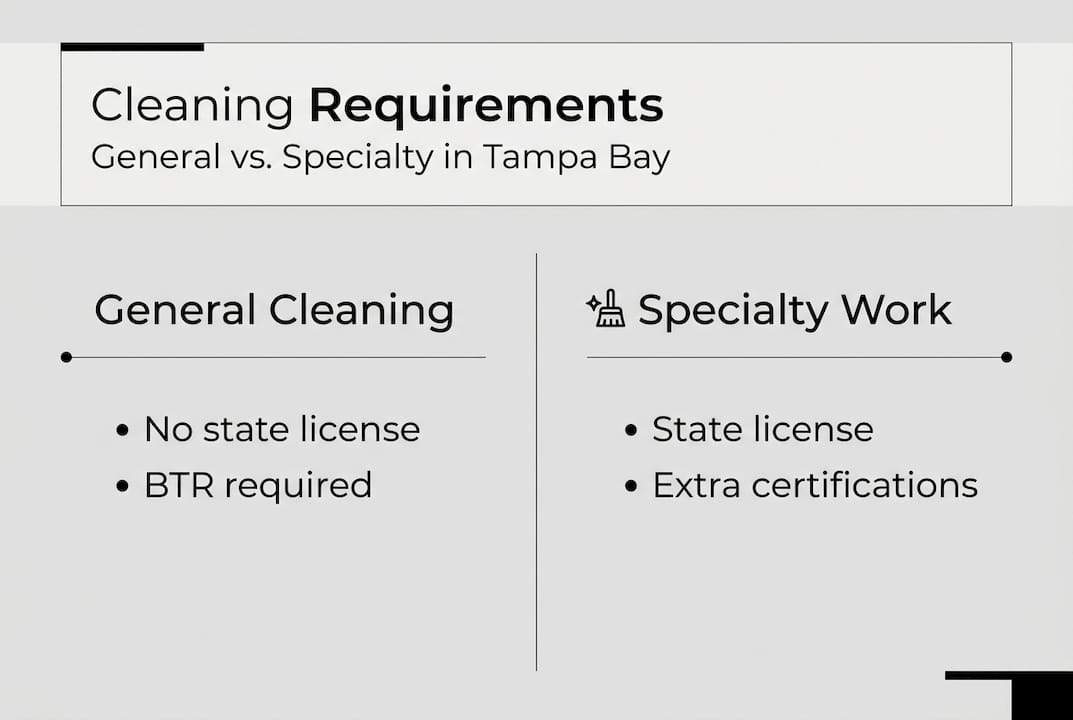
Understanding this table helps you ask the right questions when you request a cleaning quote. If you need general house cleaning, confirm the BTR and insurance. If you need mold remediation after a Florida rainy season, ask specifically for DBPR credentials.
Common myths and facts about cleaning licenses in Tampa Bay:
- Myth: All cleaning companies must pass a Florida state exam.
Fact: No state exam exists for general cleaning. Only specialty trades like mold remediation require DBPR licensing. - Myth: A business license means the company is bonded and insured.
Fact: A BTR only confirms legal operation. Insurance and bonding are separate and must be verified independently. - Myth: Larger companies are automatically more compliant.
Fact: Company size has no bearing on compliance. Small local firms can be fully compliant; large ones can cut corners. - Myth: “Licensed” on a website means the same thing everywhere in Florida.
Fact: Licensing requirements vary by city and county. Always confirm which jurisdiction issued the BTR.
Knowing the benefits of licensed cleaning goes beyond the permit itself. It’s about understanding what that permit does and does not guarantee, and then filling in the gaps with your own verification.
Why hiring a licensed cleaner matters for safety and liability
Understanding who counts as a licensed cleaner, let’s examine how this affects your safety and your wallet.
When something goes wrong during a cleaning job, whether a broken vase, a slip-and-fall injury, or damage to a hardwood floor, the question of liability lands fast. If the company you hired is properly set up, their insurance handles it. If they’re not, you could be looking at a personal injury claim filed against your homeowner’s policy, or worse, no coverage at all.
Licensed firms reduce liability through workers’ compensation coverage, which is mandatory in Florida for companies with more than four employees, and through general liability insurance that protects your property. Background checks on employees are another layer that reputable companies use to protect clients.
“Hiring a cleaner without verifying insurance and workers’ comp coverage is like handing someone your house keys without knowing their name. One incident can turn a $150 cleaning appointment into a $15,000 legal headache.” — Industry risk consultant perspective on home services liability
Unlicensed specialty work creates a specific and serious problem. If a company performs mold remediation without the proper DBPR license and something goes wrong, your homeowner’s insurance provider may deny the claim entirely. The work was done illegally, so the coverage is void. That scenario is far more common than most property managers realize.
Data table: Licensed vs. unlicensed cleaners
| Factor | Licensed and insured cleaner | Unlicensed or uninsured cleaner |
|---|---|---|
| Property damage coverage | Covered by company’s liability policy | Falls on homeowner |
| Worker injury on your property | Covered by workers’ comp | May become your liability |
| Specialty work validity | Legally performed, insurable | Can void homeowner’s insurance |
| Background checks | Standard with reputable firms | No guarantee |
| Dispute resolution | Clear process via insurance | No formal recourse |
For property managers overseeing multiple units, the stakes are even higher. One unlicensed cleaning crew working across ten units creates ten separate liability exposures. The math on that risk is not complicated.
Pro Tip: Always request a copy of the company’s BTR and their current certificate of insurance before the first appointment. A legitimate company will send these without hesitation. If they stall or offer excuses, move on.
Reviewing the licensed vs. unlicensed risks in detail before signing any service agreement is time well spent. It takes five minutes and can save you from situations that take months to resolve.
Eco-friendly cleaning practices and licensing: What to look for
With safety and liability covered, Tampa Bay’s climate raises additional challenges for responsible cleaning.
Tampa Bay’s heat and humidity create a perfect environment for mold, mildew, and allergens to thrive indoors. Standard cleaning products can mask these problems temporarily, but they often contain volatile organic compounds (VOCs) that make indoor air quality worse over time. VOCs are chemical gases released from many conventional cleaning sprays and disinfectants. In a tightly sealed, air-conditioned Florida home, those gases accumulate quickly.
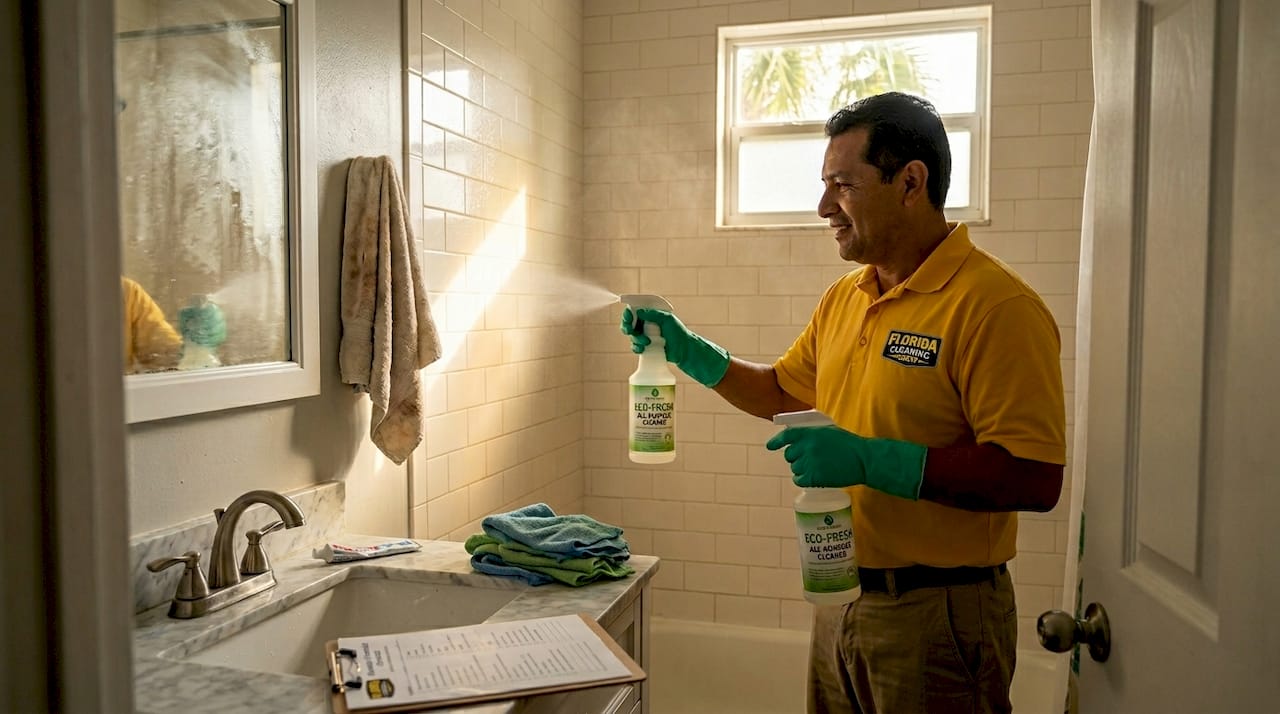
EPA Safer Choice and Green Seal certified products use plant-based, low-VOC, and biodegradable formulas that match the performance of traditional cleaners in head-to-head tests, while significantly reducing asthma and respiratory risks. Research from the Environmental Working Group links traditional cleaning chemicals to roughly 22% of occupational asthma cases, a statistic that hits differently when you consider how much time Tampa Bay residents spend indoors during summer heat.
Eco-certification is also an indirect signal of professionalism. Companies that invest in certified products are typically paying closer attention to compliance, training, and client safety across the board. It’s not a guarantee, but it’s a meaningful indicator.
Pro Tip: When interviewing cleaning companies, ask specifically whether they use EPA Safer Choice or Green Seal certified products. If they can’t name the certifications or point to specific products, their “eco-friendly” claim is likely just marketing language.
You can learn more about eco-friendly cleaning options that are specifically suited to Tampa Bay’s conditions, including products designed to prevent mold regrowth in high-humidity environments.
Features of a genuinely eco-friendly cleaning company:
- Uses EPA Safer Choice or Green Seal certified cleaning products
- Can provide product data sheets or ingredient lists on request
- Avoids bleach-based or ammonia-based products in enclosed spaces
- Trains staff on proper dilution ratios to reduce chemical waste
- Uses microfiber cloths instead of disposable paper products
- Recycles or properly disposes of cleaning waste
- Offers fragrance-free options for clients with chemical sensitivities
If a company checks most of these boxes, you’re looking at a service that takes both your health and the local environment seriously. For more practical guidance, eco house cleaning tips tailored to Florida homes can help you maintain results between professional visits.
How to verify licensing and eco-friendly claims when hiring
Eco-friendly and licensed doesn’t mean much unless you can verify it. Here’s how to do it.
The cleaning industry has a higher-than-average rate of unverifiable claims. Companies know that most clients never actually check credentials, so they use terms like “licensed,” “bonded,” “green,” and “certified” freely. Your job is to be the client who does check.
For Tampa Bay homeowners and property managers, prioritizing BTR and insurance verification over vague “licensed” claims is the most practical first step. Here is a numbered process that works:
- Ask for the BTR number. Every legitimate cleaning company in Tampa Bay has one. You can verify it through the Hillsborough County Tax Collector, Pinellas County Tax Collector, or the relevant city office. The verification takes about two minutes online.
- Request a certificate of insurance. This document should show general liability coverage and workers’ compensation. Confirm that the policy is current, not expired. Ask to be listed as an additional insured for the duration of service.
- Confirm specialty credentials separately. If you need mold remediation, biohazard cleanup, or post-construction cleaning, ask for the company’s DBPR license number and verify it at myfloridalicense.com.
- Ask about product certifications. Request the names of the specific cleaning products used and look them up on the EPA Safer Choice database or the Green Seal website. Both databases are free and searchable.
- Check references from similar properties. A company that cleans Airbnb units has different experience than one that handles large commercial spaces. Match their track record to your specific needs.
- Review the estimate in detail. A thorough cleaning estimate should itemize services, products used, and any specialty work. Vague estimates are a warning sign.
- Confirm service area coverage. Some companies list broad service areas but subcontract work in certain zones. Confirm directly that their own insured staff will handle your property. You can check licensed cleaners in your city to find verified local coverage.
This process sounds thorough because it is. But it takes less than 30 minutes and gives you a clear picture of who you’re actually hiring. Most homeowners skip it entirely and then wonder why results are inconsistent.
The uncomfortable truth: Why ‘licensed’ isn’t the only thing that matters
Here’s something most articles about cleaning licenses won’t tell you: the word “licensed” is doing a lot of heavy lifting in this industry, and most of it is marketing.
We’ve seen companies with perfectly valid BTRs send undertrained crews, use products that trigger allergic reactions, and skip background checks entirely. The permit was real. The service was not what it claimed to be. Conversely, we’ve seen smaller operations with every credential in order, thorough training programs, and genuine commitment to eco-safe products.
The real differentiators in Tampa Bay’s cleaning market are insurance depth, background check practices, product transparency, and consistency of staff. BTR and insurance verification is your starting point, not your finish line. Licensed firms that also perform background checks and meet eco standards are the ones worth your long-term business.
Tampa Bay’s humidity adds a layer that most national cleaning guides ignore. A company that works in Minnesota has no frame of reference for how quickly mold returns in a Florida bathroom after a substandard cleaning. Local experience, combined with the right certified products, matters more than a generic “licensed” badge on a website.
We believe the best way to evaluate any cleaning company is to ask hard questions and expect clear answers. If a company can’t explain what license they hold, what insurance covers, and what products they use, that’s your answer. The reliability beyond licensing is built through transparency, not paperwork.
Discover reliable licensed cleaning for Tampa Bay homes and businesses
Ready to find a cleaning company that meets all these standards?
At Florida Cleaning Company, we hold all required local Business Tax Receipts, carry full general liability and workers’ compensation insurance, and use EPA Safer Choice certified products designed for Tampa Bay’s unique climate. Our team is background-checked, trained, and consistent.
Whether you need residential cleaning in Tampa for your home, commercial cleaning services for your office or rental units, or want to explore our eco-friendly product options, we make it easy to get started. Request a free quote online, and we’ll walk you through exactly what’s included, what credentials we carry, and what products we’ll use in your space. No vague promises. Just clear, verifiable service from a Tampa Bay team that knows what local homes actually need.
Frequently asked questions
Do Tampa Bay cleaners need a state license?
No. General cleaning firms need local Business Tax Receipts, but only specialty services like mold remediation require state DBPR licenses. No statewide license is required for residential or commercial cleaning in Florida.
What specialty cleaning jobs require extra licenses or certification?
Mold remediation, biohazard jobs, post-construction cleaning, and projects involving structural work require specialty licenses or certifications. Mold remediation and biohazard work specifically require separate DBPR licenses in Florida.
How can I check if a cleaner uses eco-friendly products?
Ask for EPA Safer Choice or Green Seal certifications. These ensure plant-based, low-VOC, and biodegradable products proven for Tampa’s climate. EPA Safer Choice certified products are searchable in a free online database you can check yourself.
Is hiring an unlicensed cleaner risky?
Yes. Unlicensed cleaners can invalidate insurance claims and create liability issues if accidents or damage occur. Unlicensed specialty work is especially dangerous because it can void your homeowner’s insurance coverage entirely.
Are eco-cleaning products as effective as traditional ones?
Yes. Tests show EPA Safer Choice and Green Seal certified products match traditional cleaners’ performance for Tampa’s humidity and mold prevention. Eco-friendly products match traditional performance while reducing asthma and respiratory risks significantly.