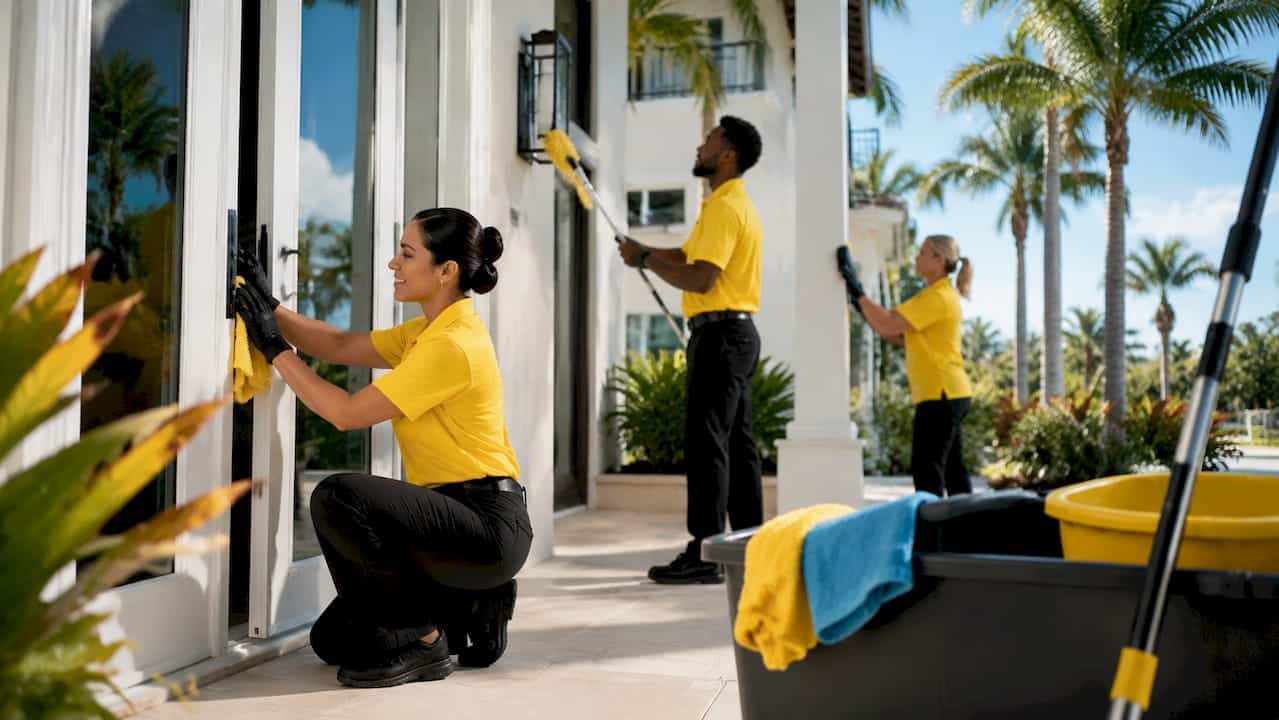

Airbnb turnover management is the full operational reset of a short-term rental property between one guest’s checkout and the next guest’s check-in. It covers cleaning, restocking, inspecting, and documenting the property so every guest walks into a space that feels fresh and cared for. Hosts who know how to manage Airbnb turnovers well protect their star ratings, reduce last-minute scrambles, and keep revenue flowing without gaps. Tools like Breezeway and Turno have made this process more systematic, but the foundation is always a clear protocol, reliable timing, and a team that knows exactly what to do without being told twice.
How to manage Airbnb turnovers: timing and scheduling
The standard turnover window is 3 to 5 hours, with checkout at 11:00 AM and check-in between 3:00 PM and 4:00 PM. That window sounds generous until you factor in a cleaner who arrives late, a guest who leaves dishes in the sink, or a washing machine that takes 45 minutes per load. The gap closes fast.
The most reliable scheduling tactic is to budget 1.25 times your estimated cleaning duration. If a two-bedroom unit normally takes two hours to clean, schedule 2.5 hours. That buffer absorbs real-world delays without pushing your check-in time.
Same-day bookings and late checkouts are the two biggest threats to a clean schedule. Late checkouts compress the cleaning window and put pressure on your cleaner to rush, which is exactly when things get missed. One way to handle this is to offer automated late checkout upsells the morning of departure. Late checkout offers achieve an 18% to 30% capture rate, and when guests follow clear checkout instructions, cleaning time drops by 8 to 12 minutes per unit. That is a meaningful gain across a multi-property portfolio.
Pro Tip: Sync your cleaning coordination platform directly with your Airbnb booking calendar. Platforms like Turno and Breezeway auto-create cleaning jobs the moment a booking is confirmed, so your cleaner gets notified before you even think to send a message.
Here are the scheduling practices that hold up under pressure:
- Set checkout at 11:00 AM and check-in at 3:00 PM or 4:00 PM as your default window
- Schedule 1.25 times the estimated cleaning time for every turnover
- Automate late checkout offers through your property management system
- Sync your booking calendar with your cleaning platform to eliminate manual job creation
- Build a 30-minute buffer after cleaning ends before check-in begins
- Communicate checkout instructions clearly in your pre-departure message the night before
How to create an effective turnover cleaning protocol
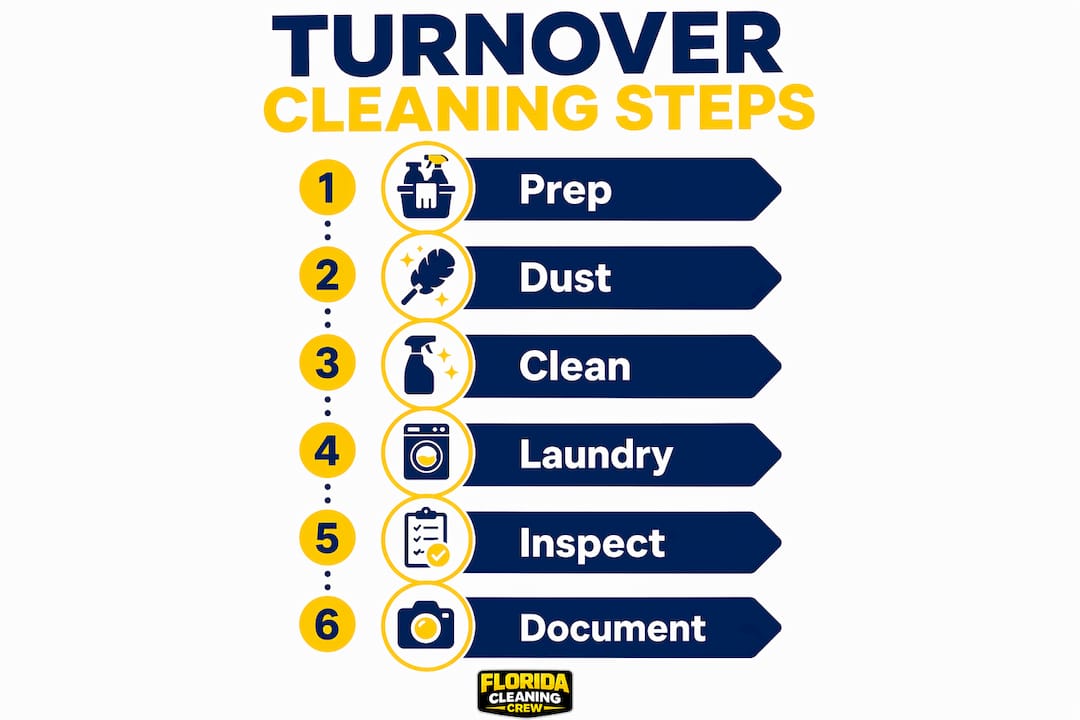
A turnover checklist is not just a list. It is a sequenced workflow that accounts for dust settling, cleaning order, and restocking logistics. Most experienced hosts use a three-layer system: a room-by-room sequence, a restock inventory list with SKUs, and a photo evidence pack. Each layer serves a different purpose, and together they give a cleaner everything needed to complete the job without a single phone call to the host.
Building the room-by-room sequence
Start with the rooms that take the longest and generate the most laundry. A practical sequence looks like this:
- Strip all beds and start the first laundry load immediately
- Clean bathrooms from top to bottom, including grout lines and behind the toilet
- Wipe down all kitchen surfaces, appliances, and inside the microwave
- Vacuum and mop all floors, starting from the back of the unit and working toward the exit
- Make beds with fresh linens and stage pillows
- Restock consumables in every room using the SKU list
- Do a final walkthrough and photograph every room before locking up
This sequence matters because it keeps the cleaner moving forward rather than backtracking. Laundry runs in the background while surfaces are cleaned, which saves 20 to 30 minutes on every turnover.
Color-coded caddies and supply management
Professional cleaners use color-coded caddy systems to prevent cross-contamination and save 15 to 20 minutes per turnover by eliminating unnecessary trips back to the supply bag. A simple system uses red for bathrooms, blue for kitchens, and green for general surfaces. Each caddy holds only the products and cloths for that zone.
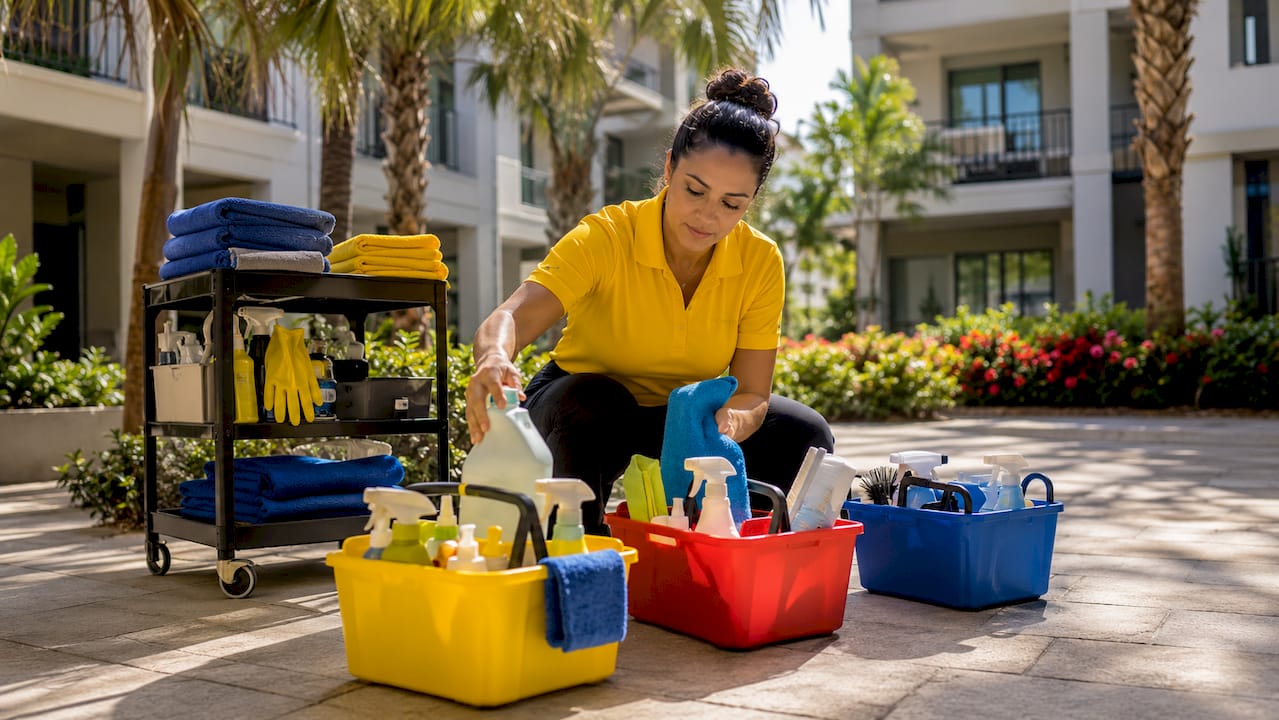
Supply shortages mid-turnover are a hidden time killer. The fix is a locked or secured supply closet stocked with essentials like toilet paper, soap, and kitchen supplies. Your cleaner should never have to leave the property to get what they need.
| Cleaning layer | Purpose | Key tool |
|---|---|---|
| Room-by-room sequence | Keeps cleaners moving efficiently | Printed or mobile checklist |
| SKU restock list | Prevents supply shortages | Inventory app or spreadsheet |
| Photo evidence pack | Protects against damage disputes | Smartphone with timestamped photos |
Deep cleans and photo documentation
Deep cleans cost between $150 and $400 and should happen every 90 days or every 30 turnovers, whichever comes first. Standard cross-cleans run $80 to $200. Deep cleans cover areas that routine turnovers skip: behind appliances, inside ovens, grout scrubbing, and mattress inspection.
Photo documentation after every turnover is non-negotiable for hosts who want to file damage claims through Airbnb’s AirCover program. AirCover requires photos filed within a 14-day window. A timestamped photo pack taken immediately after each turnover is your only reliable evidence if a guest disputes a damage charge.
Pro Tip: Create a shared photo folder for each property and have your cleaner upload images in a consistent order: entry, living room, kitchen, each bathroom, each bedroom, and any outdoor spaces. Consistent order makes it easy to spot what changed between stays.
What tools help you manage guest checkouts and turnovers?
The right technology removes the manual coordination that burns host time. Platforms like Turno and Breezeway automate job creation, send cleaner reminders, and flag scheduling conflicts before they become problems. For hosts managing more than two properties, these tools pay for themselves in hours saved each week.
Here is a breakdown of the core tool categories and what each one does:
- Cleaning scheduling platforms (Turno, Breezeway): Auto-create jobs from booking data, notify cleaners, and escalate automatically if a cleaner does not confirm within 30 minutes
- Guest messaging automation (Hospitable, Smartbnb): Send pre-departure instructions and late checkout offers without manual input
- Inventory management: Track consumable stock levels by property and alert you when supplies fall below par
- Photo upload workflows: Allow cleaners to submit timestamped photos directly into a shared drive or property management system
- Quality scoring tools: Some platforms let you rate each turnover and flag recurring issues by cleaner or property
| Tool category | Primary benefit | Best for |
|---|---|---|
| Turno | Auto job creation and cleaner marketplace | Hosts needing on-demand cleaners |
| Breezeway | Property care workflows and inspections | Multi-property managers |
| Hospitable | Guest messaging automation | Hosts managing communication manually |
| Inventory tracker | Prevents mid-turnover supply gaps | Properties with high booking frequency |
For hosts in Tampa, Clearwater, and St. Petersburg, the short-term rental cleaning guide from The Maid Society offers additional operational frameworks that complement these tools well. Pairing a solid platform with a clear protocol is what separates hosts who react to problems from those who prevent them.
You can also find detailed scheduling frameworks in Floridacc’s guide on scheduling rental turnovers that apply directly to the Tampa Bay market.
How to troubleshoot common turnover challenges
Even well-run operations hit snags. The hosts who recover fastest are the ones who have already thought through the failure modes before they happen.
Last-minute bookings and cancellations create the most pressure. A booking that comes in six hours before check-in gives you almost no time to coordinate. Charge a premium for same-day turnovers and make sure your cleaner knows that rate in advance. Cancellations that free up a turnover slot are an opportunity to schedule a deep clean or a maintenance check.
Cleaner no-shows are the single biggest operational risk for solo hosts. Smart hosts maintain backup cleaning staff and set up automatic escalation if an assigned cleaner does not confirm within 30 minutes. Platforms like Turno have a marketplace feature that lets you find a replacement cleaner in your area quickly. Without a backup plan, one no-show can cost you a five-star review.
Linen shortages stop a turnover cold. Hosts with at least three complete linen sets per bed can swap linens immediately without waiting for laundry to finish. Three sets means one on the bed, one in the wash, and one clean and ready. This is the minimum for any property with back-to-back bookings.
“Cleaning is not just a cost. It is a conversion lever that secures cleanliness ratings and keeps your best cleaners coming back.” — Sean Rakidzich, Airbnb Cleaning Protocol Guide
Cleaner retention is an underrated part of turnover management. Hosts who treat cleaners as partners rather than vendors get better results. Offering $5 per turnover pay bumps at milestone completions reduces cleaner turnover and preserves the institutional knowledge that makes your protocol run smoothly. A cleaner who has done your property 50 times knows where the quirks are. Replacing that person costs more than the raise.
Incomplete checklists are the most common source of guest complaints. A cleaner who works from memory will eventually miss something. Every turnover should use a mobile-accessible checklist. If your cleaner cannot pull up the checklist on their phone, the checklist is not doing its job. Pair the checklist with a vacation rental cleaning checklist that covers every room and every consumable so nothing gets skipped.
Key takeaways
Effective Airbnb turnover management requires a sequenced cleaning protocol, reliable scheduling with built-in buffers, the right technology, and a cleaner team you actively invest in keeping.
| Point | Details |
|---|---|
| Use a 3-to-5-hour window wisely | Schedule 1.25 times your estimated cleaning time to absorb real-world delays. |
| Build a three-layer cleaning system | Combine a room-by-room checklist, an SKU restock list, and a photo evidence pack. |
| Automate scheduling and communication | Use Turno or Breezeway to auto-create jobs and send cleaner notifications from booking data. |
| Maintain three linen sets per bed | Three sets prevent laundry delays from stopping a turnover mid-process. |
| Invest in your cleaning team | Pay milestone bonuses and provide mobile checklists to reduce cleaner turnover and errors. |
Why turnover quality is the real competitive edge in Tampa Bay
Tampa Bay’s short-term rental market moves fast. During peak season, properties in St. Petersburg and Clearwater Beach can flip two or three times a week. At that pace, a weak turnover protocol does not just create guest complaints. It creates a compounding problem where each rushed reset makes the next one harder.
What I have seen working with hosts in this market is that the gap between a four-star and a five-star property is almost never the furniture or the location. It is the cleanliness and the small details: a restocked coffee station, a spotless bathroom, linens that smell fresh. Guests notice those things immediately, and they write about them in reviews.
The hosts who consistently hit five stars treat their turnover protocol the way a restaurant treats its kitchen prep. It is not glamorous, but it is the foundation everything else rests on. They have a checklist their cleaner can follow without a single text message. They have three linen sets per bed. They have a backup cleaner on call. And they photograph every room after every turnover, not because they expect a dispute, but because the habit protects them when one happens.
The one mistake I see most often is hosts who build a great protocol and then stop maintaining it. Checklists go stale. Consumable par levels drift. Cleaners start skipping steps because no one is checking. A quarterly review of your turnover system, where you walk through the property with your cleaner and update the checklist together, keeps the protocol sharp and keeps your cleaner engaged.
Tampa Bay hosts who want to compete at the top of their market need to treat turnover management as an ongoing operation, not a one-time setup. The properties that hold their ratings through high season are the ones where the host is still paying attention.
— Matt
Professional turnover cleaning for Tampa Bay Airbnb hosts
Running a tight turnover schedule is easier when you have a cleaning team that already knows what a five-star reset looks like. Floridacc provides Airbnb turnover cleaning for hosts across Tampa, Clearwater, and St. Petersburg, with teams trained on room-by-room protocols, photo documentation, and consumable restocking.

If you are building or refining your turnover system, Floridacc’s residential cleaning service guide covers the full scope of what professional cleaning looks like for short-term rental properties in the Tampa Bay area. Whether you manage one property or ten, having a reliable local cleaning partner removes the biggest variable from your operation and gives you one less thing to troubleshoot between guests.
FAQ
What is a standard Airbnb turnover window?
The standard turnover window is 3 to 5 hours, with checkout at 11:00 AM and check-in between 3:00 PM and 4:00 PM. Scheduling 1.25 times your estimated cleaning duration protects that window from real-world delays.
How often should an Airbnb get a deep clean?
Deep cleans should happen every 90 days or every 30 turnovers, whichever comes first. They cover areas that routine cross-cleans skip, including behind appliances, inside ovens, and grout lines.
Why is photo documentation required after every turnover?
Photo evidence is required to file damage claims through Airbnb’s AirCover program, which has a 14-day filing window from checkout. Timestamped photos taken immediately after each turnover are the only reliable proof of the property’s condition.
What tools do Airbnb hosts use to manage turnovers?
Hosts use platforms like Turno and Breezeway to automate job creation, cleaner notifications, and scheduling escalation. Guest messaging tools like Hospitable handle pre-departure instructions and late checkout offers automatically.
How many linen sets does an Airbnb host need per bed?
Hosts need at least three complete linen sets per bed. One set stays on the bed, one goes through the wash, and one stays clean and ready. This prevents laundry delays from stopping a turnover mid-process.