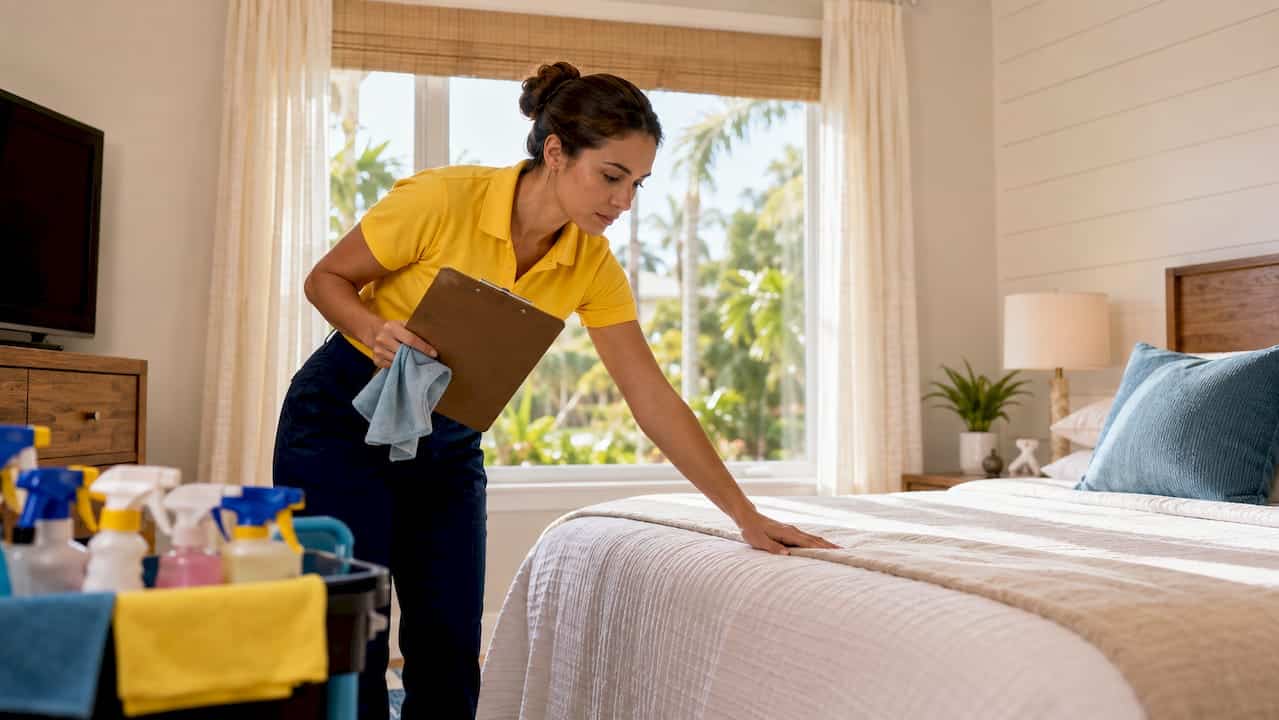
Cleanliness is the single most direct driver of occupancy rates in short-term and long-term rental properties. The role of cleaners in occupancy rates is not a soft operational detail. It is a measurable revenue variable. Properties with higher perceived cleanliness increase revenue by 17.5% and occupancy by 16.5%, with 80% of guest reviews relating directly to cleaning standards. For Tampa Bay property owners managing Airbnb units in St. Petersburg, vacation rentals in Clearwater, or multi-unit buildings in Tampa, this means your cleaning team is not a cost center. It is your occupancy strategy.
How does cleanliness affect guest booking decisions and occupancy?
Cleanliness affects occupancy through reputation and demand mechanisms, not through a direct mechanical link. Guests read reviews before they book. They filter by ratings. They compare listings side by side on Airbnb and Booking.com. When your cleaning score is high, you win that comparison. When it slips, you lose visibility before a single guest even clicks your listing.
The mechanism works like this: a guest has a clean, well-presented stay, leaves a five-star review mentioning the spotless bathroom and fresh linens, and that review feeds the platform’s ranking algorithm. Platform algorithms prioritize listings with high cleanliness ratings, increasing both visibility and booking likelihood. Listings with average cleaning ratings below 4.5 stars receive less exposure and are often forced to reduce nightly rates just to regain traction. That rate reduction is a direct, measurable cost of poor cleaning.
Guest behavior reinforces this pattern. Travelers consistently rank cleanliness as their top selection factor when choosing between comparable properties. This is not a preference. It is a filter. A guest who has experienced one dirty rental will eliminate any listing with ambiguous or mixed cleanliness reviews from their shortlist entirely.
“Cleanliness is not just about appearance. It is the first signal guests use to judge whether a property is managed professionally.”
Here is what the data tells property managers about the impact of cleaning on bookings:
- Properties with consistent 5-star cleanliness ratings generate approximately 20% more revenue than comparable listings with mixed scores.
- 80% of guest reviews on major booking platforms reference cleanliness directly or indirectly.
- Listings with cleanliness scores below 4.5 stars must reduce rates to compete, eroding annual revenue by thousands of dollars.
- The cleanliness and occupancy correlation is strongest in competitive urban and coastal markets, exactly the environment Tampa Bay hosts operate in.
For hosts managing properties in Tampa, Clearwater, or St. Petersburg, the competitive density of the short-term rental market makes this dynamic especially sharp. A 0.3-star drop in your cleanliness rating can push your listing to page two of search results, where booking rates collapse.
What operational cleaning protocols improve occupancy in busy rental markets?
Cleaning quality is not just about what gets cleaned. It is about when it gets done and how consistently the standard holds across every turnover. In high-demand rental markets, the gap between a property being cleaned and a property being guest-ready within the check-in window is where occupancy is won or lost.

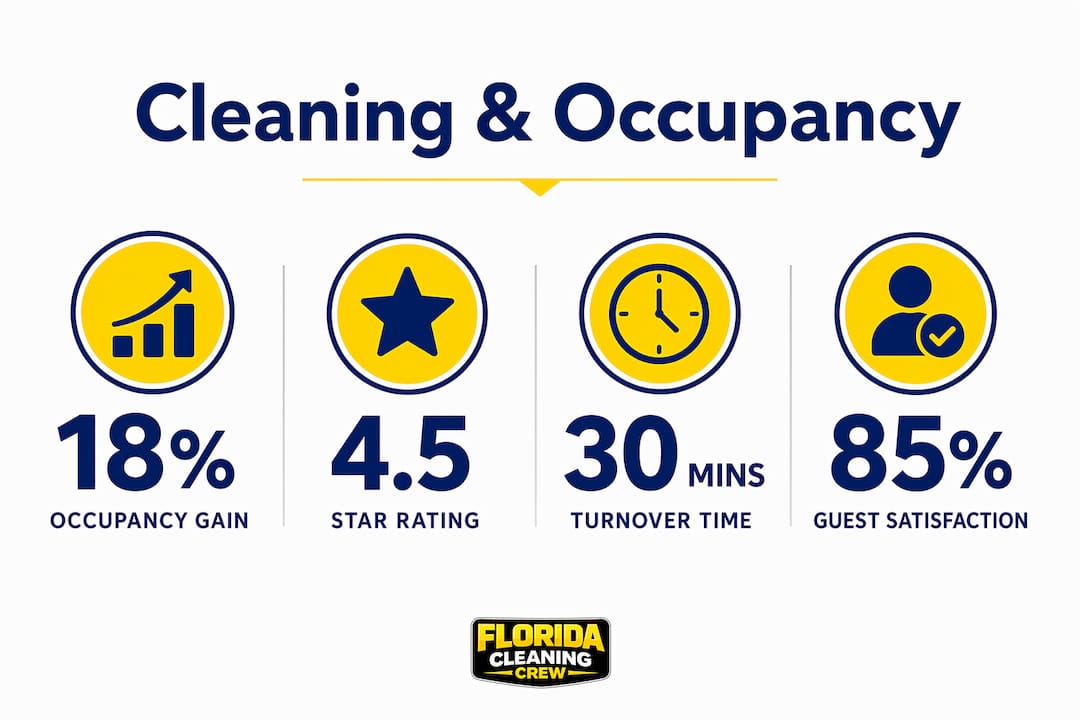
A well-documented case from the hotel sector shows exactly what protocol improvements deliver. Improved cleaning workflows reduced room turnaround time from 45 minutes to 30 minutes and increased rooms ready before 3 PM from 45% to 75%. Guest satisfaction scores rose significantly across three consecutive quarters. The same principle applies directly to Airbnb and vacation rental operations in Tampa Bay. When a cleaner finishes a turnover at 1 PM instead of 4 PM, you can accept same-day bookings. Same-day bookings fill gaps in your calendar that would otherwise sit empty.
The operational protocols that produce these results follow a clear structure:
- Standardized room-by-room checklists that leave no task to memory or interpretation. Every cleaner follows the same sequence, every time.
- Timed task assignments that set realistic expectations for turnover duration and flag delays before they affect check-in.
- Pre-inspection walkthroughs completed by a supervisor or lead cleaner before the property is marked ready.
- Scheduled deep cleaning cycles layered on top of standard turnovers, targeting grout, appliances, upholstery, and HVAC filters on a monthly or quarterly basis.
- Post-stay audits that log any damage, missing items, or recurring cleaning issues so patterns can be addressed before they generate a negative review.
Standardized cleaning playbooks and quality controls reduce missed tasks and rushed turnovers, preventing guest complaints and stabilizing occupancy. Workflow consistency is what converts cleaning effort into predictable guest experience scores. Without it, you are relying on individual cleaner memory, which is not a system.
Pro Tip: If you manage more than two rental units in Tampa Bay, treat your cleaning operation like a production schedule. Assign specific time windows to each property, build in buffer time for same-day turnovers, and review your checklist completion rate weekly. One missed task in a bathroom costs you a five-star review.
The vacation rental cleaning guide published by Floridacc covers turnover sequencing and checklist structure in detail for hosts managing properties across the Tampa Bay area.
How does cleaning quality affect guest satisfaction beyond appearance?
Most property managers think about cleaning in visual terms: is the floor swept, are the sheets changed, does the bathroom look clean. But housekeeping affects guest satisfaction across dimensions that go well beyond what a guest sees when they walk in the door.
A study of 50 respondents across six hotels in Cebu found that housekeeping affects satisfaction through timeliness, room presentation, and staff professionalism, not just cleanliness alone. These are distinct service dimensions, and each one contributes independently to the guest’s overall experience and their likelihood of leaving a positive review.
Here is how each dimension connects to occupancy outcomes:
- Timeliness: A room that is cleaned on schedule signals operational reliability. Guests who check in on time, to a ready room, start their stay with a positive impression that colors every subsequent interaction.
- Room presentation: Folded towels, arranged pillows, and a clean welcome setup communicate care. Guests interpret these details as evidence that the property is managed by someone who takes pride in it.
- Staff professionalism: In properties where guests interact with cleaning staff, the manner and appearance of that staff member becomes part of the guest experience. A professional, courteous cleaner reinforces the quality signal the property is trying to send.
- Odor control: This is the most underrated cleaning dimension in short-term rentals. A visually clean room that smells stale or musty will generate a negative review regardless of how thorough the surface cleaning was.
- Consistency across stays: A guest who books a second stay expects the same standard they experienced the first time. Inconsistency is the fastest way to lose repeat bookings.
Guest satisfaction positively affects RevPAR, with occupancy rate partially mediating this relationship. A study of 312 three-star hotels between 2019 and 2024 confirmed that housekeeping quality links directly to financial performance through the guest satisfaction pathway. This means cleaning is not just about avoiding bad reviews. It is about generating the positive reviews that drive future bookings.
For Tampa Bay hosts, the practical implication is clear. Hiring a cleaner who shows up and wipes surfaces is not enough. You need a cleaner who understands that their work is the guest’s first impression, and that impression determines whether that guest books again or recommends your property to someone else.
What measurable occupancy improvements follow enhanced cleaning standards?
The data connecting cleaning investment to occupancy gains is specific enough to use in a business case. Enhanced deep cleaning standards led to 12 to 18% occupancy increases within six months of implementation. A 0.5-star improvement in cleanliness ratings correlated with 8 to 10% higher booking rates. These are not marginal gains. For a property generating $3,000 per month in rental income, a 15% occupancy increase adds $450 per month, or $5,400 per year, from cleaning alone.
The mechanism behind these numbers is worth understanding. When a property owner invests in deep cleaning protocols, the immediate effect is a cleaner property. The downstream effect is better reviews. Better reviews improve platform ranking. Higher ranking generates more impressions. More impressions convert to more bookings. The occupancy gain is the end result of a chain reaction that starts with a mop and a checklist.
| Cleaning improvement | Measured outcome |
|---|---|
| Deep cleaning protocol implementation | 12 to 18% occupancy increase within six months |
| 0.5-star cleanliness rating improvement | 8 to 10% higher booking conversion rate |
| Consistent 5-star cleanliness ratings | Approximately 20% more revenue vs. mixed-score comparables |
| Turnaround time reduction (45 to 30 min) | Rooms ready before 3 PM increased from 45% to 75% |
Monitoring cleanliness at the subcategory level, rather than just tracking an overall average, helps predict booking conversion rates more accurately. If your bathroom score is 4.2 but your overall cleanliness average is 4.6, you have a specific problem that is suppressing bookings in a way your average score does not reveal. Targeted interventions at the subcategory level produce faster rating improvements than broad cleaning overhauls.
Pro Tip: Pull your cleanliness subcategory scores from your Airbnb or Vrbo dashboard monthly. If any subcategory falls below 4.5, address it with a targeted protocol change before it drags your overall rating down and affects your search placement.
The turnover cleaning guide from Floridacc breaks down how Tampa Bay rental hosts can structure their cleaning cycles to protect and improve their platform ratings over time.
For property managers overseeing multiple units in Tampa, Clearwater, or St. Petersburg, the property manager’s guide to turnovers offers a framework for scaling these protocols across a portfolio without sacrificing consistency.
Key takeaways
Consistent, professional cleaning is the most direct operational lever property owners have for improving occupancy rates, guest satisfaction scores, and rental income.
| Point | Details |
|---|---|
| Cleanliness drives occupancy | Properties with high cleanliness ratings see up to 16.5% higher occupancy and 17.5% more revenue. |
| Platform algorithms reward clean listings | Listings below 4.5 stars lose search visibility and must cut rates to compete. |
| Protocol consistency matters as much as quality | Standardized checklists and timed turnovers reduce downtime and support same-day bookings. |
| Deep cleaning produces measurable gains | Enhanced protocols deliver 12 to 18% occupancy increases within six months. |
| Satisfaction goes beyond appearance | Timeliness, odor control, and staff professionalism each independently affect guest reviews and repeat bookings. |
Why I treat cleaning as the most underrated revenue tool in property management
I have worked with property owners across Tampa Bay who spend thousands on furniture upgrades, professional photography, and listing optimization, and then wonder why their occupancy is stuck at 65%. Nine times out of ten, the answer is in the cleaning. Not the photography. Not the pricing algorithm. The cleaning.
The mistake most hosts make is treating cleaning as a commodity. They hire whoever is cheapest and available, give them a vague verbal brief, and assume the job will get done to an acceptable standard. It rarely does. And the cost of that assumption shows up in the reviews, in the platform ranking, and eventually in the revenue report.
What I have found actually works is treating the cleaning operation the way you would treat any other revenue-generating function. You document the standard. You train to the standard. You inspect against the standard. You measure the output in guest scores, not just in whether the bed got made. When you do that, cleaning stops being a cost and starts being a competitive advantage.
The hosts I have seen do this well in Tampa and St. Petersburg share one habit: they review their cleanliness subcategory scores after every stay, not just their overall rating. They catch problems early, fix them fast, and maintain the kind of consistent five-star cleanliness record that keeps their listing at the top of search results without having to discount their rates to fill the calendar.
The role of cleaning in hospitality success is not a philosophical argument. It is a financial one. The numbers are clear. The only question is whether you are treating your cleaning operation with the same seriousness you give to your pricing and marketing.
— Matt
How Floridacc helps Tampa Bay hosts protect their occupancy rates

Floridacc provides professional cleaning services across Tampa, Clearwater, and St. Petersburg, built specifically for rental property owners and managers who cannot afford inconsistent turnovers. From Airbnb turnover cleans to scheduled deep cleaning cycles, every service follows a documented protocol designed to protect your cleanliness ratings and keep your calendar full.
If you manage residential rentals or commercial properties in the Tampa Bay area, the residential cleaning service guide from Floridacc is a practical starting point for understanding how professional cleaning integrates with your occupancy goals. You can also explore Tampa Bay residential cleaning services and request a free estimate directly through the site. No obligation, no pressure. Just a clear picture of what consistent, professional cleaning can do for your property’s performance.
FAQ
How does cleanliness directly impact occupancy rates?
Cleanliness improves occupancy by generating positive reviews, which improve platform search rankings and increase booking conversion rates. Properties with high cleanliness ratings see up to 16.5% higher occupancy compared to lower-rated comparables.
What cleanliness rating do I need to maintain on Airbnb?
Listings with average cleanliness ratings below 4.5 stars receive reduced platform visibility and typically need to lower their nightly rates to compete. Maintaining a score of 4.7 or above keeps your listing competitive in search results.
How quickly can better cleaning protocols improve my occupancy?
Enhanced deep cleaning standards have been shown to produce 12 to 18% occupancy increases within six months of consistent implementation, according to data from property management operations tracking rating and booking changes.
Does faster turnover cleaning actually affect bookings?
Yes. Reducing turnaround time from 45 to 30 minutes increases the share of rooms ready before the standard 3 PM check-in window, which directly enables same-day booking acceptance and reduces calendar gaps.
Should I hire a professional cleaning service or manage it in-house?
Outsourcing to a professional service with standardized checklists and inspection protocols produces more consistent results than informal in-house arrangements, particularly for hosts managing more than two properties or operating in high-demand markets like Tampa Bay.