TL;DR:
- Post-construction cleaning involves multiple structured phases to remove hazardous dust and debris.
- Tampa Bay’s humidity and sand infiltration make cleaning more complex and potentially more costly.
- Professional cleaning ensures thorough dust removal, improves air quality, and prevents costly callbacks.
Walking through a newly renovated or freshly built home, you might think a quick sweep and mop is all that stands between you and move-in day. That assumption costs homeowners and property managers time, money, and sometimes their health. Post-construction cleaning is a specialized, multi-stage process that removes hazardous particles, eliminates hidden debris, and transforms a raw construction site into a safe, livable space. In Tampa Bay, the region’s notorious humidity, fine sand, and demanding construction pace make this process even more involved than in most other parts of the country. This guide walks you through every stage, cost factor, and local challenge so you know exactly what to expect.
Table of Contents
- Defining post-construction cleaning: More than dusting
- Three phases of post-construction cleaning explained
- Costs, timing, and Tampa Bay challenges
- DIY vs. hiring pros: Weighing the risks and rewards
- Special considerations and extra precautions
- A pro’s perspective: What most guides won’t tell you
- Book reliable post-construction cleaning in Tampa Bay
- Frequently asked questions
Key Takeaways
| Point | Details |
|---|---|
| Specialized multi-phase process | Post-construction cleaning involves rough, detail, and final stages to ensure full safety and readiness. |
| Costs vary by scope | Expect $0.15–$0.75 per square foot, with added Tampa-specific labor for climate challenges. |
| Professional benefits | Hiring experts means quicker, safer cleaning with specialized tools—especially in Florida’s climate. |
| DIY comes with risks | Doing it yourself can lead to health hazards and unfinished results, especially with construction dust. |
| Extra steps for tough cases | Large, older, or special properties may need HVAC, hazard, and bonus cleaning steps for best outcomes. |
Defining post-construction cleaning: More than dusting
Most people picture post-construction cleaning as a glorified tidying session. In reality, it is a highly structured, multi-phase operation that requires specialized equipment, trained technicians, and a systematic approach that standard house cleaning simply cannot replicate.
What sets it apart from regular cleaning?
Regular house cleaning handles everyday dust, grime, and surface dirt. Post-construction cleaning deals with a completely different category of contaminants. Think fine silica particles from cut concrete, drywall dust embedded in every crack, adhesive residue on glass, paint overspray on hardware, nails and screws scattered across subfloors, and packaging materials stuffed into corners. These are not problems a mop and a vacuum from the hardware store can solve safely or thoroughly.
Who needs this service?
The need for post-construction cleaning applies across a wide range of situations and client types:
- Homeowners finishing a kitchen or bathroom renovation who want a safe, livable result
- Custom home builders preparing a newly constructed property for buyer handover
- Property managers turning over a unit that underwent significant repairs or upgrades
- Real estate agents who need a freshly renovated listing to shine for showings
- Commercial landlords preparing renovated office or retail space for tenants
What kinds of hazards are commonly left behind?
Construction sites generate debris that falls into two broad categories: visible and invisible. Visible debris includes wood scraps, drywall chunks, packaging foam, tape remnants, and leftover fasteners. Invisible hazards are far more dangerous. Fine drywall and silica dust settle into HVAC systems, carpet fibers, cabinet interiors, and wall cavities. These particles are small enough to pass through standard vacuum filters and can trigger respiratory problems when airborne.
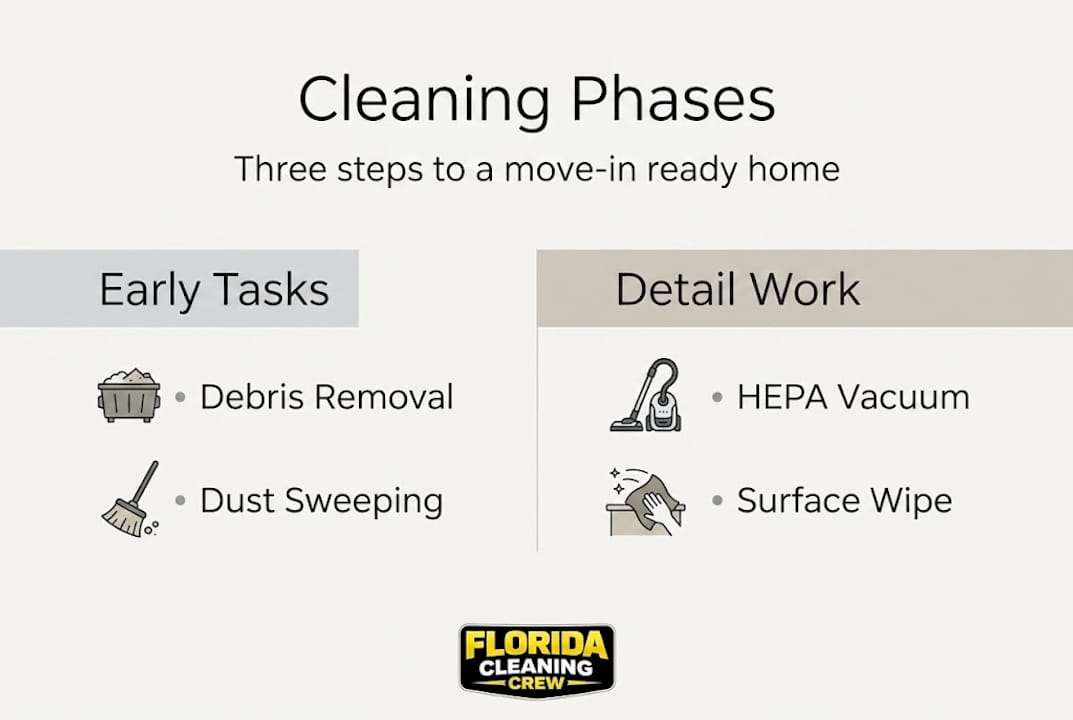
“It follows a structured three-phase process: rough clean to remove bulk debris like scraps, packaging, and nails; detail clean for fine dust removal from surfaces, fixtures, and windows using HEPA vacuums and microfiber cloths; and a final punch clean for touch-ups, sanitizing high-touch areas, and polishing for move-in readiness.”
Understanding these phases before hiring anyone, or before attempting the job yourself, helps you ask the right questions and set realistic expectations. Exploring the full range of available cleaning services can help you understand how post-construction work fits alongside ongoing maintenance options.
Three phases of post-construction cleaning explained
With an understanding of what makes post-construction cleaning unique, let’s break down the professional process step by step. Each phase builds on the last, and skipping any one of them creates problems that show up days or weeks later.
Phase 1: Rough clean
The rough clean is exactly what it sounds like: removing the bulk of what construction workers left behind. This phase involves hauling out scraps of lumber, drywall offcuts, empty joint compound buckets, shrink wrap, cardboard, and any leftover materials from trades. Workers also sweep and scrape floors, clear window frames of labels and tape, and remove nails or staples from surfaces.
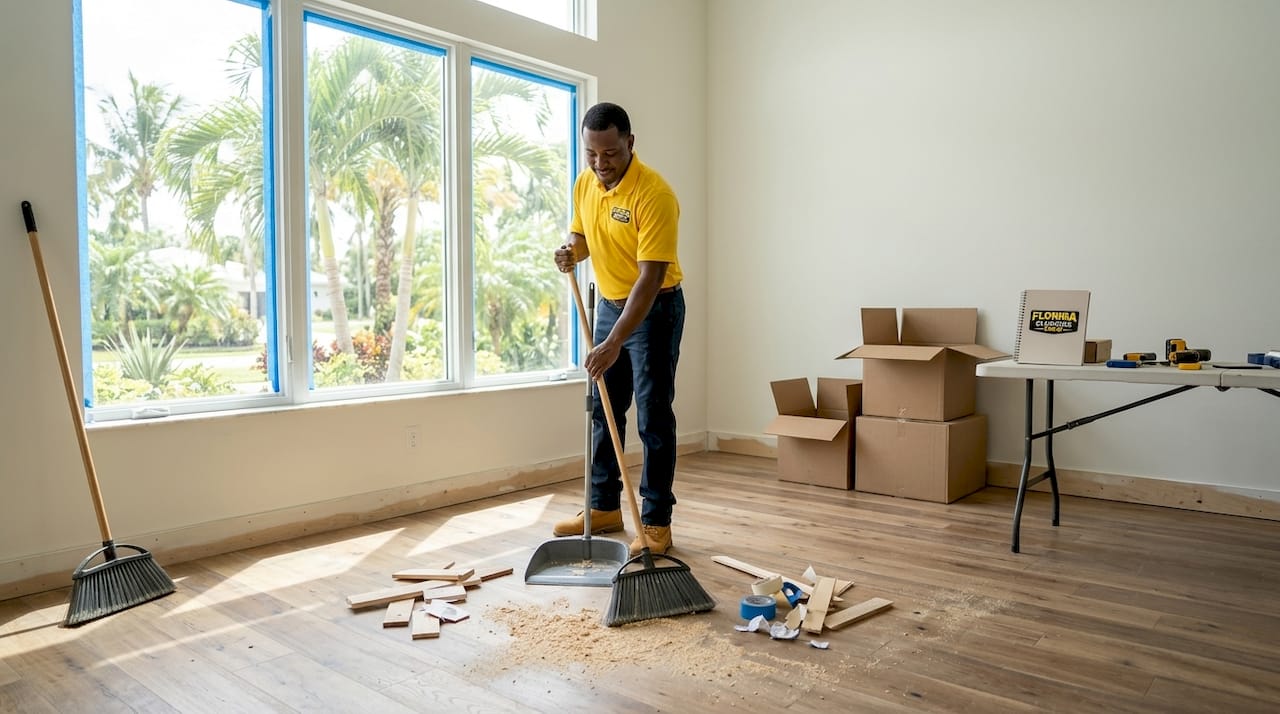
This phase is physically demanding and labor intensive. On a large commercial build or a full home renovation, a rough clean alone can take an entire day or more, depending on crew size and site conditions.
Phase 2: Detail clean (also called light clean)
This is where room-by-room clean up strategy becomes critical. The detail clean targets what the rough clean cannot: microscopic dust that has settled on every horizontal surface, inside cabinets, on light fixtures, along baseboards, and inside window tracks. HEPA vacuums (machines with filters capable of capturing particles as small as 0.3 microns) are essential here. Microfiber cloths trap fine dust rather than spreading it. Workers clean windows inside and out, wipe down cabinet interiors, scrub grout lines, and address paint overspray.
This phase is where indoor air quality (IAQ) is actually protected. Drywall dust contains calcium sulfate, and concrete cutting produces silica, a particle linked to a serious lung condition called silicosis when inhaled repeatedly. A proper detail clean removes these hazards from the breathing zone.
Phase 3: Final punch clean
The final punch clean is a quality-assurance pass. It happens after all trades have completed their work and the contractor has done their own walkthrough. Cleaners sanitize high-touch surfaces like door handles, light switches, and faucets. They polish stainless steel appliances, buff fixtures, and address any dust that resettled since the detail clean. The property should be move-in ready when this phase wraps.
| Phase | Main tasks | Key equipment | Goal |
|---|---|---|---|
| Rough clean | Debris removal, sweeping, tape/label removal | Brooms, scrapers, dumpsters | Clear bulk waste |
| Detail clean | Dust removal, window cleaning, cabinet wipe-down | HEPA vacuums, microfiber cloths | Eliminate fine particles and hazards |
| Final punch clean | Sanitizing, polishing, touch-up cleaning | Disinfectants, polishing cloths | Move-in readiness |
Pro Tip: Always check HVAC vents and replace filters before the detail clean begins. Construction dust settles deep inside ductwork, and running the system before cleaning will recirculate particles throughout every room, undoing hours of work.
Costs, timing, and Tampa Bay challenges
After learning about the process, it’s important to understand the cost and local conditions you’ll face in Tampa Bay. Pricing varies based on square footage, the number of phases needed, and several local environmental factors that are unique to this region.
What does it cost?
Tampa Bay cleaning costs range from $0.15 to $0.75 per square foot overall, with the rough clean phase running $0.10 to $0.30 per square foot, and the detail or final clean coming in at $0.20 to $0.50 per square foot. For a 2,000 square foot home, that translates to a total cleaning investment of roughly $300 to $1,500, depending on which phases are needed and how intensive the job turns out to be. Florida’s humidity adds complications like tacky dust and sand infiltration, which can increase labor time by 5 to 10 percent compared to drier climates.
Here is how a 2,000 sq ft home breaks down by phase:
| Phase | Cost per sq ft | Estimated total (2,000 sq ft) |
|---|---|---|
| Rough clean | $0.10 to $0.30 | $200 to $600 |
| Detail clean | $0.20 to $0.50 | $400 to $1,000 |
| Final punch clean | $0.15 to $0.40 | $300 to $800 |
| Full three-phase package | $0.15 to $0.75 | $300 to $1,500 |
Tampa Bay’s unique climate challenges
Tampa Bay’s subtropical climate creates conditions that make post-construction cleaning considerably more complex than in most U.S. markets. Here is what makes this region different:
- High humidity: Florida’s average relative humidity hovers above 70 percent for much of the year. Drywall dust mixed with moisture becomes tacky, sticking to surfaces more stubbornly than dry dust and requiring more aggressive cleaning products and more scrubbing time.
- Sand infiltration: Construction sites near the Gulf or in sandy soil zones see fine quartz sand tracked throughout the property. Unlike drywall dust, sand is abrasive and can scratch flooring if swept improperly.
- Longer drying times: Surfaces cleaned with water-based solutions take significantly longer to dry in humid conditions, which extends the timeline and can create mold risk if not managed properly.
- Storm debris: Tampa Bay’s active storm season means construction sites can accumulate wind-blown debris between phases, requiring additional rough clean passes.
Factors that affect your final price
Several add-on conditions can push costs toward the higher end of the range or require separate quotes:
- Hazardous materials like asbestos or lead paint that need certified abatement
- High ceilings or cathedral spaces that require scaffolding or lifts
- HVAC system cleaning and filter replacements beyond a basic change
- Extensive window cleaning on multi-story or large-format windows
- Tight deadlines requiring larger crews or overtime hours
Checking for available cleaning discounts is always worth doing before you book, especially for larger projects where small percentage savings add up quickly.
DIY vs. hiring pros: Weighing the risks and rewards
Understanding costs and complexities raises the question: Should you do it yourself or call in a professional? The honest answer depends on your situation, but the risks of DIY are much higher than most people expect.
The case for DIY
There are legitimate reasons someone might attempt post-construction cleaning on their own:
- Lower direct cost if you already own some equipment
- Complete schedule flexibility without waiting for a contractor
- Hands-on control over products and methods used
- Suitable for very small projects like a single room refresh
The risks you are taking on
The DIY approach carries serious risks, however. Standard shop vacuums do not filter fine silica or drywall dust; they simply exhaust it back into the air. Without HEPA-rated equipment, you are spreading the very particles you are trying to remove. Beyond air quality, DIY cleaners frequently damage newly installed surfaces: wrong cleaning agents strip grout sealant, abrasive pads scratch new flooring, and overly wet mopping can warp hardwood installed during renovation. What a professional team finishes in two to three days can stretch into several weekends for a homeowner working alone, delaying occupancy and potentially voiding warranties on new finishes.
When hiring a professional is the clear choice
Some situations make the DIY question easy to answer:
- Any project over 1,000 square feet
- Renovations involving drywall, concrete cutting, or tile work
- Commercial spaces where tenant move-in deadlines are firm
- Properties with known or suspected hazardous materials
- Projects where a realtor needs the listing ready quickly
Pro Tip: Even small renovation jobs like a bathroom retile hide more dust than you think. Fine particles travel through air currents into adjacent rooms, settling on surfaces you never touched during construction. A professional cleaning team has the tools and technique to track down and eliminate that hidden contamination, protecting your family’s health for the long term.
You can get a cleaning estimate before committing, which helps you compare the real cost of professional service against the time investment and risk of doing it yourself. For homeowners specifically, professional house cleaning teams trained in post-construction work understand the difference between fresh renovation and routine maintenance, and they bring the right tools for each.
Special considerations and extra precautions
Even with a great cleaning plan, unique property conditions and post-construction edge cases can complicate the process. Knowing these scenarios in advance helps you avoid costly surprises and ensures your property is genuinely safe before anyone moves in.
Hazardous materials: A separate job entirely
If your renovation disturbed any material suspected of containing asbestos or lead paint, standard post-construction cleaning cannot proceed until a certified abatement contractor completes remediation. In Tampa Bay, many homes built before 1980 contain asbestos in floor tiles, ceiling texture, or pipe insulation. Renovation work that disturbs these materials requires licensed removal, followed by clearance testing, before any cleaning crew should enter. Attempting to clean around these hazards without clearance puts workers and future occupants at serious risk.
“Hazardous materials like asbestos and lead require separate services; high ceilings and commercial spaces need scaffolding; HVAC protection is essential through filter changes and vent cleaning to avoid dust spread; and a post-punch list touch-up prevents recontamination from final trades.”
Scheduling matters more than most people realize
One of the most common and costly mistakes in post-construction cleaning is scheduling the cleaning crew before all trades have finished. Electricians, painters, and trim carpenters who return after the detail clean is complete will introduce new debris and dust, requiring an additional cleaning pass. The right sequence is:
- Confirm all construction trades have completed their punch list work
- Schedule rough clean to remove bulk debris
- Allow HVAC system to run briefly with temporary filters to capture airborne dust
- Schedule detail clean with HEPA equipment
- Conduct a final walkthrough to identify any remaining trade work
- Schedule the final punch clean only after confirming no trades will return
Additional precautions for specific property types
Some buildings require steps that go beyond the standard three-phase process:
- Add vent and duct cleaning if the HVAC system ran during construction without a temporary filter
- Address high or vaulted ceilings with the correct scaffolding setup rather than extending ladders
- Schedule window cleaning as a separate phase for multi-story or commercial properties with extensive glass
- Plan for a post-occupancy touch-up clean approximately two to four weeks after move-in, when settling dust becomes visible again
For properties that generate significant construction waste, combining your cleaning service with junk removal for renovation debris saves time and coordination effort, handling both the bulk waste and the detailed cleaning under a single service appointment.
A pro’s perspective: What most guides won’t tell you
Most guides on post-construction cleaning focus on checklists and phase breakdowns. What they skip is the real-world experience that separates a property that looks clean from one that actually is clean. Here is what we have learned from working in Tampa Bay across hundreds of renovation and new construction projects.
The most underestimated problem is always the dust that you cannot immediately see. Even experienced property managers who have managed dozens of renovations are routinely surprised by how much silica and drywall particulate hides in places the eye skips over: inside cabinet hinges, behind outlet covers, in the gap between a window frame and its trim, and deep inside HVAC ductwork. A property that looks move-in ready to a builder’s eye is often months away from being truly clean from an air quality standpoint.
The final punch clean is not optional, it is the step that prevents costly callbacks. Last-minute trades such as electricians adding cover plates or painters touching up baseboards after the detail clean routinely reintroduce fine dust into rooms that have already been cleaned. Skipping a true punch clean to save money means the dust those late trades create never gets removed.
We also see a consistent pattern with HVAC neglect. Residential clients almost never change their HVAC filters after renovation. They clean every visible surface, feel confident the job is done, and then spend the next three months recirculating construction dust every time the system runs. This is one of the most impactful things you can do for your home’s air quality: replace every HVAC filter immediately after the detail clean is complete.
Finally, Tampa Bay’s climate demands climate-aware cleaning. A company that learned its technique in a dry climate will underestimate how humidity changes dust behavior, drying time, and the risk of moisture-related problems after cleaning. Choosing a company with real Tampa Bay experience, one familiar with detailed room cleaning in humid conditions, is the difference between a one-time clean and recurring issues. If you are not sure where to start, scheduling a deep clean with a locally experienced team removes the guesswork entirely.
Book reliable post-construction cleaning in Tampa Bay
Ready for a truly clean, move-in ready space? Finding the right cleaning partner makes all the difference between a property that looks finished and one that actually is.

Florida Cleaning Company’s residential cleaning specialists handle every phase of post-construction cleaning for both residential and commercial properties throughout Tampa Bay. From initial rough clean through final punch, our licensed, insured team brings HEPA-grade equipment, eco-friendly products, and deep familiarity with Tampa Bay’s climate-specific challenges. You can get a fast quote online in minutes and bundle your cleaning with our junk removal add-on to handle bulk construction waste in the same visit. No coordination headaches, no hidden fees, and a satisfaction guarantee that backs every job.
Frequently asked questions
How is post-construction cleaning different from regular house cleaning?
Post-construction cleaning removes hazardous dust and debris and requires a multi-phase deep-clean approach that standard cleaning does not provide, including HEPA vacuuming, hazardous particle removal, and sanitizing newly installed surfaces.
What does a typical post-construction cleaning include?
It includes debris removal, fine dust cleaning with HEPA tools, sanitizing surfaces, and polishing fixtures for move-in readiness, following a structured three-phase process of rough, detail, and final punch clean.
How much does post-construction cleaning cost in Tampa Bay?
Expect to pay $0.15 to $0.75 per square foot, or roughly $300 to $1,500 for a 2,000 sq ft home, based on Tampa Bay regional pricing that accounts for humidity and sand infiltration challenges specific to Florida.
Are there special considerations for large or older properties?
Properties with high ceilings, hazardous materials, or older HVAC systems need additional steps including scaffolding, certified abatement, and dedicated vent cleaning to prevent dust from spreading through the ductwork after cleaning.
Can I do post-construction cleaning myself, or should I hire professionals?
DIY is possible on very small projects but carries real risks: without HEPA-rated equipment and training, you risk spreading silica and drywall dust rather than removing it, and professionals typically complete the job in days rather than weeks.